![Daniel Mobbs as Guillaume Tell and Talise Trevigne as Jemmy [Photo by Gabe Palacio courtesy of Caramoor Festival 2011]](http://www.operatoday.com/20110709Caramoor_9556.gif)
12 Jul 2011
Guillaume Tell, Caramoor Festival
For classical music fans, summer means only one thing: summer festivals. The goal of these festivals is to showcase a wide range of repertory with thought provoking creativity.
English Touring Opera are delighted to announce a season of lyric monodramas to tour nationally from October to December. The season features music for solo singer and piano by Argento, Britten, Tippett and Shostakovich with a bold and inventive approach to making opera during social distancing.
This tenth of ten Live from London concerts was in fact a recorded live performance from California. It was no less enjoyable for that, and it was also uplifting to learn that this wasn’t in fact the ‘last’ LfL event that we will be able to enjoy, courtesy of VOCES8 and their fellow vocal ensembles (more below …).
Ever since Wigmore Hall announced their superb series of autumn concerts, all streamed live and available free of charge, I’d been looking forward to this song recital by Ian Bostridge and Imogen Cooper.
Although Stile Antico’s programme article for their Live from London recital introduced their selection from the many treasures of the English Renaissance in the context of the theological debates and upheavals of the Tudor and Elizabethan years, their performance was more evocative of private chamber music than of public liturgy.
Evidently, face masks don’t stifle appreciative “Bravo!”s. And, reducing audience numbers doesn’t lower the volume of such acclamations. For, the audience at Wigmore Hall gave soprano Elizabeth Llewellyn and pianist Simon Lepper a greatly deserved warm reception and hearty response following this lunchtime recital of late-Romantic song.
For this week’s Live from London vocal recital we moved from the home of VOCES8, St Anne and St Agnes in the City of London, to Kings Place, where The Sixteen - who have been associate artists at the venue for some time - presented a programme of music and words bound together by the theme of ‘reflection’.
'Such is your divine Disposation that both you excellently understand, and royally entertaine the Exercise of Musicke.’
‘And there was war in heaven: Michael and his angels fought against the dragon; and the dragon fought and his angels, And prevailed not; neither was their place found any more in heaven … that old serpent … Satan, which deceiveth the whole world: he was cast out into the earth, and his angels were cast out with him.’
There was never any doubt that the fifth of the twelve Met Stars Live in Concert broadcasts was going to be a palpably intense and vivid event, as well as a musically stunning and theatrically enervating experience.
‘Love’ was the theme for this Live from London performance by Apollo5. Given the complexity and diversity of that human emotion, and Apollo5’s reputation for versatility and diverse repertoire, ranging from Renaissance choral music to jazz, from contemporary classical works to popular song, it was no surprise that their programme spanned 500 years and several musical styles.
The Academy of St Martin in the Fields have titled their autumn series of eight concerts - which are taking place at 5pm and 7.30pm on two Saturdays each month at their home venue in Trafalgar Square, and being filmed for streaming the following Thursday - ‘re:connect’.
The London Symphony Orchestra opened their Autumn 2020 season with a homage to Oliver Knussen, who died at the age of 66 in July 2018. The programme traced a national musical lineage through the twentieth century, from Britten to Knussen, on to Mark-Anthony Turnage, and entwining the LSO and Rattle too.
With the Live from London digital vocal festival entering the second half of the series, the festival’s host, VOCES8, returned to their home at St Annes and St Agnes in the City of London to present a sequence of ‘Choral Dances’ - vocal music inspired by dance, embracing diverse genres from the Renaissance madrigal to swing jazz.
Just a few unison string wriggles from the opening of Mozart’s overture to Le nozze di Figaro are enough to make any opera-lover perch on the edge of their seat, in excited anticipation of the drama in music to come, so there could be no other curtain-raiser for this Gala Concert at the Royal Opera House, the latest instalment from ‘their House’ to ‘our houses’.
"Before the ending of the day, creator of all things, we pray that, with your accustomed mercy, you may watch over us."
The doors at The Metropolitan Opera will not open to live audiences until 2021 at the earliest, and the likelihood of normal operatic life resuming in cities around the world looks but a distant dream at present. But, while we may not be invited from our homes into the opera house for some time yet, with its free daily screenings of past productions and its pay-per-view Met Stars Live in Concert series, the Met continues to bring opera into our homes.
Music-making at this year’s Grange Festival Opera may have fallen silent in June and July, but the country house and extensive grounds of The Grange provided an ideal setting for a weekend of twelve specially conceived ‘promenade’ performances encompassing music and dance.
There’s a “slide of harmony” and “all the bones leave your body at that moment and you collapse to the floor, it’s so extraordinary.”
“Music for a while, shall all your cares beguile.”
The hum of bees rising from myriad scented blooms; gentle strains of birdsong; the cheerful chatter of picnickers beside a still lake; decorous thwacks of leather on willow; song and music floating through the warm evening air.
For classical music fans, summer means only one thing: summer festivals. The goal of these festivals is to showcase a wide range of repertory with thought provoking creativity.
One such festival is the Caramoor Music Festival of Katonah, New York with its dedication to bel canto repertoire for its opera portion. It is true that since its resurgence after World War II, at the hands of Joan Sutherland and Maria Callas, bel canto opera is now firmly ensconced in the repertoire. But do not be fooled. As Will Crutchfield, the festival’s conductor, has previously stated, the goal of the festival is to present the lesser known bel canto operas. To that end, the festival is formatted such that one staple shares the stage with a more obscure work. Last year, Donizetti’s evergreen, drunken revelry L’elisir D’Amore was paired with Rossini’s majestic Semiramide.
This year, eyebrows were raised when Caramoor presented Rossini’s seldom heard epic Guillaume Tell alongside Gilbert and Sullivan’s operetta HMS Pinafore. True, HMS Pinafore does not belong to the group of operas that we recognize as bel canto. Yet, according to an article in the New York Times by Allan Kozinn, audiences fail to realize that Arthur Sullivan held a job as a copyist in which he created reductions of bel canto opera. As a consequence, he was well acquainted with stylistic conventions, and his operettas can be seen as having evolved from that tradition. Furthermore, Patrick Dillon, a writer for Opera News argues that Guillaume Tell while a bel canto opera in the strictest sense had far reaching effects in the creation and standardization of French Grand Opera that lasted until the composition of Verdi’s Don Carlo. In this way, the theme of this Caramoor season seems to be the long lasting legacy of bel canto opera.
Regarding Guillaume Tell, I have nothing but good news to report. It was one of those performances of which opera lovers dream. Under the direction of the eminent Mr. Will Crutchfield, the orchestra of St. Luke’s demonstrated all the drama and complexities of Rossini’s vast score.
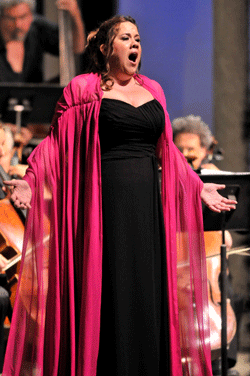 Julianna Di Giacomo as Mathilde
To comment on their dynamics and flare for theatricality would be obvious; I was most impressed with the dialogue between instrumental sections. If this were one of Rossini’s Italian comedies such as L’Italiana in Algeri, the opera would be full of ensembles in which the vocals lines would similarly interact with each other. Here, however, I was impressed with Rossini’s ability to transpose his skill for ensemble writing to the orchestra itself. Additionally, the strings brought a mellow burnished quality to the music; presenting a beautiful cohesive tone in a score with a plethora of strings.
The cast was in excellent form. Bass-baritone Daniel Mobbs, who sang the role of Tell, gave a thrilling dynamic portrayal. He managed to cover all facets of the character from revolutionary leader to husband and father while singing with style and spell-binding tone. Much the same can be said of Mezzo Vanessa Cariddi. Although, early on, her dramatic commitment to the role was less apparent, it came beautifully into focus with the last act. However, it is quite plausible that the reason for her character’s lack of substance lies within the opera itself. Tenor Michael Spyres, in the role of Arnold, sang with conviction and made his character a convincing case for the beloved operatic trope of tenor-as-lover. He also sang the role’s astronomically high tessitura with ease. Still two aspects of his performance should be mentioned. Vocally, he seemed to get lost in passages of either high powered orchestral work, or in ensembles. Additionally, he needs to develop a better physical and emotional connection with the other characters. Soprano Julianna Di Giacomo was incredibly compelling in the smaller but crucial role of Mathilde. Her deeply lyrical soprano was a joy to behold. Her voice brought much appreciated texture to the trio of Act IV with Mathilde, Tell’s wife Hedwige, and Tell’s son Jemmy. Soprano Talise Trevigne was delightfully boyish as Jemmy, while Scott Bearden was ferocious as Switerland’s Hapsburg governor.
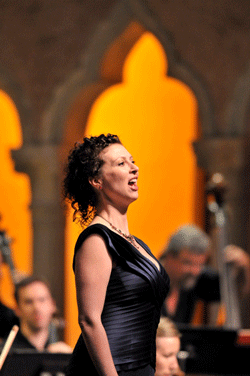 Vanessa Cariddi as Hedwige
The Caramoor festival chorus was in full vocal throttle when they joined the rest of the cast during the many ensembles. I could not help but smile at Rossini’s overt attempts to incorporate the tastes of the Paris Opera.
It remains to be said that Caramoor is a beautiful setting. When an obscure opera like Guillaume Tell is performed in such grand style and the audience is treated to fresh air, and exquisitely perfumed gardens, the question becomes, why isn’t this opera performed more often? My guess would be size and expense. It is true that massive forces are required to perform the work, and that according to Patrick Dillon of Opera News, the opera has never been performed in its complete version in the U.S. Yet despite the opera’s marathon four hours, this is an engrossing opera permitting time to pass quickly. Therefore, I have to say that I would gladly see Guillaume Tell again. And after all, isn’t that the goal of bel canto at Caramoor?
Gregory Moomjy