![(Back to front) Eglise Gutiérrez As La Fée and Joyce DiDonato as Cendrillon [Photo by Bill Cooper courtesy of The Royal Opera]](http://www.operatoday.com/CENDRILLON.201107020188.gif)
12 Jul 2011
Cendrillon, Royal Opera
Words, stories, books — the gateway to a world of fantasy in which anything is possible.
English Touring Opera are delighted to announce a season of lyric monodramas to tour nationally from October to December. The season features music for solo singer and piano by Argento, Britten, Tippett and Shostakovich with a bold and inventive approach to making opera during social distancing.
This tenth of ten Live from London concerts was in fact a recorded live performance from California. It was no less enjoyable for that, and it was also uplifting to learn that this wasn’t in fact the ‘last’ LfL event that we will be able to enjoy, courtesy of VOCES8 and their fellow vocal ensembles (more below …).
Ever since Wigmore Hall announced their superb series of autumn concerts, all streamed live and available free of charge, I’d been looking forward to this song recital by Ian Bostridge and Imogen Cooper.
Although Stile Antico’s programme article for their Live from London recital introduced their selection from the many treasures of the English Renaissance in the context of the theological debates and upheavals of the Tudor and Elizabethan years, their performance was more evocative of private chamber music than of public liturgy.
Evidently, face masks don’t stifle appreciative “Bravo!”s. And, reducing audience numbers doesn’t lower the volume of such acclamations. For, the audience at Wigmore Hall gave soprano Elizabeth Llewellyn and pianist Simon Lepper a greatly deserved warm reception and hearty response following this lunchtime recital of late-Romantic song.
For this week’s Live from London vocal recital we moved from the home of VOCES8, St Anne and St Agnes in the City of London, to Kings Place, where The Sixteen - who have been associate artists at the venue for some time - presented a programme of music and words bound together by the theme of ‘reflection’.
'Such is your divine Disposation that both you excellently understand, and royally entertaine the Exercise of Musicke.’
‘And there was war in heaven: Michael and his angels fought against the dragon; and the dragon fought and his angels, And prevailed not; neither was their place found any more in heaven … that old serpent … Satan, which deceiveth the whole world: he was cast out into the earth, and his angels were cast out with him.’
There was never any doubt that the fifth of the twelve Met Stars Live in Concert broadcasts was going to be a palpably intense and vivid event, as well as a musically stunning and theatrically enervating experience.
‘Love’ was the theme for this Live from London performance by Apollo5. Given the complexity and diversity of that human emotion, and Apollo5’s reputation for versatility and diverse repertoire, ranging from Renaissance choral music to jazz, from contemporary classical works to popular song, it was no surprise that their programme spanned 500 years and several musical styles.
The Academy of St Martin in the Fields have titled their autumn series of eight concerts - which are taking place at 5pm and 7.30pm on two Saturdays each month at their home venue in Trafalgar Square, and being filmed for streaming the following Thursday - ‘re:connect’.
The London Symphony Orchestra opened their Autumn 2020 season with a homage to Oliver Knussen, who died at the age of 66 in July 2018. The programme traced a national musical lineage through the twentieth century, from Britten to Knussen, on to Mark-Anthony Turnage, and entwining the LSO and Rattle too.
With the Live from London digital vocal festival entering the second half of the series, the festival’s host, VOCES8, returned to their home at St Annes and St Agnes in the City of London to present a sequence of ‘Choral Dances’ - vocal music inspired by dance, embracing diverse genres from the Renaissance madrigal to swing jazz.
Just a few unison string wriggles from the opening of Mozart’s overture to Le nozze di Figaro are enough to make any opera-lover perch on the edge of their seat, in excited anticipation of the drama in music to come, so there could be no other curtain-raiser for this Gala Concert at the Royal Opera House, the latest instalment from ‘their House’ to ‘our houses’.
"Before the ending of the day, creator of all things, we pray that, with your accustomed mercy, you may watch over us."
The doors at The Metropolitan Opera will not open to live audiences until 2021 at the earliest, and the likelihood of normal operatic life resuming in cities around the world looks but a distant dream at present. But, while we may not be invited from our homes into the opera house for some time yet, with its free daily screenings of past productions and its pay-per-view Met Stars Live in Concert series, the Met continues to bring opera into our homes.
Music-making at this year’s Grange Festival Opera may have fallen silent in June and July, but the country house and extensive grounds of The Grange provided an ideal setting for a weekend of twelve specially conceived ‘promenade’ performances encompassing music and dance.
There’s a “slide of harmony” and “all the bones leave your body at that moment and you collapse to the floor, it’s so extraordinary.”
“Music for a while, shall all your cares beguile.”
The hum of bees rising from myriad scented blooms; gentle strains of birdsong; the cheerful chatter of picnickers beside a still lake; decorous thwacks of leather on willow; song and music floating through the warm evening air.
Words, stories, books — the gateway to a world of fantasy in which anything is possible.
This is the starting point for Laurent Pelly’s vision of the Cinderella story — this, and the substantial faithfulness with which Massenet’s opera adheres to the original Perrault fairytale. The opening tableau is the opening pages of the Perrault, enlarged to wall-size; a small room soon grows into a bigger room, and a bigger room still. Soon, words are everywhere. As Lucette — the eponymous Cendrillon — falls sadly asleep in the middle of the first act, the stars come out — pin-pricks in the text on the wall, just where the dot of every ‘i’ should be. Next, ten or so Lucette-clones appear with lamps in their hands, as if making the stars dance, and thus the text begins to come literally to life.
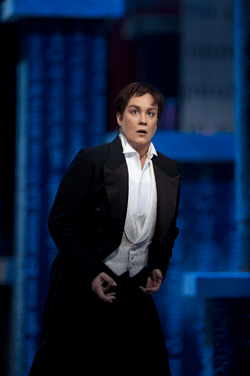 Alice Coote as Le Prince Charmant
The clones turn out to be the pet spirits of Lucette’s Fairy Godmother, who get sent off to prepare Cendrillon’s gown and carriage and horses. Of course it is handy having ten singers and dancers running round the stage who look exactly like the heroine — an eminently practical way of ensuring that the real Cinders can be smuggled off unnoticed for her quick change.
The word-theme continues throughout, with Cendrillon’s carriage being made of the letters of the word “Carosse” (drawn by four dancers dressed as horses) and the giant golden gates of the palace being formed of the letters of the phrase “Les portes du palais”. Some would think this slavish, but I simply got a strong and comforting sense that Pelly has a real, affectionate love for this children’s tale.
The princesses at the ball were a grotesque array of cartoonish ladies in red, all with exaggerated shapes and figures (none more so than Cendrillon’s unpleasant stepmother and sisters, the former resplendent in what looked more like a piece of amply-upholstered furniture than a dress) and many looking like Grecian urns or elaborate topiary. If I hadn’t known that the production dates back to 2006 (in Santa Fe) I would have thought them a reference to the Queen of Hearts in the Royal Ballet’s recent Alice’s Adventures in Wonderland. Cendrillon is, after all, one of the few French 19th-century operas where a ballet scene fits nicely into the story without having to have an opportunity created for its existence, and it is telling that as I left the opera house at the end of the evening, I had strains of various divertissements from The Nutcracker floating through my mind along with snippets of Massenet.
If the visual inventiveness lapses in the early part of Act 3, all is restored in the curious ‘Fairy Oak’ scene (an invention of Massenet and his librettist) in which the stage is transformed into a rooftop scene (chimneys replacing the forest trees of the stage directions) which at first conjured up the chimney-sweep scene from Mary Poppins. But later a more apt comparison occurred to me; it’s the sort of scene generally seen from the garret window in La boheme. This is more relevant than you might think, as despite the supposedly fantastical context, it becomes one of the opera’s most genuinely human scenes, climaxing in a rapturous love duet in which the Prince’s voice joins Lucette’s in glorious unison before parting into harmony.
It was in this duet, and to a lesser extent their other scenes together, that the two stunning mezzo leads were showcased to best effect. The voices worked wonderfully well together — Joyce DiDonato’s tone sweet and soprano-like in the title role, and Alice Coote’s velvety, plush shades as an ardent Prince Charming. Individually of course they were just as good. Coote has plenty of experience in trouser roles, and not merely because of her voice type — her credibility as a hot-blooded youth is impeccable, evidently the result of meticulous observation. Meanwhile, DiDonato had a handful of high pianissimi which didn’t quite come off, despite the fact that the high-lying role generally seems to sit very comfortably in her voice, but she was a delightful heroine, making much of the understated, attractive music Massenet gives her.
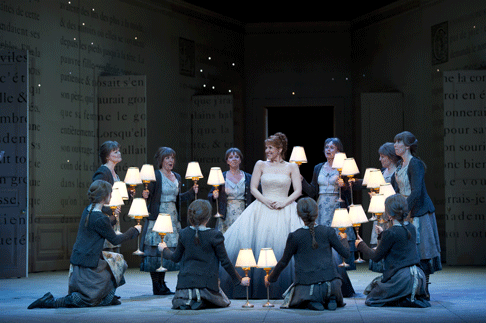 Joyce DiDonato as Cendrillon
DiDonato was equally touching in the scenes with her father, Pandolfe, sung by the French bass-baritone Jean-Philippe Lafont. Lafont makes much of the character, but his voice is evidently far beyond its peak, grating and wobbly.
In less distinguished company, the great Polish contralto Ewa Podleś as Madame de la Haltière would have walked away with the entire show. Her lower register remains earth-shaking, but more to the point, she understands the critical importance of playing farce straight. Her final declamation of ‘Ma fille!’ — when she finally sees fit to acknowledge Lucette as a daughter — brought the house down.
Pelly generously makes this latter-day change of heart a result of an intervention by the Fairy, rather than a cynical acknowledgement ot Lucette’s sudden acquisition of status and glamour. And what an accomplished Fairy we had in the Cuban-American soprano Eglise Gutiérrez. She is confident and ravishing in spinning high lines, and her trill is so impressive that I will forgive her the occasional intonation lapse in staccato coloratura. Her poised and alluring stage presence put me in mind of Tytania from Britten’s Dream; she was given a bit of an edge with a modern, spiky hairdo, and I wouldn’t have been surprised to see a pair of customised Doc Marten boots under her lavish silver-grey ballgown.
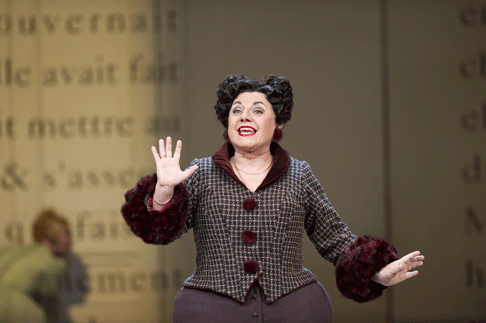 Ewa Podleś as Madame De La Haltière
ROH Young Artists Madeleine Pierard and Kai Rüütel were well-matched as the two stepsisters, Noémie and Dorothée; in the first scene (in which, incidentally, they appeared to be dressed as pastel-coloured lampshades) their diction was indistinct, but this improved as the evening went on.
Bertrand de Billy’s conducting, a couple of lapses in ensemble aside, had energy and sensitivity. But the Fairy clearly thinks she can do a better; atop a giant pile of books, like a Valkyrie calling from a mountain-top, she hijacks the task of conducting the final few bars to make quite, quite sure of her happy ending.
Ruth Elleson © 2011