![Brenda Rae as Armida and Luca Pisaroni as Argante. [Photo by Bill Cooper courtesy of Glyndebourne Festival 2011]](http://www.operatoday.com/300cbc201106270950.gif)
13 Jul 2011
Rinaldo at Glyndebourne
Handel’s Rinaldo at the Glyndebourne Festival is a triumph in musical terms. Don’t miss it when it appears at the BBC Proms this summer in concert performance, because some of the singing is very good indeed.
English Touring Opera are delighted to announce a season of lyric monodramas to tour nationally from October to December. The season features music for solo singer and piano by Argento, Britten, Tippett and Shostakovich with a bold and inventive approach to making opera during social distancing.
This tenth of ten Live from London concerts was in fact a recorded live performance from California. It was no less enjoyable for that, and it was also uplifting to learn that this wasn’t in fact the ‘last’ LfL event that we will be able to enjoy, courtesy of VOCES8 and their fellow vocal ensembles (more below …).
Ever since Wigmore Hall announced their superb series of autumn concerts, all streamed live and available free of charge, I’d been looking forward to this song recital by Ian Bostridge and Imogen Cooper.
Although Stile Antico’s programme article for their Live from London recital introduced their selection from the many treasures of the English Renaissance in the context of the theological debates and upheavals of the Tudor and Elizabethan years, their performance was more evocative of private chamber music than of public liturgy.
Evidently, face masks don’t stifle appreciative “Bravo!”s. And, reducing audience numbers doesn’t lower the volume of such acclamations. For, the audience at Wigmore Hall gave soprano Elizabeth Llewellyn and pianist Simon Lepper a greatly deserved warm reception and hearty response following this lunchtime recital of late-Romantic song.
For this week’s Live from London vocal recital we moved from the home of VOCES8, St Anne and St Agnes in the City of London, to Kings Place, where The Sixteen - who have been associate artists at the venue for some time - presented a programme of music and words bound together by the theme of ‘reflection’.
'Such is your divine Disposation that both you excellently understand, and royally entertaine the Exercise of Musicke.’
‘And there was war in heaven: Michael and his angels fought against the dragon; and the dragon fought and his angels, And prevailed not; neither was their place found any more in heaven … that old serpent … Satan, which deceiveth the whole world: he was cast out into the earth, and his angels were cast out with him.’
There was never any doubt that the fifth of the twelve Met Stars Live in Concert broadcasts was going to be a palpably intense and vivid event, as well as a musically stunning and theatrically enervating experience.
‘Love’ was the theme for this Live from London performance by Apollo5. Given the complexity and diversity of that human emotion, and Apollo5’s reputation for versatility and diverse repertoire, ranging from Renaissance choral music to jazz, from contemporary classical works to popular song, it was no surprise that their programme spanned 500 years and several musical styles.
The Academy of St Martin in the Fields have titled their autumn series of eight concerts - which are taking place at 5pm and 7.30pm on two Saturdays each month at their home venue in Trafalgar Square, and being filmed for streaming the following Thursday - ‘re:connect’.
The London Symphony Orchestra opened their Autumn 2020 season with a homage to Oliver Knussen, who died at the age of 66 in July 2018. The programme traced a national musical lineage through the twentieth century, from Britten to Knussen, on to Mark-Anthony Turnage, and entwining the LSO and Rattle too.
With the Live from London digital vocal festival entering the second half of the series, the festival’s host, VOCES8, returned to their home at St Annes and St Agnes in the City of London to present a sequence of ‘Choral Dances’ - vocal music inspired by dance, embracing diverse genres from the Renaissance madrigal to swing jazz.
Just a few unison string wriggles from the opening of Mozart’s overture to Le nozze di Figaro are enough to make any opera-lover perch on the edge of their seat, in excited anticipation of the drama in music to come, so there could be no other curtain-raiser for this Gala Concert at the Royal Opera House, the latest instalment from ‘their House’ to ‘our houses’.
"Before the ending of the day, creator of all things, we pray that, with your accustomed mercy, you may watch over us."
The doors at The Metropolitan Opera will not open to live audiences until 2021 at the earliest, and the likelihood of normal operatic life resuming in cities around the world looks but a distant dream at present. But, while we may not be invited from our homes into the opera house for some time yet, with its free daily screenings of past productions and its pay-per-view Met Stars Live in Concert series, the Met continues to bring opera into our homes.
Music-making at this year’s Grange Festival Opera may have fallen silent in June and July, but the country house and extensive grounds of The Grange provided an ideal setting for a weekend of twelve specially conceived ‘promenade’ performances encompassing music and dance.
There’s a “slide of harmony” and “all the bones leave your body at that moment and you collapse to the floor, it’s so extraordinary.”
“Music for a while, shall all your cares beguile.”
The hum of bees rising from myriad scented blooms; gentle strains of birdsong; the cheerful chatter of picnickers beside a still lake; decorous thwacks of leather on willow; song and music floating through the warm evening air.
Handel’s Rinaldo at the Glyndebourne Festival is a triumph in musical terms. Don’t miss it when it appears at the BBC Proms this summer in concert performance, because some of the singing is very good indeed.
The catch is that the staging is bizarre. Baroque is, by nature, bizarre and “fantastikal” to use antique terminology. Baroque audiences went to the opera to be stunned by spectacular feats and outrageous plots. Rinaldo has inherent dramatic promise — malevolent magic, beauties and heroes, exotic strangers, sex, battlefields and scene changes so extreme that they couldn’t be done literally, especially given the limits of baroque stage production. In many ways, baroque audiences had greater tolerance for fantasy than we do now.
Rinaldo is set in the Crusades but has nothing to do with history, religion or even common sense. By removing the hero Rinaldo, the defenders of Jerusalem think they can end the war. So Almira magics him off to an enchanted island, far from the deserts around Jerusalem. Strange Realpolitik. Goffredo and other Christians rescue him and all ends well.
So why the literal staging in this new production directed by Robert Carsen, designed by Gideon Davey? It predicates on the notion that Rinaldo is a schoolboy in a boarding school, who gets bullied by his classmates and caned by his teachers. Indeed, caning recurs frequently in this production, which does make one wonder. The schoolboy concept is largely irrelevant to the very adult, sophisticated nature of Handel’s narrative, and feels forced and infantile.
The sirens don’t need to be coy schoolgirls, and the sight of Almirena in a maxi skirt gymslip is just absurd. The best images would work fine without any schoolboy silliness. For example, Rinaldo and his friends march off not on horses but on bicycles, Rinaldo suspended in the air on high wires. Had they been dressed as warriors, the irony would have been even more pointedly irreverent.
Although Rinaldo is funny, its deeper levels would not have been lost on baroque audiences. Handel, through Torquato Tasso, is also obliquely mocking the futility of war and power games. If even Almira the dominatrix Queen can make up with ferocious philanderer Argante, there’s hope for all.
Ottavio Dantone conducted the Orchestra of the Age of Enlightment, one of the finest specialist period instrument orchestras in the world. Extremely high playing standards, though I would have liked Dantone to have injected more punch overall, though the Battaglia was vivid. Handel’s instrumentation is lively and inventive. Harpsichord, not only as continuo but as a quirky voice in itself, and in this acoustic, assertively clear. Good growling percussion and brass for thunder and battle. I was so intrigued by the bird-like instrumentation around Almirena’s “Augelletti, che cantate”, that I went up to the pit at the interval to check what it was.The musician wasn’t there but other members of the orchestra were enthusiastic. “It’s a sopranino”, someone said. “Not a flute, not a recorder”.
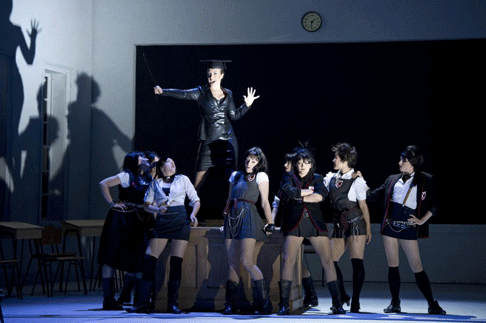 Brenda Rae as Armida with Glyndebourne Chorus and dancers
Sonia Prina sang Rinaldo. She’s a very experienced Handel singer, so the production was perhaps designed around her, much as the recent Glyndebourne Die Meistersinger von von Nürnberg reviewed here, may have been created to enhance Gerald Finley’s voice. She and director Carsen have worked together before. Prina’s short, compact and sassy, so looks convincing as a schoolboy, Hers isn’t a transcendentally glowing Rinaldo but she has stamina. In “Cara Sposa”, she stretched the long vowels sturdily.
As Armida as Dominatrix, Brenda Rae looked the part in tight black rubber and vertiginous stilettos. The characterization made an asset of the sharpness at her top, but attention should be on the singing, not the fetish.
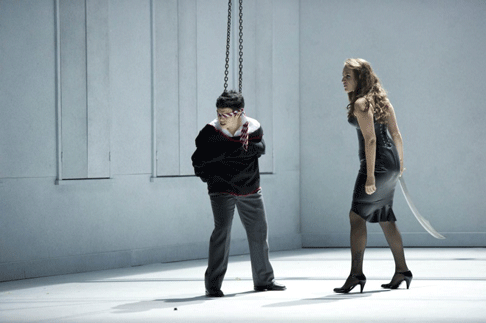 Sonia Prina as Rinaldo and Brenda Rae as Armida
Argante can be a relatively small part, but Luca Pisaroni made it central, by the sheer force of personality in his singing. His voice has great depth and range and is used intelligently. Pisaroni understands the purpose of the elaborate ornamentations Handel wants in the part. When he sings “Sibillar gli angui d’Aletto”, his variations are richly roccoco, emphasizing Argante’s status as ruler, and the complexity of his character. Thus, when Argante is humbled by his feelings for Almirena, Pisaroni’s voice becomes gracious and tender. Pisaroni doesn’t sing when he’s strung up by Armida, but his body language conveys feeling, twitching with anguish, even though his face is hidden. Restored, he becomes the virile, dignified leader he was before, as Pisaroni’s firm, well modulated singing in the Act 3 duet demonstrates. This Argante is more than a match for Armida. (Please read the interview he gave Opera Today here).
Varduhi Abrahamyan sang Goffredo. Being an admirer of countertenors, I was delighted by William Tower’s Mago and Tim Mead’s Eustazio.
Perhaps there’s a much better production inside this Glyndebourne Rinaldo, waiting, like the eponymous hero, to be set free. Handel’s music is inherently dramatic, so the concert performance planned for the BBC Proms on 25th August will be a much better opportunity to appreciate this production. It’s being broadcast live, online, on demand and internationally. A DVD is also planned, and the filming may reshape the staging so it comes over more effectively, enhancing the musical values oif this production.
For more information, read the Glyndebourne Festival site and the BBC Proms site.
Anne Ozorio