19 Jul 2011
Havergal Brian’s “Gothic” Symphony
The BBC Proms has given Havergal Brian’s Symphony no. 1 the best and most extensive exposure the composer has ever enjoyed.
English Touring Opera are delighted to announce a season of lyric monodramas to tour nationally from October to December. The season features music for solo singer and piano by Argento, Britten, Tippett and Shostakovich with a bold and inventive approach to making opera during social distancing.
This tenth of ten Live from London concerts was in fact a recorded live performance from California. It was no less enjoyable for that, and it was also uplifting to learn that this wasn’t in fact the ‘last’ LfL event that we will be able to enjoy, courtesy of VOCES8 and their fellow vocal ensembles (more below …).
Ever since Wigmore Hall announced their superb series of autumn concerts, all streamed live and available free of charge, I’d been looking forward to this song recital by Ian Bostridge and Imogen Cooper.
The Sixteen continues its exploration of Henry Purcell’s Welcome Songs for Charles II. As with Robert King’s pioneering Purcell series begun over thirty years ago for Hyperion, Harry Christophers is recording two Welcome Songs per disc.
Although Stile Antico’s programme article for their Live from London recital introduced their selection from the many treasures of the English Renaissance in the context of the theological debates and upheavals of the Tudor and Elizabethan years, their performance was more evocative of private chamber music than of public liturgy.
In February this year, Albanian soprano Ermonela Jaho made a highly lauded debut recital at Wigmore Hall - a concert which both celebrated Opera Rara’s 50th anniversary and honoured the career of the Italian soprano Rosina Storchio (1872-1945), the star of verismo who created the title roles in Leoncavallo’s La bohème and Zazà, Mascagni’s Lodoletta and Puccini’s Madama Butterfly.
Evidently, face masks don’t stifle appreciative “Bravo!”s. And, reducing audience numbers doesn’t lower the volume of such acclamations. For, the audience at Wigmore Hall gave soprano Elizabeth Llewellyn and pianist Simon Lepper a greatly deserved warm reception and hearty response following this lunchtime recital of late-Romantic song.
Collapsology. Or, perhaps we should use the French word ‘Collapsologie’ because this is a transdisciplinary idea pretty much advocated by a series of French theorists - and apparently, mostly French theorists. It in essence focuses on the imminent collapse of modern society and all its layers - a series of escalating crises on a global scale: environmental, economic, geopolitical, governmental; the list is extensive.
For this week’s Live from London vocal recital we moved from the home of VOCES8, St Anne and St Agnes in the City of London, to Kings Place, where The Sixteen - who have been associate artists at the venue for some time - presented a programme of music and words bound together by the theme of ‘reflection’.
'Such is your divine Disposation that both you excellently understand, and royally entertaine the Exercise of Musicke.’
Amongst an avalanche of new Mahler recordings appearing at the moment (Das Lied von der Erde seems to be the most favoured, with three) this 1991 Mahler Second from the 2nd Kassel MahlerFest is one of the more interesting releases.
‘And there was war in heaven: Michael and his angels fought against the dragon; and the dragon fought and his angels, And prevailed not; neither was their place found any more in heaven … that old serpent … Satan, which deceiveth the whole world: he was cast out into the earth, and his angels were cast out with him.’
If there is one myth, it seems believed by some people today, that probably needs shattering it is that post-war recordings or performances of Wagner operas were always of exceptional quality. This 1949 Hamburg Tristan und Isolde is one of those recordings - though quite who is to blame for its many problems takes quite some unearthing.
There was never any doubt that the fifth of the twelve Met Stars Live in Concert broadcasts was going to be a palpably intense and vivid event, as well as a musically stunning and theatrically enervating experience.
‘Love’ was the theme for this Live from London performance by Apollo5. Given the complexity and diversity of that human emotion, and Apollo5’s reputation for versatility and diverse repertoire, ranging from Renaissance choral music to jazz, from contemporary classical works to popular song, it was no surprise that their programme spanned 500 years and several musical styles.
The Academy of St Martin in the Fields have titled their autumn series of eight concerts - which are taking place at 5pm and 7.30pm on two Saturdays each month at their home venue in Trafalgar Square, and being filmed for streaming the following Thursday - ‘re:connect’.
The London Symphony Orchestra opened their Autumn 2020 season with a homage to Oliver Knussen, who died at the age of 66 in July 2018. The programme traced a national musical lineage through the twentieth century, from Britten to Knussen, on to Mark-Anthony Turnage, and entwining the LSO and Rattle too.
With the Live from London digital vocal festival entering the second half of the series, the festival’s host, VOCES8, returned to their home at St Annes and St Agnes in the City of London to present a sequence of ‘Choral Dances’ - vocal music inspired by dance, embracing diverse genres from the Renaissance madrigal to swing jazz.
Just a few unison string wriggles from the opening of Mozart’s overture to Le nozze di Figaro are enough to make any opera-lover perch on the edge of their seat, in excited anticipation of the drama in music to come, so there could be no other curtain-raiser for this Gala Concert at the Royal Opera House, the latest instalment from ‘their House’ to ‘our houses’.
"Before the ending of the day, creator of all things, we pray that, with your accustomed mercy, you may watch over us."
The BBC Proms has given Havergal Brian’s Symphony no. 1 the best and most extensive exposure the composer has ever enjoyed.
Havergal Brian (1876-1972) is a cult figure in British music who attracts an intense following, even though his music is rarely performed and existing recordings are of not of the highest standards. He’s better known by reputation than by listening experience. Indeed, it’s this very air of exclusivity that’s part of his appeal. BBC Prom 4 was a historic watershed in Brian reception, because it gave Brian maximum possible publicity, and the best performance to date.
This was a truly spectacular, extravagant event. Brian’s “Gothic” Symphony is apparently in the Guinness Book of Records for being the biggest symphony ever written, and only the BBC Proms can provide the resources to do it justice. Thus, this Prom was a once-in-a-lifetime experience, a historic occasion that wasn’t to be missed. It was a form of total theatre that will be remembered for decades.
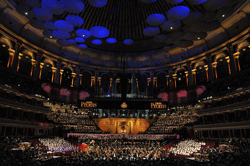
One third of the massive Royal Albert Hall was reserved to accommodate the sheer number of performers, almost a thousand in all. Nine choruses, no less, visually impressive, especially the women’s choir in lavender, and the children’s choirs in white. Two main orchestras, the BBC National Orchestra of Wales and the BBC Concert Orchestra. Two “timpani orchestras”, as opposed to “symphony orchestras”, positioned at the sides of the auditorium, between the choristers and audience. Those sitting near them may be deaf for days. And, like a Colossus above them all, the mighty Royal Albert Hall Willis organ, with its 9,997 pipes and 149 stops, the largest in Europe.
Martyn Brabbins conducted the gargantuan forces with aplomb. He’s braved the dense jungle of this score like a fearless explorer mapping unknown territory. He’s clearly prepared the work thoroughly, searching out the main features in this bewildering terrain. Brian’s “Gothic” is a strange Leviathan which has defeated the best efforts of many, so Brabbins deserves a medal for persistence and dedication.
Brabbins focuses on the many details which build up to form the dense undergrowth. A flurry of harps, for example, and a bizarre chorus of xylophones, springing out unexpectedly, like exotic birds startled into flight. The whole symphony seems to be built from details like this, an accumulation whose object is to amass as many pieces as possible — not a jigsaw, for the ideas don’t really cohere. So Brabbins’s carefully thought out detail brings out the endless proliferation that gives this symphony its charm.
Brian was a self-taught, almost eccentric character who wasn’t particularly bothered by the practicalities of performance. There are many ideas in this symphony, but they are briefly glimpsed and don’t develop. On paper, they may look good, but they don’t necessarily make much sense in practical performance. For example, the timpani orchestras, backed by very loud brass. At first they call out to each other across the expanse of the auditorium. Then one falls more or less silent thereafter.
Brian’s Gothic has been compared to Mahler’s Eighth Symphony, on the basis that the latter was marketed as the “symphony of a thousand”, but the comparison is nonsense. The label was a PR ruse. Mahler’s focus was on spiritual meaning. Although Mahler’s structure is unorthodox, there’s a powerful trajectory that pulls it forward. The inspiration behind Brian’s symphony isn’t consistent. Liturgical texts are used, but the thrust isn’t particularly spiritual. Brian is certainly ambitious, quoting Goethe’s Faust on his title page, (“Whoever strives with all his might, that man we can redeem”), but the energy dissipates.
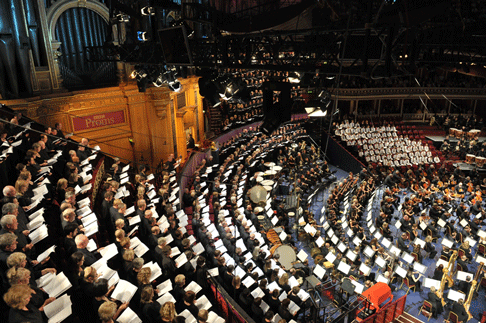
For example, in the final movement, the ‘Te ergo quaesumus’, Alastair Miles intones lines that waver upwards and down, perhaps in homage to Orthodox chant, but the orchestra then plays a parody of jazz swing. Sometimes contrasts have reason, but in this symphony they seem to exist for variety’s sake. When Susan Gritton sings ‘Judex crederis esse venturus’ from way up in the rafters, it’s a truly sublime moment — magnificent singing, magnificently theatrical. But the rest of the movement consists of that 4-word sentence alone, and it’s quickly dispensed with in favour of meaningless extended vocalise. In all three major Proms concerts so far (Janáček’s Glagolitic Mass and Rossini’s William Tell) the tenor parts have been fiendishly difficult. Peter Auty deserves recognition for valour, since he surmounted Brian’s extreme demands for his part. Christine Rice sang part well, but Brian leaves the part curiously underwritten.
This performance of Brian’s “Gothic” symphony was hugely enjoyable because it worked remarkably well as theatre. Brian himself may not have anticipated the concept of sonic architecture quite in the way that others — including Stockhausen, whom Brabbins also conducts well — but the BBC Proms and the Royal Albert Hall can work wonders. Brabbins and his multitude deserve a great deal of credit, but so too, do the organizers who made this possible in the first place — a thousand performers and a huge array of instruments. Moving this army must have been a logistic nightmare. Many of these choirs are major names on the choral scene, and were brought in from all over the country.
Hopefully, Brabbins’s Proms performance of Brian’s “Gothic” will be recorded, if only to recoup the enormous costs. It’s a superlative way into the symphony particularly as so little of this music is available. Fortunately, the Havergal Brian Society website is so comprehensive that now everyone can become familiar with his work even if they haven’t heard it.
Every single concert in the BBC Proms 2011 series is broadcast live online and on demand for several days, complete with facsimile programmed notes. For more details, please visit the BBC Proms website.
Anne Ozorio