![Robert Poulton as Rigoletto and Julia Sporsén as Gilda. [Photo by Fritz Curzon.courtesy of Opera Holland Park]](http://www.operatoday.com/Rigo-207-1.gif)
29 Jul 2011
Rigoletto, Opera Holland Park
It’s always a good idea to ferret away a sure-fire winner amongst the rarities, and Opera Holland Park’s Rigoletto certainly meets, and in some aspects surpasses, expectations.
English Touring Opera are delighted to announce a season of lyric monodramas to tour nationally from October to December. The season features music for solo singer and piano by Argento, Britten, Tippett and Shostakovich with a bold and inventive approach to making opera during social distancing.
This tenth of ten Live from London concerts was in fact a recorded live performance from California. It was no less enjoyable for that, and it was also uplifting to learn that this wasn’t in fact the ‘last’ LfL event that we will be able to enjoy, courtesy of VOCES8 and their fellow vocal ensembles (more below …).
Ever since Wigmore Hall announced their superb series of autumn concerts, all streamed live and available free of charge, I’d been looking forward to this song recital by Ian Bostridge and Imogen Cooper.
Although Stile Antico’s programme article for their Live from London recital introduced their selection from the many treasures of the English Renaissance in the context of the theological debates and upheavals of the Tudor and Elizabethan years, their performance was more evocative of private chamber music than of public liturgy.
Evidently, face masks don’t stifle appreciative “Bravo!”s. And, reducing audience numbers doesn’t lower the volume of such acclamations. For, the audience at Wigmore Hall gave soprano Elizabeth Llewellyn and pianist Simon Lepper a greatly deserved warm reception and hearty response following this lunchtime recital of late-Romantic song.
For this week’s Live from London vocal recital we moved from the home of VOCES8, St Anne and St Agnes in the City of London, to Kings Place, where The Sixteen - who have been associate artists at the venue for some time - presented a programme of music and words bound together by the theme of ‘reflection’.
'Such is your divine Disposation that both you excellently understand, and royally entertaine the Exercise of Musicke.’
‘And there was war in heaven: Michael and his angels fought against the dragon; and the dragon fought and his angels, And prevailed not; neither was their place found any more in heaven … that old serpent … Satan, which deceiveth the whole world: he was cast out into the earth, and his angels were cast out with him.’
There was never any doubt that the fifth of the twelve Met Stars Live in Concert broadcasts was going to be a palpably intense and vivid event, as well as a musically stunning and theatrically enervating experience.
‘Love’ was the theme for this Live from London performance by Apollo5. Given the complexity and diversity of that human emotion, and Apollo5’s reputation for versatility and diverse repertoire, ranging from Renaissance choral music to jazz, from contemporary classical works to popular song, it was no surprise that their programme spanned 500 years and several musical styles.
The Academy of St Martin in the Fields have titled their autumn series of eight concerts - which are taking place at 5pm and 7.30pm on two Saturdays each month at their home venue in Trafalgar Square, and being filmed for streaming the following Thursday - ‘re:connect’.
The London Symphony Orchestra opened their Autumn 2020 season with a homage to Oliver Knussen, who died at the age of 66 in July 2018. The programme traced a national musical lineage through the twentieth century, from Britten to Knussen, on to Mark-Anthony Turnage, and entwining the LSO and Rattle too.
With the Live from London digital vocal festival entering the second half of the series, the festival’s host, VOCES8, returned to their home at St Annes and St Agnes in the City of London to present a sequence of ‘Choral Dances’ - vocal music inspired by dance, embracing diverse genres from the Renaissance madrigal to swing jazz.
Just a few unison string wriggles from the opening of Mozart’s overture to Le nozze di Figaro are enough to make any opera-lover perch on the edge of their seat, in excited anticipation of the drama in music to come, so there could be no other curtain-raiser for this Gala Concert at the Royal Opera House, the latest instalment from ‘their House’ to ‘our houses’.
"Before the ending of the day, creator of all things, we pray that, with your accustomed mercy, you may watch over us."
The doors at The Metropolitan Opera will not open to live audiences until 2021 at the earliest, and the likelihood of normal operatic life resuming in cities around the world looks but a distant dream at present. But, while we may not be invited from our homes into the opera house for some time yet, with its free daily screenings of past productions and its pay-per-view Met Stars Live in Concert series, the Met continues to bring opera into our homes.
Music-making at this year’s Grange Festival Opera may have fallen silent in June and July, but the country house and extensive grounds of The Grange provided an ideal setting for a weekend of twelve specially conceived ‘promenade’ performances encompassing music and dance.
There’s a “slide of harmony” and “all the bones leave your body at that moment and you collapse to the floor, it’s so extraordinary.”
“Music for a while, shall all your cares beguile.”
The hum of bees rising from myriad scented blooms; gentle strains of birdsong; the cheerful chatter of picnickers beside a still lake; decorous thwacks of leather on willow; song and music floating through the warm evening air.
It’s always a good idea to ferret away a sure-fire winner amongst the rarities, and Opera Holland Park’s Rigoletto certainly meets, and in some aspects surpasses, expectations.
Tom Scutt’s clever set is economical and theatrically effective. Two rusty, corrugated iron freight units, helpfully labelled ‘Italia’ in case we are in any doubt of the location, may not immediately be visually appealing; but, spun and disrobed to reveal first a bordello bondage cage à la Berlusconi, then Rigoletto’s meek abode, next Sparafucile’s seedy bar which is itself transformed into the assassin’s gruesome abattoir, they prove efficient and engaging.
They also neatly contain the various locations but also allow for some pointed juxtapositions between interiors and exteriors, thereby enhancing tragic ironies. Thus, as Gilda promises her father that her love was only for him and for God, we see the Duke persuading Giovanna to allow him admittance to the young innocent’s sparse bedroom, foreshadowing the subsequent seduction. Similarly, we witness the plotting of Gilda’s abductors as she sleeps unknowingly within. Moreover, Gilda’s own ascent to the roof-top, effectively indicates her desire for freedom from her father’s jealous, selfish oppression. Most powerfully, in the Act 3 quartet, Gilda and Rigoletto cower in the gloom without, overhearing the Duke’s flirtations with Maddalena within — the contrasting sentiments which animate the four characters convincingly revealed and fully intelligible.
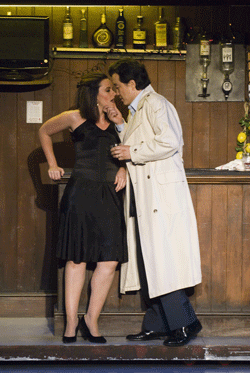 Jaewoo Kim as Duke and Patricia Orr as Maddalena
Director Lindsay Posner has updated the action to an unspecified modern era — Jonathan Miller’s Mafioso motifs, all sinister dark glasses and slick suits, retain their influence. But, despite the success of Miller’s seminal production, there remain some problems with such an updating. The opening ball scene may be suitably colourful — red velvet-clad hussies slinkily gyrating and twisting between the black-masked tuxedoes, and the piquant dances and carefree gaiety ticking the debauchery box — but the overall impression is not really the ‘kingdom of pleasure’ of which the revellers boast.
And, bunga-bunga parties don’t generally employ a ‘court jester’. Thus Rigoletto’s appearance, clutching a cane walking stick, afflicted by a small hunch, and sporting a ‘buffone’ ti-shirt seems a little out of kilter.
Similarly, it’s customarily necessary for the audience to imagine Gilda as much younger than the average prima donna in the role: but here, it is hard to believe that the tomboy-ish naïf in hoodie and leggings knows nothing at all of life or love, or even her father’s name. Moreover, for one so innocent, Gilda’s maidenly resistance gives way with remarkable rapidly under the pressure of the Duke’s passionate wiles. Surely the florid coloratura of one so pure should not be accompanied by sexual shivering and writhing among the tousled sheets?
Bewitched by her aristocratic wooer, Gilda delivers ‘Caro nome’ clutching a pillow in a dancing embrace, while her hairbrush is fashioned into a wannabe’s microphone — all that is missing is some air-guitar strumming and strutting; not bad for a girl who leaves the house only to go to church, and who — judging by the paucity of her decrepit surroundings (certainly her home is humble, but is it really a hovel?) - is not in possession of even a transistor radio.
Perhaps such criticisms are unfair, for elsewhere, Posner demonstrates a notable attention to detail, resulting in an imaginative reinterpretation of familiar moments. Thus, we witness Gilda’s suicidal lunging for Sparafucile’s knife intent, despite her beloved’s infidelities, on self-sacrifice to save the Duke. And, the bar-TV screen, showing Seria A is interrupted by Pavarotti’s rendering of ‘La donna è mobile’, itself swiftly silenced by some speedy zapping by the Duke, neatly timed to coincide with the score.
And, there is much fine singing. As the Mantuan Duke, Korean-born Australian tenor Jaewoo Kim is perhaps somewhat miscast. Solid and reliable, he never looked completely comfortable as the smarmy charmer, or sufficiently predatory as the celebrant of promiscuity in ‘Questa o quella’. A rather tentative host in the opening party scene, the Duke’s dishevelled appearance in boxer shorts after his assignation with Maddelena hardly presents him as a louche libertine. Though accurate and secure of intonation, Kim lacks a true lyric quality and the requisite warm palette of colours, and his voice was somewhat hard and inflexible, particularly at top. Without sufficient musical and theatrical presence to command the stage, the Duke was at times unfortunately overshadowed, as in his agitated Act 2 aria when he laments the loss of the girl who has become the lodestar of his life — never convincing sentiments at the best of times.
Verdi’s jester is not a benign joker, rather a bitter, cruel man who, warped by his physical deformity, is selfish and abusive. But he is also a portrait of psychological and physical suffering and thus his physical deformities must be made clear if he is to be more than a mischievous imp, and if his paranoia and resulting spiteful vindictiveness are to be understood and forgiven. In his donkey jacket and Viking helmet, Robert Poulton’s scarcely inhibited ‘hunchback’ has to work hard to win our sympathy. But, Poulton proves himself eminently able to deal with the vocal demands and stamina of this challenging role; particularly impressive were the long recitatives, such as that which follows his first encounter with Sparafucile. His vengeful anger and bitterness were always clear, and he worked hard to arouse our sympathy in the duets with Gilda, producing a pleasing cantabile in ‘Piangi, fanciulla’.
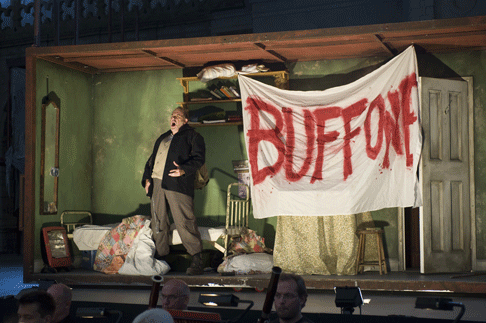 Robert Poulton as Rigoletto
Julia Sporsén, as Gilda, was a real revelation, displaying superb clarity and projection, her tone pure and effortlessly pleasing; she revelled in the bright coloratura and the simple childlike lyricism with equal aplomb — although, as ever, it proved difficult to reconcile the showy bravura with trusting simplicity. Sporsén may have lacked a genuine pianissimo but she demonstrated true tenderness in the opera’s final moments, and more than compensated for a lack of dynamic range with a soaring, gilded soprano as she appealed to Heaven for pity. Posner’s ‘masterstroke’ was saved for this final duet: for, instead of a momentary miracle recovery in father’s arms, summoning just enough strength to tell her heart-broken, frenzied father how she deceived him, this Gilda has already joined her mother in Heaven - an angelic voice, aloft, real or imagined, while the hunchback, clutching a body-bag, laments his misguided love and irredeemable loss. For once, no suspension of disbelief was required, and the distance both literal and metaphorical between father and daughter was touchingly rendered.
Graeme Broadbent’s Sparafucile radiated stentorian menace; his cavernous bass conveyed the emotionless amorality of the aproned butcher, who sharpened his knives like a demon barber. As Monterone, William Robert Allenby struck a dignified figure, his brooding, powerful bass-baritone suitably aggrieved.
In the other minor roles, a leather-clad Patricia Orr was a lively Maddalena, while Laura Wood’s Giovanna smuggled the Duke under Gilda’s dressing table with perfect timing. The chorus sung with secure ensemble.
Conductor Stuart Stratford was consistently alert to the musical details, coaxing beautiful solo playing from his principal cello, clarinet and oboe. After a solemn opening (perhaps the horns might have provided a touch more menace), he skilfully controlled the subtle shifts of pace, volleying rhythmic rises, and swelling instrumental furies followed by anxious descents, which characterise Verdi’s melodramatic score.
The venue itself provided the icing on the cake, as the darkening sky cast natural shadows heralding the approach of the louring storm and soughing wind, and signalled the unavoidable fulfilment of Monterone’s curse.
Overall, OHP served up a truly enjoyable evening of much fine musicianship and, despite a few false notes, some genuinely fresh theatrical insights.
Claire Seymour