![Antonio Pappano conducts the Orchestra and Chorus of the Academy of Santa Cecilia [Photo by Chris Christodoulou.courtesy of the BBC]](http://www.operatoday.com/Antonio-Pappano-2---Prom-2%2C.gif)
18 Jul 2011
Guillaume Tell, BBC Proms
Operatic fashions are fickle and, more to the point, often plain wrong. We all have our grievance lists of works that are ‘scandalously neglected’.
English Touring Opera are delighted to announce a season of lyric monodramas to tour nationally from October to December. The season features music for solo singer and piano by Argento, Britten, Tippett and Shostakovich with a bold and inventive approach to making opera during social distancing.
This tenth of ten Live from London concerts was in fact a recorded live performance from California. It was no less enjoyable for that, and it was also uplifting to learn that this wasn’t in fact the ‘last’ LfL event that we will be able to enjoy, courtesy of VOCES8 and their fellow vocal ensembles (more below …).
Ever since Wigmore Hall announced their superb series of autumn concerts, all streamed live and available free of charge, I’d been looking forward to this song recital by Ian Bostridge and Imogen Cooper.
Although Stile Antico’s programme article for their Live from London recital introduced their selection from the many treasures of the English Renaissance in the context of the theological debates and upheavals of the Tudor and Elizabethan years, their performance was more evocative of private chamber music than of public liturgy.
Evidently, face masks don’t stifle appreciative “Bravo!”s. And, reducing audience numbers doesn’t lower the volume of such acclamations. For, the audience at Wigmore Hall gave soprano Elizabeth Llewellyn and pianist Simon Lepper a greatly deserved warm reception and hearty response following this lunchtime recital of late-Romantic song.
For this week’s Live from London vocal recital we moved from the home of VOCES8, St Anne and St Agnes in the City of London, to Kings Place, where The Sixteen - who have been associate artists at the venue for some time - presented a programme of music and words bound together by the theme of ‘reflection’.
'Such is your divine Disposation that both you excellently understand, and royally entertaine the Exercise of Musicke.’
‘And there was war in heaven: Michael and his angels fought against the dragon; and the dragon fought and his angels, And prevailed not; neither was their place found any more in heaven … that old serpent … Satan, which deceiveth the whole world: he was cast out into the earth, and his angels were cast out with him.’
There was never any doubt that the fifth of the twelve Met Stars Live in Concert broadcasts was going to be a palpably intense and vivid event, as well as a musically stunning and theatrically enervating experience.
‘Love’ was the theme for this Live from London performance by Apollo5. Given the complexity and diversity of that human emotion, and Apollo5’s reputation for versatility and diverse repertoire, ranging from Renaissance choral music to jazz, from contemporary classical works to popular song, it was no surprise that their programme spanned 500 years and several musical styles.
The Academy of St Martin in the Fields have titled their autumn series of eight concerts - which are taking place at 5pm and 7.30pm on two Saturdays each month at their home venue in Trafalgar Square, and being filmed for streaming the following Thursday - ‘re:connect’.
The London Symphony Orchestra opened their Autumn 2020 season with a homage to Oliver Knussen, who died at the age of 66 in July 2018. The programme traced a national musical lineage through the twentieth century, from Britten to Knussen, on to Mark-Anthony Turnage, and entwining the LSO and Rattle too.
With the Live from London digital vocal festival entering the second half of the series, the festival’s host, VOCES8, returned to their home at St Annes and St Agnes in the City of London to present a sequence of ‘Choral Dances’ - vocal music inspired by dance, embracing diverse genres from the Renaissance madrigal to swing jazz.
Just a few unison string wriggles from the opening of Mozart’s overture to Le nozze di Figaro are enough to make any opera-lover perch on the edge of their seat, in excited anticipation of the drama in music to come, so there could be no other curtain-raiser for this Gala Concert at the Royal Opera House, the latest instalment from ‘their House’ to ‘our houses’.
"Before the ending of the day, creator of all things, we pray that, with your accustomed mercy, you may watch over us."
The doors at The Metropolitan Opera will not open to live audiences until 2021 at the earliest, and the likelihood of normal operatic life resuming in cities around the world looks but a distant dream at present. But, while we may not be invited from our homes into the opera house for some time yet, with its free daily screenings of past productions and its pay-per-view Met Stars Live in Concert series, the Met continues to bring opera into our homes.
Music-making at this year’s Grange Festival Opera may have fallen silent in June and July, but the country house and extensive grounds of The Grange provided an ideal setting for a weekend of twelve specially conceived ‘promenade’ performances encompassing music and dance.
There’s a “slide of harmony” and “all the bones leave your body at that moment and you collapse to the floor, it’s so extraordinary.”
“Music for a while, shall all your cares beguile.”
The hum of bees rising from myriad scented blooms; gentle strains of birdsong; the cheerful chatter of picnickers beside a still lake; decorous thwacks of leather on willow; song and music floating through the warm evening air.
Operatic fashions are fickle and, more to the point, often plain wrong. We all have our grievance lists of works that are ‘scandalously neglected’.
No one would claim that, Riccardo Muti notwithstanding, ‘serious’ Rossini was in fashion. On the basis of this Proms concert performance of Guillaume Tell, I cannot say that I feel deprived. Indeed I should express unalloyed relief, were it not for the fact that its place tends to be assumed by less rather than more interesting works. Schiller’s wonderful play, Wilhelm Tell, becomes something tedious and uninvolving – and, moreover, tedious and uninvolving at very great length. One gains no real sense of the characters as characters, of why one should or even might care about them. Now it might well be that individual psychology is not the point; it certainly is not in, say, Fidelio. Yet there one has a noble, overwhelming instantiation of the bourgeois idea of freedom at its greatest. Here one has interminable exchanges between men from different Swiss cantons ramble on uninspiringly about a Swiss fatherland, but never with fervour, lest Rossini’s monarchist protectors become alarmed. The nationalism – or, perhaps better, caricatured anti-German sentiment – is so preposterous that one can only hope nobody took it seriously even at the time. Certainly if this were a German work and the boot were on the other foot, we should expect howls of protest. The romantic element, between the Habsburg princess Mathilde, who rejects the wicked governor Gessler, and Arnold Meuchtal, a Swiss conspirator, is implausible – and implausible at great length. And how much lolling about in the sun by peasants can anyone reasonably be expected to take? Music can express languor very well; think of Debussy. Here, however, it less expresses boredom than becomes lamentably nondescript – at, you guessed it, inordinate length. Indeed, the entire first act could be cut without the slightest harm to the plot; on this occasion, it was the fourth that suffered, being cut down to twenty minutes, creating the rather odd impression of a rush to the finishing line far too late. I have never attended an operatic performance at which so many in the audience were constantly checking their watches, nor, indeed, in which so many leaped to their feet and departed, as soon as the performance was over, not even waiting to engage in the most desultory applause.
So much for the work: I was genuinely interested to have the rare opportunity to hear it, but now do not feel the need to do so again. What of the performances? Antonio Pappano had his moments, perhaps more so in the crowd control of the choral exchanges, or some of the recitative passages. Yet I could not help but wonder what a conductor such as Muti would have brought to the work; perhaps his iron grip might have had one believe in something as implausible as this. Even the overture failed to impress. It is sectional, of course, but surely a conductor ought to try to mask that just a little; there was no discernible attempt at transition whatsoever. The storm section was absurdly hard-driven, and the whole quite lacked charm, despite some fine woodwind playing from the Santa Cecilia orchestra. Though the strings on occasion sounded a little feeble here, they were on good form for most of what was to come. To have members of the orchestra take solo bows following the overture was straightforwardly bizarre.
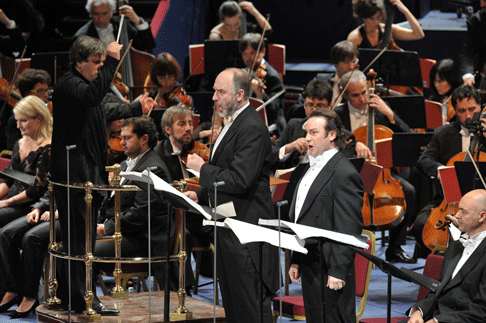 Michele Pertusi (William Tell) and John Osborn (Arnold Melchthal)
Vocal performance remained. The choral singing was generally very good indeed, and improved as the night went on: Ciro Visco is clearly an excellent choral trainer. Michele Pertusi, sad to say, made a dull Tell. Someone charismatic in this role might have pulled off a miracle, but that was not to be. Most of the rest of the cast outshone him, not least John Osborn’s outstanding Arnold, his fourth-cast aria, ‘Asile héréditaire’, proving the evening’s high-point: sweetly and elegantly sung. (Pappano should not, however, have allowed the prolonged intrusion of applause thereafter.) Elena Zanthoudakis sang well as Jemmy, Tell’s son, though her French vowels often left a good deal to be desired. The wideness of Patricia Bardon’s vibrato as Hedwige, Tell’s wife, would not have been to all tastes, and was certainly not to mine. Bar the odd unfortunate moment, such as a culiminating shriek in her Act II Scene 3 exchange with Arnold, Malin Byström proved impressive as Mathilde, her coloratura almost always precise and tasteful, though the end of the third act brought some notably flat singing. Nicolas Courjal’s Gessler in many ways came the closest to a convincing portrayal of character, certainly as close as one could imagine, suavity of line and demeanour suggesting a more sophisticated malevolence than one might have expected.
The singing, then, or rather some of the singing, was the only real point of interest. I can imagine that a staged performance with an outstanding conductor – a Muti or an Abbado – and an interesting, properly deconstructive production – from, say, a Stefan Herheim or a Peter Konwitschny – might work wonders, though I suspect one would tend to think that such talents would be better employed elsewhere. At least the celebrated scene with the apple, for which everyone not unreasonably appeared to be waiting, might elicit some sort of impact, whereas in concert, one merely notes the lack thereof. I am far from a Rossini devotee, but give me the sparkle of Il barbiere di Siviglia any day over this, and if it must be grand opéra, then Rienzi, which boasts some truly extraordinary music, let alone the masterpieces of Berlioz. Even Meyerbeer if necessary… I could not help but think of Wagner’s Opera and Drama, in which he portrays nineteenth-century opera as having degenerated into a chaotic farrago of different elements, randomly mixed and presented, permitting each spectator choosing whatever took his fancy: ‘Here the dainty leap of a ballerina, there the singer’s daring passage-work, here the set-painter’s brilliant effect, there the amazing eruption of an orchestral volcano.’ In this way, Wagner, claimed, composers such as Rossini had become the toast of the ‘entire civilised world’, and acquired the protection of Prince Metternich (the Austrian Prince Metternich, be it noted) and his European System, reinforcing rather than questioning the social order. Such a work, then, is undoubtedly of historical importance; its modern-day interest, however, largely escaped me.
Mark Berry