![Libretto of Le Nozze di Figaro, Prague 1786 [Image courtesy of Wikipedia]](http://www.operatoday.com/Mozart_libretto_figaro_1786.gif)
07 Jul 2011
The Marriage of Figaro, Opera Holland Park
Even before a note was sounded at Opera Holland Park on Saturday evening, the still summer evening was ruffled by a breeze of unease.
English Touring Opera are delighted to announce a season of lyric monodramas to tour nationally from October to December. The season features music for solo singer and piano by Argento, Britten, Tippett and Shostakovich with a bold and inventive approach to making opera during social distancing.
This tenth of ten Live from London concerts was in fact a recorded live performance from California. It was no less enjoyable for that, and it was also uplifting to learn that this wasn’t in fact the ‘last’ LfL event that we will be able to enjoy, courtesy of VOCES8 and their fellow vocal ensembles (more below …).
Ever since Wigmore Hall announced their superb series of autumn concerts, all streamed live and available free of charge, I’d been looking forward to this song recital by Ian Bostridge and Imogen Cooper.
Although Stile Antico’s programme article for their Live from London recital introduced their selection from the many treasures of the English Renaissance in the context of the theological debates and upheavals of the Tudor and Elizabethan years, their performance was more evocative of private chamber music than of public liturgy.
Evidently, face masks don’t stifle appreciative “Bravo!”s. And, reducing audience numbers doesn’t lower the volume of such acclamations. For, the audience at Wigmore Hall gave soprano Elizabeth Llewellyn and pianist Simon Lepper a greatly deserved warm reception and hearty response following this lunchtime recital of late-Romantic song.
For this week’s Live from London vocal recital we moved from the home of VOCES8, St Anne and St Agnes in the City of London, to Kings Place, where The Sixteen - who have been associate artists at the venue for some time - presented a programme of music and words bound together by the theme of ‘reflection’.
'Such is your divine Disposation that both you excellently understand, and royally entertaine the Exercise of Musicke.’
‘And there was war in heaven: Michael and his angels fought against the dragon; and the dragon fought and his angels, And prevailed not; neither was their place found any more in heaven … that old serpent … Satan, which deceiveth the whole world: he was cast out into the earth, and his angels were cast out with him.’
There was never any doubt that the fifth of the twelve Met Stars Live in Concert broadcasts was going to be a palpably intense and vivid event, as well as a musically stunning and theatrically enervating experience.
‘Love’ was the theme for this Live from London performance by Apollo5. Given the complexity and diversity of that human emotion, and Apollo5’s reputation for versatility and diverse repertoire, ranging from Renaissance choral music to jazz, from contemporary classical works to popular song, it was no surprise that their programme spanned 500 years and several musical styles.
The Academy of St Martin in the Fields have titled their autumn series of eight concerts - which are taking place at 5pm and 7.30pm on two Saturdays each month at their home venue in Trafalgar Square, and being filmed for streaming the following Thursday - ‘re:connect’.
The London Symphony Orchestra opened their Autumn 2020 season with a homage to Oliver Knussen, who died at the age of 66 in July 2018. The programme traced a national musical lineage through the twentieth century, from Britten to Knussen, on to Mark-Anthony Turnage, and entwining the LSO and Rattle too.
With the Live from London digital vocal festival entering the second half of the series, the festival’s host, VOCES8, returned to their home at St Annes and St Agnes in the City of London to present a sequence of ‘Choral Dances’ - vocal music inspired by dance, embracing diverse genres from the Renaissance madrigal to swing jazz.
Just a few unison string wriggles from the opening of Mozart’s overture to Le nozze di Figaro are enough to make any opera-lover perch on the edge of their seat, in excited anticipation of the drama in music to come, so there could be no other curtain-raiser for this Gala Concert at the Royal Opera House, the latest instalment from ‘their House’ to ‘our houses’.
"Before the ending of the day, creator of all things, we pray that, with your accustomed mercy, you may watch over us."
The doors at The Metropolitan Opera will not open to live audiences until 2021 at the earliest, and the likelihood of normal operatic life resuming in cities around the world looks but a distant dream at present. But, while we may not be invited from our homes into the opera house for some time yet, with its free daily screenings of past productions and its pay-per-view Met Stars Live in Concert series, the Met continues to bring opera into our homes.
Music-making at this year’s Grange Festival Opera may have fallen silent in June and July, but the country house and extensive grounds of The Grange provided an ideal setting for a weekend of twelve specially conceived ‘promenade’ performances encompassing music and dance.
There’s a “slide of harmony” and “all the bones leave your body at that moment and you collapse to the floor, it’s so extraordinary.”
“Music for a while, shall all your cares beguile.”
The hum of bees rising from myriad scented blooms; gentle strains of birdsong; the cheerful chatter of picnickers beside a still lake; decorous thwacks of leather on willow; song and music floating through the warm evening air.
Even before a note was sounded at Opera Holland Park on Saturday evening, the still summer evening was ruffled by a breeze of unease.
Producer James Clutton took to the stage to announce that the original Susanna, Claire Meghnagi, had “left the production” and been replaced at short notice by Jane Harrington. In addition, Matthew Hargreaves, our elegantly attired factotum for the evening was not feeling on top form, but would soldier on regardless.
To paraphrase Lady Bracknell, “to lose one principal may be regarded as a misfortune; to lose two looks like carelessness”. In the event, if Hargreaves was suffering it did not affect him too greatly; there were a few problems with projection initially — he was rather tentative in the opening duets — but he quickly warmed up and by ‘Se Vuol Ballare’ was well into his stride (although conductor Matthew Willis nearly knocked him off-balance with some unexpected and inexplicable changes of tempo). If Hargreaves fudged a few of his notes at the top, it did not detract from a committed and lively performance. His camp, mincing, Jeeves-like antics were energetic and eye-catching, and he demonstrated a good sense of timing in what is an intricately choreographed production.
As for Harrington, she slipped effortlessly into the comic capers and complicated stage manoeuvres; she clearly knows this opera well, but if she really had had only a few days of rehearsal, she must have a remarkable stage memory. Her Susanna exuded brio, confidence and charm. Her Act 3 duet with the Countess ‘Sull’ aria’ was exquisitely sweet and clear. Indeed, the vocal expressivity of Elizabeth Llewellyn, as the disillusioned, disheartened Countess, was one of the highlights of the evening. Both ‘Porgi amor’ and ‘Dove sono’ powerfully conveyed her distress and established her aristocratic dignity. However, Llewellyn and her philandering Count, George von Bergen, (equally strong vocally, his dark registers booming out to suggest menace) are not the most convincing of actors and in a production that often found them at the front of the stage, statically facing the audience, they didn’t always make dramatic impact.
And, herein lies much of the problem with this production. For Liam Steel frequently neglects to direct the principals while involving the chorus in ceaseless hectic, and often distracting, activity. During the overture, the hustle and bustle of the upstairs/downstairs world was captured by a seething mass of servile retainers who rushed about the stage, plumping cushions, airing linen, carrying silverware (a debt, conscious or otherwise, to David McVicar’s ROH production?), and charging helter-skelter in and out of the numerous doors which extended in sharp perspective from the arched walls of Holland Park House (Emma Wee’s graceful set, cleverly calling the walls of the house into action). Such frenetic commotion on stage was not matched in the pit where, here and throughout the performance, rhythmic drive and forward momentum — so essential to the comic impetus — were sadly lacking. In general, Willis adopted an overly lyrical approach, eschewing the brisk crispness of the Classical idiom; occasional exaggerated dynamic contrasts and clumsy accelerations of pace could not inject the necessary joie de vivre.
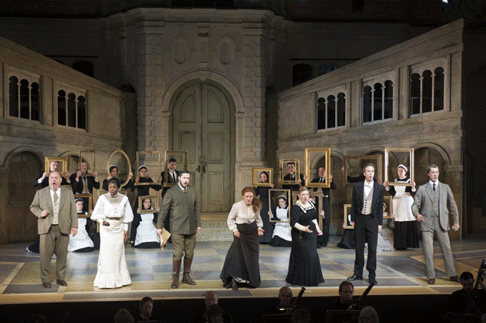 Scene from The Marriage of Figaro [Photo by Fritz Curzon]
There were some deft theatrical touches — Cherubino’s leap through the chamber window into the geranium beds, for example, was neatly and wryly effected — but on the whole there was too much clutter and fussy choreography, which frequently hindered the singers’ attempts to establish character and dramatic situation through the music itself. Thus, Lynton Black struggled to convince us of Dr Bartolo’s vicious anger in the vengeful ‘La vendetta’, as the chorus farcically waved red books to and fro in the background; in case we were uncertain that Antonio (Henry Grant Kersell) is a gardener, his arrival in search of the destroyer of his precious flowerbeds was accompanied by a chorus of dancing geranium pots. When they weren’t parading picture frames or pirouetting around the furniture, the chorus were placing ‘legless’ furniture beneath the derrieres of their distressed masters and mistresses. The music was simply never allowed to speak for itself. Thus, even Cherubino’s gauche outpouring of adolescent passion, ‘Voi che sapete’, sung with bright clarity by a perky Hannah Pedley, was ‘illustrated’ by some mimed shenanigans by the four principals, subsequently imitated in a choreographed coda by a lower class quartet.
Although this chaotic stage business might have resembled a bedroom farce, the fact is that it simply wasn’t funny. The unpoetic banalities of the ‘re-written libretto’ (I hesitate to use the word ‘translation’) did not help; the surtitles not only lacked the grace of Da Ponte’s witty couplets, but frequently had only a tenuous relationship to the events and dialogue that the original libretto describes. Thus, despite some fine singing, hyperactivity on stage contrasted with lethargy in the pit, and as darkness fell, what is a long opera began to feel like a languorous one; one of the finest musical comedies reduced to dramatic inertia.
Claire Seymour