![Richard Paul Fink (Wozzeck) [Photo by Ken Howard courtesy of Santa Fe Opera]](http://www.operatoday.com/WOZ1_0267a.gif)
27 Aug 2011
Santa Fe: Best of Show 2011
As this is written, the third week of August, the Santa Fe music season is winding down.
English Touring Opera are delighted to announce a season of lyric monodramas to tour nationally from October to December. The season features music for solo singer and piano by Argento, Britten, Tippett and Shostakovich with a bold and inventive approach to making opera during social distancing.
This tenth of ten Live from London concerts was in fact a recorded live performance from California. It was no less enjoyable for that, and it was also uplifting to learn that this wasn’t in fact the ‘last’ LfL event that we will be able to enjoy, courtesy of VOCES8 and their fellow vocal ensembles (more below …).
Ever since Wigmore Hall announced their superb series of autumn concerts, all streamed live and available free of charge, I’d been looking forward to this song recital by Ian Bostridge and Imogen Cooper.
Although Stile Antico’s programme article for their Live from London recital introduced their selection from the many treasures of the English Renaissance in the context of the theological debates and upheavals of the Tudor and Elizabethan years, their performance was more evocative of private chamber music than of public liturgy.
Evidently, face masks don’t stifle appreciative “Bravo!”s. And, reducing audience numbers doesn’t lower the volume of such acclamations. For, the audience at Wigmore Hall gave soprano Elizabeth Llewellyn and pianist Simon Lepper a greatly deserved warm reception and hearty response following this lunchtime recital of late-Romantic song.
For this week’s Live from London vocal recital we moved from the home of VOCES8, St Anne and St Agnes in the City of London, to Kings Place, where The Sixteen - who have been associate artists at the venue for some time - presented a programme of music and words bound together by the theme of ‘reflection’.
'Such is your divine Disposation that both you excellently understand, and royally entertaine the Exercise of Musicke.’
‘And there was war in heaven: Michael and his angels fought against the dragon; and the dragon fought and his angels, And prevailed not; neither was their place found any more in heaven … that old serpent … Satan, which deceiveth the whole world: he was cast out into the earth, and his angels were cast out with him.’
There was never any doubt that the fifth of the twelve Met Stars Live in Concert broadcasts was going to be a palpably intense and vivid event, as well as a musically stunning and theatrically enervating experience.
‘Love’ was the theme for this Live from London performance by Apollo5. Given the complexity and diversity of that human emotion, and Apollo5’s reputation for versatility and diverse repertoire, ranging from Renaissance choral music to jazz, from contemporary classical works to popular song, it was no surprise that their programme spanned 500 years and several musical styles.
The Academy of St Martin in the Fields have titled their autumn series of eight concerts - which are taking place at 5pm and 7.30pm on two Saturdays each month at their home venue in Trafalgar Square, and being filmed for streaming the following Thursday - ‘re:connect’.
The London Symphony Orchestra opened their Autumn 2020 season with a homage to Oliver Knussen, who died at the age of 66 in July 2018. The programme traced a national musical lineage through the twentieth century, from Britten to Knussen, on to Mark-Anthony Turnage, and entwining the LSO and Rattle too.
With the Live from London digital vocal festival entering the second half of the series, the festival’s host, VOCES8, returned to their home at St Annes and St Agnes in the City of London to present a sequence of ‘Choral Dances’ - vocal music inspired by dance, embracing diverse genres from the Renaissance madrigal to swing jazz.
Just a few unison string wriggles from the opening of Mozart’s overture to Le nozze di Figaro are enough to make any opera-lover perch on the edge of their seat, in excited anticipation of the drama in music to come, so there could be no other curtain-raiser for this Gala Concert at the Royal Opera House, the latest instalment from ‘their House’ to ‘our houses’.
"Before the ending of the day, creator of all things, we pray that, with your accustomed mercy, you may watch over us."
The doors at The Metropolitan Opera will not open to live audiences until 2021 at the earliest, and the likelihood of normal operatic life resuming in cities around the world looks but a distant dream at present. But, while we may not be invited from our homes into the opera house for some time yet, with its free daily screenings of past productions and its pay-per-view Met Stars Live in Concert series, the Met continues to bring opera into our homes.
Music-making at this year’s Grange Festival Opera may have fallen silent in June and July, but the country house and extensive grounds of The Grange provided an ideal setting for a weekend of twelve specially conceived ‘promenade’ performances encompassing music and dance.
There’s a “slide of harmony” and “all the bones leave your body at that moment and you collapse to the floor, it’s so extraordinary.”
“Music for a while, shall all your cares beguile.”
The hum of bees rising from myriad scented blooms; gentle strains of birdsong; the cheerful chatter of picnickers beside a still lake; decorous thwacks of leather on willow; song and music floating through the warm evening air.
As this is written, the third week of August, the Santa Fe music season is winding down.
Best of the summer for this observer included the closing performance of Alban Berg’s magical expressionist tragedy, Wozzeck. It was a complete realization of the 2001 production by Daniel Slater and Robert Innes Hopkins, which captivated everyone at the time and has remained in memory as an historic highlight of the company’s quality. So it was again this season through only four performances (La bohème enjoyed ten). Under the music direction of St Louis Symphony’s superlative conductor David Robertson, the musical quality was, if anything, improved over 2001. I attended the first and final performances, and the show grew and developed into musical-dramatic tour de force — a deeply touching one.
Berg’s 1925 masterwork was not professionally staged in its entirety in this country until 1959 at the New York Met, though excerpts had been heard in concert form in 1951, presented by Dmitri Mitropoulos at Carnegie Hall and issued on Columbia records (some will argue that the 1931 Leopold Stokowski presentation of Wozzeck in Philadelphia was the North American premiere, though it was a semi-professional company, derived out of patroness Mrs Bok’s local conservatory with, remarkably, Nelson Eddy in the title role). Nowadays, the complicated score is relatively easily listenable so one can turn to matters of message and dramatic effect — and the elegance of its deeply beautiful, if complex orchestral music. As in Wagner’s famous quip about his own operas, here “the drama is in the orchestra.” Berg’s innovative atonal writing, with its remarkable orchestration and colors, right up to a thunderous held chord on B for the full orchestra, a kind of massive punctuation mark, followed by a tonal interlude centered on D-minor, seduces the audience into thinking the worst is over. The cruelties dealt to Wozzeck by life, in the person of virtually all his associates, are too much for him; his mind finally snaps and he, along with his mistress, die. After the healing surprise of the D-minor interlude near the end of the opera, we suddenly find Wozzeck’s young son riding his stick horse across the stage, murmuring ‘hip hop, hip hop.” With his parents dead, there is no one to hear him — and now the atonal patterns return, the tragedy of life starts all over again.
A fine cast was led by the strong baritone Richard Paul Fink, memorable in the intense title role, with debutante German soprano, the skilled Nicola Beller Carbone, fascinating as Marie. The pungency of Slater’s staging — it’s tension and release, aided by Hopkins’ remarkable set that leans and dips according to the action — never ceases until the final shattering moments of the 90-minute opera. In secondary but important roles, the proven talents of Robert Brubaker, Eric Owens and Stuart Skelton, along with Patricia Risley and Jason Slayden, gave much reward. The Santa Fe orchestra was entirely up to its task, with, I’ll say again, David Robertson the master of the evening. I could go to this opera with much enjoyment many more times, most especially in Santa Fe’s heightened expressionistic production.
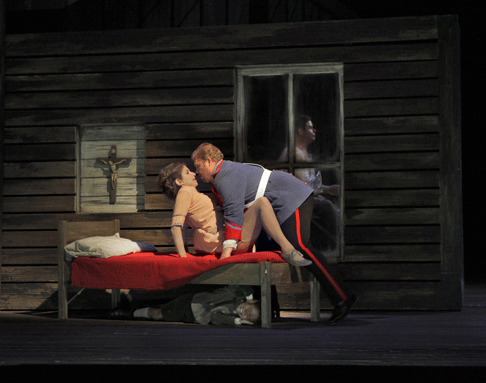 Nicola Beller Carbone (Marie), Stuart Skelton (Drum Major) & Richard Paul Fink (Wozzeck)
A common denominator between the opera and a new voice recital series, played over three concerts in August at the Scottish Rite Temple in downtown Santa Fe, was the memorable talent of basso-cantante Eric Owens. The singer, known especially to opera audiences as General Leslie Groves in Adams’ Dr Atomic, proved a pleasant surprise as a proponent of German lied. The dramatic statements of several of Schubert’s largest lied lay easily within the eloquent basso’s grasp; yet he could spin a piano tone in Duparc, or crisply deliver a merry old English song. Ironically, perhaps the greatest achievement of his hour’s recital was a stunningly vocalized and moving encore of King Philip’s monologue from Verdi’s Don Carlos. In German, French and Italian, this splendid artist is a man for all seasons; the voice fine-grained but purposeful, the musicality secure, the diction square on.
Mr. Owens has it all, and may fate grant him a long and fruitful artistic life. Appreciation is due Santa Fe conductor and concert promoter Joseph Illick for developing the new vocal series, which we hear will return next season. It is nice to see life breathed back into the art of the art song!
Finally, and in some ways most enjoyable of all, the Santa Fe Chamber Music Festival presented in a noontime recital at the resonant St. Francis Auditorium, the young Korean-American pianist Joyce Yang. I had heard this artist play in California during the Spring and found her exceptional. All expectations were fulfilled in a program based on Lowell Liebermann’s Gargoyles (1989), a jaunty, layered showpiece of pianistic technique, which was a breeze for Miss Yang. Debussy’s Estampes followed, flowing richly from her big Steinway, a riot of impressionistic nuance, color and fleet image-making from the young Debussy’s inspired imagination. Miss Yang took one’s breath away with her ease and maturity of phrasing, the mistress of resourcefulness and thrilling resolve. I know, but it really was that good!
The climax of the event was the great and glorious Carnival of Robert Schumann, a landmark of romantic invention, and a strong test of any pianist. Miss Yang seemed to approach the 20-some scenes of Schumann’s storytelling with absolute certainty of what she was about, playing with reserves of power, tasteful musicality and poise, that were most vivifying for this old masterwork. The audience went crazy, as they should have, and encores were offered. The best possible encore is to have this young sorceress back as soon and often as possible!
Any three ‘best’ choices are bound to be arbitrary; but with the bountiful offerings of the music and opera festivals in Santa Fe’s high season, I suggest these selections, out of dozens of other wonderful moments, as a taste of what “America’s Salzburg” is all about.
James A. Van Sant © 2011