![Vesselina Kasarova as Romeo and Ekaterina Siurina as Giulietta [Photo: Wilfried Hösl / Bayerische Staatsoper]](http://www.operatoday.com/Capuleti_Kasarova_Siurina_1.gif)
14 Aug 2011
Starry-Crossed Lovers in Bavaria
In the waning days of the annual summer festival, Munich’s Bavarian State Opera fielded enough star power to fire up a minor galaxy with its wholly absorbing production of I Capuleti e i Montecchi.
English Touring Opera are delighted to announce a season of lyric monodramas to tour nationally from October to December. The season features music for solo singer and piano by Argento, Britten, Tippett and Shostakovich with a bold and inventive approach to making opera during social distancing.
This tenth of ten Live from London concerts was in fact a recorded live performance from California. It was no less enjoyable for that, and it was also uplifting to learn that this wasn’t in fact the ‘last’ LfL event that we will be able to enjoy, courtesy of VOCES8 and their fellow vocal ensembles (more below …).
Ever since Wigmore Hall announced their superb series of autumn concerts, all streamed live and available free of charge, I’d been looking forward to this song recital by Ian Bostridge and Imogen Cooper.
Although Stile Antico’s programme article for their Live from London recital introduced their selection from the many treasures of the English Renaissance in the context of the theological debates and upheavals of the Tudor and Elizabethan years, their performance was more evocative of private chamber music than of public liturgy.
Evidently, face masks don’t stifle appreciative “Bravo!”s. And, reducing audience numbers doesn’t lower the volume of such acclamations. For, the audience at Wigmore Hall gave soprano Elizabeth Llewellyn and pianist Simon Lepper a greatly deserved warm reception and hearty response following this lunchtime recital of late-Romantic song.
For this week’s Live from London vocal recital we moved from the home of VOCES8, St Anne and St Agnes in the City of London, to Kings Place, where The Sixteen - who have been associate artists at the venue for some time - presented a programme of music and words bound together by the theme of ‘reflection’.
'Such is your divine Disposation that both you excellently understand, and royally entertaine the Exercise of Musicke.’
‘And there was war in heaven: Michael and his angels fought against the dragon; and the dragon fought and his angels, And prevailed not; neither was their place found any more in heaven … that old serpent … Satan, which deceiveth the whole world: he was cast out into the earth, and his angels were cast out with him.’
There was never any doubt that the fifth of the twelve Met Stars Live in Concert broadcasts was going to be a palpably intense and vivid event, as well as a musically stunning and theatrically enervating experience.
‘Love’ was the theme for this Live from London performance by Apollo5. Given the complexity and diversity of that human emotion, and Apollo5’s reputation for versatility and diverse repertoire, ranging from Renaissance choral music to jazz, from contemporary classical works to popular song, it was no surprise that their programme spanned 500 years and several musical styles.
The Academy of St Martin in the Fields have titled their autumn series of eight concerts - which are taking place at 5pm and 7.30pm on two Saturdays each month at their home venue in Trafalgar Square, and being filmed for streaming the following Thursday - ‘re:connect’.
The London Symphony Orchestra opened their Autumn 2020 season with a homage to Oliver Knussen, who died at the age of 66 in July 2018. The programme traced a national musical lineage through the twentieth century, from Britten to Knussen, on to Mark-Anthony Turnage, and entwining the LSO and Rattle too.
With the Live from London digital vocal festival entering the second half of the series, the festival’s host, VOCES8, returned to their home at St Annes and St Agnes in the City of London to present a sequence of ‘Choral Dances’ - vocal music inspired by dance, embracing diverse genres from the Renaissance madrigal to swing jazz.
Just a few unison string wriggles from the opening of Mozart’s overture to Le nozze di Figaro are enough to make any opera-lover perch on the edge of their seat, in excited anticipation of the drama in music to come, so there could be no other curtain-raiser for this Gala Concert at the Royal Opera House, the latest instalment from ‘their House’ to ‘our houses’.
"Before the ending of the day, creator of all things, we pray that, with your accustomed mercy, you may watch over us."
The doors at The Metropolitan Opera will not open to live audiences until 2021 at the earliest, and the likelihood of normal operatic life resuming in cities around the world looks but a distant dream at present. But, while we may not be invited from our homes into the opera house for some time yet, with its free daily screenings of past productions and its pay-per-view Met Stars Live in Concert series, the Met continues to bring opera into our homes.
Music-making at this year’s Grange Festival Opera may have fallen silent in June and July, but the country house and extensive grounds of The Grange provided an ideal setting for a weekend of twelve specially conceived ‘promenade’ performances encompassing music and dance.
There’s a “slide of harmony” and “all the bones leave your body at that moment and you collapse to the floor, it’s so extraordinary.”
“Music for a while, shall all your cares beguile.”
The hum of bees rising from myriad scented blooms; gentle strains of birdsong; the cheerful chatter of picnickers beside a still lake; decorous thwacks of leather on willow; song and music floating through the warm evening air.
In the waning days of the annual summer festival, Munich’s Bavarian State Opera fielded enough star power to fire up a minor galaxy with its wholly absorbing production of I Capuleti e i Montecchi.
The lovely Ekaterina Siurina can always be counted upon to sing sublimely and act meaningfully, but on this occasion she raised the bar past even her own high standard. Ms. Siurina embodied Giulietta with complete immersion in the heroine’s emotional state. There was nary a false move nor a wasted gesture, and the soprano managed a fully-rounded traversal of the heroine that was one moment stunningly economical, and the next extravagantly abandoned.
What a joy that her singing is not only faultlessly produced, but seems to emanate from the very soul of the doomed girl. Her shimmering, secure soprano is ample enough to fill the house at all volumes and throughout the extensive range of Bellini’s demands. Within the scope of her lyric instrument, Ekaterina skillfully suggests an amazing palette of vocal colors, witness the hollow, despairing reading of her opening phrases that inform the character’s mental state, and portend her eventual fate. Her meticulously sung, completely rendered theatrical portrayal had all the elements of Sills at her finest (and her slimmest!).
Miss S. had a worthy partner indeed in the Romeo of Vesselina Kasarova, arguably the starriest name in the cast. The Bulgarian mezzo has all the assets to triumph in the part: a heldentenorial timbre in the chest voice, a well-knitted passage into the lower middle, searing top notes, and an often jaw-dropping way with the fiendish fioriture. Ms. Kasarova is also blessed with a distinctive, dark vocal presence that is uniquely her own, making her uncommonly well suited to trouser roles.
Too, she has an unaffected swagger and such a fierce commitment that her confrontational moments suggested a lion about to claim its lunch. That said, this seasoned artist seemed to begin the evening a little off form. Her opening aria was punctuated by uncharacteristic gulps and glottal attacks, and the cabaletta was a bit hysterical and mannered (she firmly slowed the pace down with her first phrase). Thereafter, however, this house favorite settled into a riveting, and heartfelt impersonation, perhaps spurred on by her sublime Giulietta. Their extended duet passage work in thirds was breath-taking, their dissimilar vocal production providing a delectable musical texture.
Young tenor Dimitri Pittas’s straight-forward, solidly vocalized Tebaldo demonstrated just why his star is rising. The substantial, straight forward tone has good squillo and an engaging aural presence. Mr. Pittas also has some of the sweetest tones to be experienced at the top of the staff, and he bends and shapes phrases with tenderness and musicality. He decisively delivers robust outbursts in the upper voice although at the very fullest throttle, the warm tone loses a little of its pleasant spin. The high profile duet with Romeo fairly crackled with intensity, and staked its claim as one of the evening’s high points.
Carlo Cigni offered an unusually youthful Lorenzo, so persuasively served by his rolling, well-modulated bass-baritone that the role seemed larger than it was. Very impressive singing. Rounding out the principals, Ante Jerkunica deployed his soft-grained bass to fine effect as the paternally misguided Capellio.
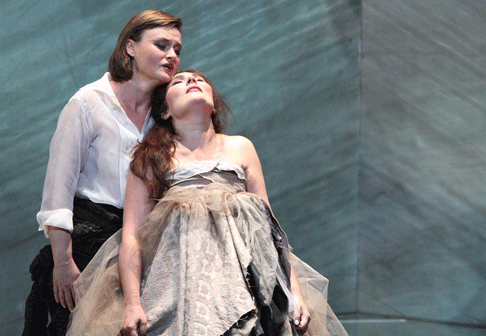 Vesselina Kasarova as Romeo and Ekaterina Siurina as Giulietta [Photo: Wilfried Hösl / Bayerische Staatsoper]
The captivating staging and design was anything but slavishly representational, opting rather to created a spiritual and emotional environment in which the performers played out the intent of a story we know by heart. Instead of being confusing, it was almost wholly intriguing. Set designer Vincent Lemaire has devised a singer friendly box of sorts, with Batik-like patterns that had the curious ability to be soothing or disturbing. This was partly owing to Guido Levi’s ambitious multi-colored lighting design which was long on imagination, but short on subtlety with the many abrupt cross fades. I might urge Mr. Levi to smooth out the edges a bit.
Mr. Lemaire, however, has created some highly charged images suggesting escape, emotional instability, and inevitably fatal choices. From the rows of saddles and stirrups hanging ominously over the courtiers in the opening scene, to the floating sculpture of two lovers suspended in flight in Juliet’s chamber, to the eternal staircase at the party that rises from the bowels of the basement and is framed like a giant painting, these were dramatically powerful visual statements.
Legendary Christian Lecroix has greatly advanced the production concept with his lavish, character specific, intentionally anachronistic costumes. The men’s chorus sports Dickensian stove-pipe hats and frock coats; Giulietta is dressed in designer white undies, a teddy-ish creation with short puffy culottes, not unlike like those paper lamb cutlet dress-ups at finer restaurants. Thus semi-clothed, she desperately clutches to her torso, then drops, then retrieves a gorgeous diaphanous dress-up gown, thereby symbolizing her ambivalence to duty, gender roles, and obedience. The women’s party dresses were a riotously colored mix of Carnevale inspirations.
Director Vincent Broussard has drawn highly charged performances from his principals. The blocking is decidedly moody, frequently menacing, yet when required, effusively romantic. Perhaps he repeats certain devices once too often, like having a troubled character face the wall as though in a Time Out Room, or having two singers stalk each other in wide circles. But other images pay off handsomely, like having Giulietta gingerly walk the huge picture frame like a balance beam during her extended party scene address, or having the poison/potion takers merely mime swallowing a handful of pills. Where did they come from? Who knows? Who cares? It was truthful and it worked. A little more attention might be paid to crowd management in the choral scenes, as the grouping and re-grouping in trite choral line-ups lacked variety. But all in all, this was a director not only true to his staging ideas, but also true to the spirit of Bellini’s musical drama.
In the pit, Yves Able wrung a highly detailed, taut, impulsive reading of a score that can sometimes come off as preciously ‘sensitive.’ Not only did Maestro Able inject a wonderful rhythmic propulsion that buoyed the entire proceeding, but he also provided appropriate elasticity that supported the sensitive phrasing and nuanced delivery from the soloists. There was also remarkably fine solo playing, most especially from the principal horn and the clarinet, both of whom gifted us with awesome technique, dramatic fire, and distinctive musical personality.
That this collective team of top professionals collaborated to give us a tremendously realized I Capuleti e i Montecchi was evidenced by the sustained, vociferous approval at evening’s end. The rowdy festival crowd called the cast back for curtain call after curtain call after curtain call. A most fitting end to celebrate a richly rewarding experience.
James Sohre