![Eva-Maria Westbroek as Giorgetta and Aleksandrs Antonenko as Luigi [Photo by Bill Cooper courtesy of The Royal Opera]](http://www.operatoday.com/IL%20TABARRO%20-%20BC20110907293%20-%20WESTBROEK%20AS%20GIORGETTA%2C%20ANTONENKO%20AS%20LUIGI%20%28C%29%20BILL%20COOPER.png)
21 Sep 2011
Il Trittico, Covent Garden
What do a ferociously violent melodrama, an ecstatic spiritual revelation and an ironic black farce have in common?
English Touring Opera are delighted to announce a season of lyric monodramas to tour nationally from October to December. The season features music for solo singer and piano by Argento, Britten, Tippett and Shostakovich with a bold and inventive approach to making opera during social distancing.
This tenth of ten Live from London concerts was in fact a recorded live performance from California. It was no less enjoyable for that, and it was also uplifting to learn that this wasn’t in fact the ‘last’ LfL event that we will be able to enjoy, courtesy of VOCES8 and their fellow vocal ensembles (more below …).
Ever since Wigmore Hall announced their superb series of autumn concerts, all streamed live and available free of charge, I’d been looking forward to this song recital by Ian Bostridge and Imogen Cooper.
The Sixteen continues its exploration of Henry Purcell’s Welcome Songs for Charles II. As with Robert King’s pioneering Purcell series begun over thirty years ago for Hyperion, Harry Christophers is recording two Welcome Songs per disc.
Although Stile Antico’s programme article for their Live from London recital introduced their selection from the many treasures of the English Renaissance in the context of the theological debates and upheavals of the Tudor and Elizabethan years, their performance was more evocative of private chamber music than of public liturgy.
In February this year, Albanian soprano Ermonela Jaho made a highly lauded debut recital at Wigmore Hall - a concert which both celebrated Opera Rara’s 50th anniversary and honoured the career of the Italian soprano Rosina Storchio (1872-1945), the star of verismo who created the title roles in Leoncavallo’s La bohème and Zazà, Mascagni’s Lodoletta and Puccini’s Madama Butterfly.
Evidently, face masks don’t stifle appreciative “Bravo!”s. And, reducing audience numbers doesn’t lower the volume of such acclamations. For, the audience at Wigmore Hall gave soprano Elizabeth Llewellyn and pianist Simon Lepper a greatly deserved warm reception and hearty response following this lunchtime recital of late-Romantic song.
Collapsology. Or, perhaps we should use the French word ‘Collapsologie’ because this is a transdisciplinary idea pretty much advocated by a series of French theorists - and apparently, mostly French theorists. It in essence focuses on the imminent collapse of modern society and all its layers - a series of escalating crises on a global scale: environmental, economic, geopolitical, governmental; the list is extensive.
For this week’s Live from London vocal recital we moved from the home of VOCES8, St Anne and St Agnes in the City of London, to Kings Place, where The Sixteen - who have been associate artists at the venue for some time - presented a programme of music and words bound together by the theme of ‘reflection’.
'Such is your divine Disposation that both you excellently understand, and royally entertaine the Exercise of Musicke.’
Amongst an avalanche of new Mahler recordings appearing at the moment (Das Lied von der Erde seems to be the most favoured, with three) this 1991 Mahler Second from the 2nd Kassel MahlerFest is one of the more interesting releases.
‘And there was war in heaven: Michael and his angels fought against the dragon; and the dragon fought and his angels, And prevailed not; neither was their place found any more in heaven … that old serpent … Satan, which deceiveth the whole world: he was cast out into the earth, and his angels were cast out with him.’
If there is one myth, it seems believed by some people today, that probably needs shattering it is that post-war recordings or performances of Wagner operas were always of exceptional quality. This 1949 Hamburg Tristan und Isolde is one of those recordings - though quite who is to blame for its many problems takes quite some unearthing.
There was never any doubt that the fifth of the twelve Met Stars Live in Concert broadcasts was going to be a palpably intense and vivid event, as well as a musically stunning and theatrically enervating experience.
‘Love’ was the theme for this Live from London performance by Apollo5. Given the complexity and diversity of that human emotion, and Apollo5’s reputation for versatility and diverse repertoire, ranging from Renaissance choral music to jazz, from contemporary classical works to popular song, it was no surprise that their programme spanned 500 years and several musical styles.
The Academy of St Martin in the Fields have titled their autumn series of eight concerts - which are taking place at 5pm and 7.30pm on two Saturdays each month at their home venue in Trafalgar Square, and being filmed for streaming the following Thursday - ‘re:connect’.
The London Symphony Orchestra opened their Autumn 2020 season with a homage to Oliver Knussen, who died at the age of 66 in July 2018. The programme traced a national musical lineage through the twentieth century, from Britten to Knussen, on to Mark-Anthony Turnage, and entwining the LSO and Rattle too.
With the Live from London digital vocal festival entering the second half of the series, the festival’s host, VOCES8, returned to their home at St Annes and St Agnes in the City of London to present a sequence of ‘Choral Dances’ - vocal music inspired by dance, embracing diverse genres from the Renaissance madrigal to swing jazz.
Just a few unison string wriggles from the opening of Mozart’s overture to Le nozze di Figaro are enough to make any opera-lover perch on the edge of their seat, in excited anticipation of the drama in music to come, so there could be no other curtain-raiser for this Gala Concert at the Royal Opera House, the latest instalment from ‘their House’ to ‘our houses’.
"Before the ending of the day, creator of all things, we pray that, with your accustomed mercy, you may watch over us."
What do a ferociously violent melodrama, an ecstatic spiritual revelation and an ironic black farce have in common?
This is the question which faces directors and composers who determine to stage in its entirety Puccini’s infrequently performed triptych of one-act operas, Il Trittico.
Is there a ‘unifying factor’? Should one even attempt to look for one? Perhaps it is the contrasts between the Il Tabarro, Suor Angelica and Gianni Schicchi that produce maximum theatrical effect and musical impact?
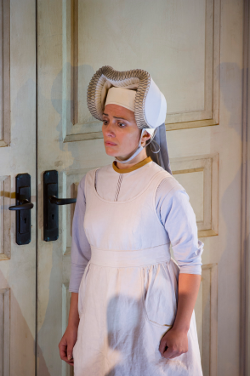 Ermonela Jaho as Sister Angelica
Il Tabarro, in director Richard Jones’ and conductor Antonio Pappano’s conception builds effectively from the leaden, repetitive melancholy of the opening scenes to a central moment of passionate ecstacy before falling terrifyingly and inexorably to its shocking, vicious conclusion. That Pappano has a masterful appreciation of the Puccinian idiom and unsurpassed ability to match musical structure to dramatic denouement, is apparent from the first: the latent violence of the riverside community suggested by disturbing and startling surges in dynamic and melodic compass which disrupt the hypnotic rhythmic repetitions of the lapping waters.
Jones presents an appropriately naturalistic stage picture, designer Ultz delivering looming brick walls, narrow alleyways and grimy barges which depressingly conjure the colourless world of the stevedores, dockers and rag-pickers who work on or beside the Seine. Popular song melodies - Ji-Min Park’s (Song Seller) street ballad, Alan Oke’s (Tinca) drinking song — provide both realism and variety.
The bleakness is broken by the Giorgetta’s outburst of yearning, the soaring warmth of Eva-Maria Westbroek’s gleaming soprano, revealing the stark contrast between feminine ideals and dreams and the wretched reality of the enchained lives s of those who make their pitiful living from the river. She is joined by Aleksandrs Antonenko’s Luigi in a rapturous paean to romantic imaginings. The only unfortunate aspect of Westbroek’s performance was a tendency for her physically voluptuous movements and exhibitionism to remind one of her last ROH incarnation, another girl longing for the city lights, Anna Nicole.
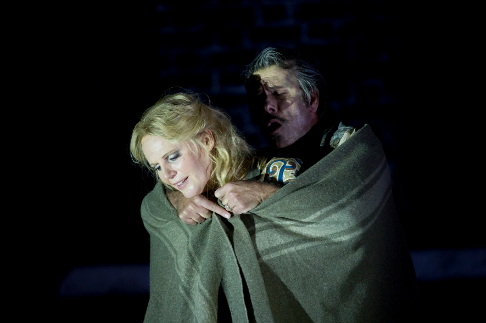 Lucio Gallo as Michele and Eva-Maria Westbroek as Giorgetta
Antonenko’s Luigi possessed a masculine swagger which was matched by a lustrous tone; together they conveyed his commitment both to revolutionary ideals and to human love. After a slightly over-blown opening, Antonenko relaxed and revealed his huge vocal capacity and glossy warmth. His affecting and appealing sound were complemented by confident, convincing acting.
Michele was sung by Lucio Gallo, whose slightly dry vocal timbre and physical rigidity successfully communicated his resignation and endurance, before stoicism was finally overwhelmed by self-destructive bitterness and frustration.
The set was effective cast by evocative shadows, literal and metaphorical, capturing the grey misery which will ensue for all the protagonists. Lighting designer, D.M. Wood, exploited similarly sombre shades in Suor Angelica, to convey a quieter loneliness; while in Gianni Schicchi contrasting flashes of brightness and darkness suggested the deceitful twists and turns of the plotting relatives.
Suor Angelica presents another enclosed world, but here the desire to escape is not represented by an aspiration to return to the bright lights of Paris in search of earthly pleasures, but rather by a longing to transcend earthly preoccupations and discover eternal salvation and bliss. The Catholic message perhaps has little resonance with many modern opera-goers and Jones has made a brilliant decision to replace religious institutionalism with secular rituals, to dispense with convents and cloisters in favour of the hospital ward of a children’s hospital, the nuns exchanging their habits for the uniforms of a nursing order. The re-location is inspired, and wonderfully realised in Miriam Buether’s arresting set.
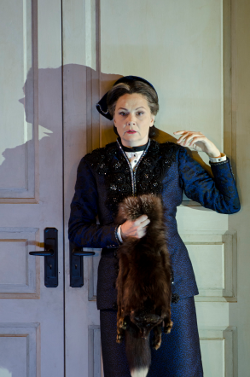 Anna Larsson as The Princess
In the title role, Albanian Ermonela Jaho, making her debut in the role after replacing German soprano Anja Harteros at short notice, did not always surmount the rich orchestral fabric, but her sound is attractive, and she often attained the requisite long-phrased melodicism.
In the libretto, recognising that her decision to commit suicide is a mortal sin, Angelica is overcome with guilt and prays for salvation; she is rewarded with a redemptive final vision of the Virgin Mary and her son, before she dies, presumably transfigured. Jones replaces this spiritual vision with a more mundane one: immobile, Angelica stares piercingly, transfixed by one of the young boys she has been nursing, a painful reminder of her own loss and culpability. Some critics have accused Puccini’s religious apotheosis of vulgarity and tastelessness, but in Jones’ hands, any sense of kitsch Catholicism is transformed into a tragic realism more commonly associated with Il Tabarro. If Jaho tired slightly towards the close, this only served to emphasise that any notion of transfiguration is, in Jones’ eyes, delusory.
As Angelica’s harridan aunt, The Princess, Anna Larsson was suitably haughty and viciously Machiavellian. The scene in which she compels Angelica to acknowledge her shame (she has given birth to a child outside marriage), not to save her niece’s soul but to manipulate her into signing away her inheritance, was chillingly cruel; most effective too was the way in Buether re-configures the set, creating a separate corridor for the desolate struggle between the two women.
Upon learning of her son’s death, Jaho delivers her aria, ‘Senza mamma’, with disturbing concentration, although her physical trembling, while painfully affecting, did result in an unfortunately exaggerated vibrato.
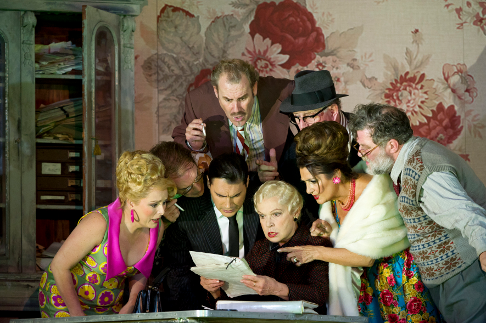 From Left To Right - Rebecca Evans as Nella, Alan Oke as Gherardo, Francesco Demuro as Rinuccio, Robert Poulton as Marco, Elena Zilio as Zita, Gwynne Howell as Simone, Marie Mclaughlin as La Ciesca and Jeremy White as Betto Di Signa
Anna Devin, a Jette Parker Young Artist, had a busy evening, impressing in all three roles. Highly competent as Sister Genovieffa, and as one of the Lovers in Il Tabarro, she subsequently stood in for indisposed the Ekaterina Siurina as Lauretta in Gianni Schicchi. Elizabeth Woollett as the Nursing Sister and Eryl Royle (Sister Osmina) also pleased.
Pappano grasped the way in which the ritualistic repetitions of the score accrue emotional meaning, building to a concentrated lyricism of escalating intensity. The ROH orchestra was the embodiment of instrumental refinement, particularly in the orchestral intermezzo.
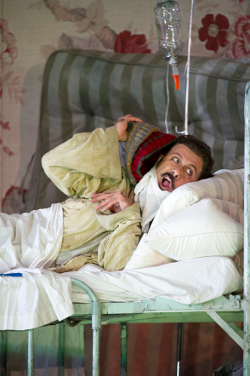 Lucio Gallo as Gianni Schicchi
However, the rushing chords which open Gianni Schicci — seen here in a revival of Jones’ 2007 staging — immediately swept aside the constrained ambience of the preceding opera, in a breathless dance of irony and wit.
For once Pappano perhaps didn’t quite always garner the requisite fleetness of foot but there was much zany zippiness, with visual humour provided by staging and costumes which recall the cardboard shabbiness of 1960s sit-com set.
The comic know-how of Gwynne Howells, returning to the role of Simone — one of the avaricious, grasping heirs of the declining Buoso Donati — provided some stability and focus among the comic capers. Rebecca Evans, making her debut in the role of Nella, relished the vulgarity of the role; while in the title role, Lucio Gallo seemed at times to find it hard to break free from the dark shadows of Il Tabarro, offering a sardonic but not ineffective interpretation.
Other strong performances came from Francesco Demuro, who demonstrated a fervent tone as Rinuccio — although in the set-piece, ‘Firenze è come un albero fiorito’ he perhaps tried a bit too hard — and Elena Zilio (Zita).
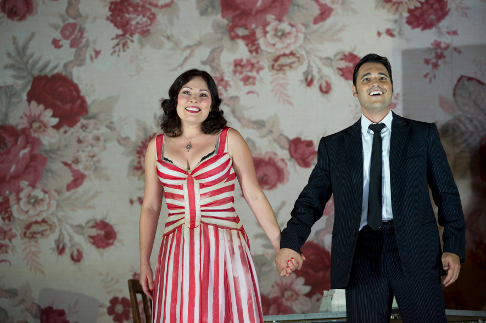 Ekaterina Siurina as Lauretta and Francesco Demuro as Rinuccio
So, is the whole triptych greater than the sum of its parts? In the final reckoning, it probably doesn’t matter either way: Jones and Pappano revealed the affective power of each of these three divergent and complementary works — no musical detail was overlooked, and each was made to cohere within an impressively paced whole, the varying spatial dimensions of each of the three operas perfectly judged. It truly was an evening when there was something for everyone.
Claire Seymour
Il Tabarro
Michele: Lucio Gallo; Giorgetta: Eva-Maria Westbroek; Luigi: Aleksandrs Antonenko; Tinca: Alan Oke; Talpa: Jeremy White; Frugola: Irina Mishura; Song Seller: Ji-Min Park; Lovers: Anna Devin, Robert Anthony Gardiner. Set Designs: Ultz. Costume Designs: Nicky Gillibrand. Lighting Design: D.M. Wood.
Suor Angelica
Monitress: Elena Zilio; Two Lay Sisters: Melissa Alder, Kate Mccarney; Mistress of the Novices: Elizabeth Sikora; Sister Lucilla: Anne Osborne; Sister Osmina: Eryl Royle; Sister Genovieffa: Anna Devin; Sister Angelica: Ermonela Jaho; Nursing Sister: Elizabeth Woollett; Two Alms Sisters: Gillian Webster, Kathleen Wilder; Abbess: Irina Mishura; The Princess: Anna Larsson. Set Designs: Miriam Beuther. Costume Designs: Nicky Gillibrand. Lighting Design: D.M. Wood.
Gianni Schicchi
Buoso Donati: Peter Curtis; Simone: Gwynne Howell; Zita: Elena Zilio; Rinuccio: Francesco Demuro; Betto di Signa: Jeremy White; Marco: Robert Poulton; La Ciesca: Marie McLaughlin; Gherado: Alan Oke; Nella: Rebecca Evans; Gerardino: Noah Scoffiedl; Gianni Schicchi: Lucio Gallo; Lauretta: Anna Devin; Maestro Spinelloccio: Henry Waddington; Ser Amantio di Nicolao: Enrico Fissore; Pinello: Daniel Grice; Guccio: John Molloy. Associate Director: Benjamin Davis. Set Designs: John Macfarlane. Costume Designs: Nicky Gillibrand. Original Lighting Design: Mimi Jordan Sherin. Revival Lighting Design: D.M. Wood.
Conductor: Antonio Pappano. Director: Richard Jones.