Subscribe to
Opera Today

Receive articles and news via RSS feeds or email subscription.


twitter_logo[1].gif


UCP_9780226043425.gif

Recently in Reviews

Domingo Conducts Holdridge’s New Opera Dulce Rosa

Dulce Rosa, a brand new opera, had its world premiere Friday night, May 17, 2013 at the Broad Stage in Santa Monica, California. It was produced by Los Angeles Opera, but staged in the smaller theater.

Verdi’s Falstaff at Glyndebourne

Richard Jones’ 2009 production of Verdi’s Falstaff translates the action from the first Elizabethan age to the start of the second.

Gareth John, Wigmore Hall

Baritone Gareth John is rapidly accumulating a war-chest of honours. Winner of the 2013 Kathleen Ferrier Award, he recently won the Royal Academy of Music Patrons’ Award and was presented the Silver Medal by the Worshipful Company of Musicians.

La bohème at ENO

This second revival of Jonathan Miller’s La bohème was the first time I had caught the production.

Rolando Villazón: Verdi (International Opera Stars Series 2013)

It’s Verdi’s bicentenary year and Rolando Villazón has two new CDs to plug — titled somewhat confusingly, ‘Villazón: Verdi’ and ‘Villazón’s Verdi’, the latter a ‘personal selection’ of favourite numbers performed by stars of the past and present.

Brahms Third in San Francisco

Nicola Luisotti and the San Francisco Opera Orchestra climbed out of the War Memorial pit, braved the wind whipped bay and held spellbound an audience at Cal Performances’ Zellerbach Auditorium at UC Berkeley.

Ariane et Barbe-Bleue on Blu-Ray

Paul Dukas’ Ariane et Barbe-Bleue, first heard in 1907, once seemed important. Arturo Toscanini conducted the Met premiere in 1911 with Farrar and later arranged some of its music for a 1947 recording with his NBC Symphony.

Glyndebourne: Ariadne auf Naxos

Utterly mad but absolutely right — Richard Strauss’s Ariadne auf Naxos started the Glyndebourne 2013 season with an explosion. Strauss could hardly have made his intentions more clear. Ariadne auf Naxos is not “about” Greek myth so much as a satire on art and the way art is made.

Wozzeck at ENO

“Man is an abyss. It makes one dizzy to look into it.” So utters Georg Büchner’s Woyzeck, repeating what was also a recurring motif in the playwright’s own letters.

Mulhouse: Rare Britten Well Done

National Opera Company of the Rhine has marked this year’s Benjamin Britten celebration with a remarkably compelling, often gripping new production of the seldom-seen Owen Wingrave.

Frankfurt's Intriguing Idomeneo

Once upon a time, Frankfurt Opera had the baddest ass reputation in Germany as “the” cutting edge producer of must-see opera.

Rigoletto at Lyric Opera of Chicago

Productions of Giuseppe Verdi’s Rigoletto can serve as a vehicle for individual singers to make a strong impression and become afterward associated with specific roles in the opera.

Britten Sinfonia with Ian Bostridge

Just in case we were not aware that the evening’s programme was ‘themed’, the Britten Sinfonia designed a visual accompaniment to their musical exploration of night, sleep and dreams.

Aida, Manitoba Opera

Poor Aida! She never seems to have anything go her way.

Superlative singing: Don Carlo, Royal Opera House

Is it possible to upstage Jonas Kaufmann? Kaufmann was brilliant in this Verdi Don Carlo at the Royal Opera House, London, but the rest of the cast was so good that he was but first among equals. Don Carlo is a vehicle for stars, but this time the stars were everyone on stage and in the pit. Even the solo arias, glorious as they are, grow organically out of perfect ensemble. This was a performance that brought out the true beauty of Verdi's music.

Sarah Connolly: French Song at Wigmore Hall

The big names were absent: Duparc, D’Indy, Debussy, Ravel … and while Fauré, Chausson, Roussel and several members of Les Six put in an appearance, in less than familiar guises, this survey of French song of the early 20th century and interwar years deliberately took us on a journey through infrequently travelled terrain.

Rare restoration: Handel’s Esther 1720

Composed between 1718 and 1720, Handel’s Esther is sometimes described as the ‘first English Oratorio’, but is in fact a hybrid form, mixing elements of oratorio, masque, pastoral and opera.

The Damnation of Faust, London

Hector Berlioz's légende dramatique, La Damnation de Faust, exists somewhere between cantata and opera. Berlioz's flexible attitude to dramatic form made the piece unworkable on the stages of early 19th century Paris and his music is so vivid that you wonder whether the piece needs staging at all.

Elizabeth Connell Memorial Concert, St John's Smith Square

St. John’s Smith Square was the site of Elizabeth Connell’s final London concert, intended as a farewell to London on her moving to Australia. It was rendered ultimately final by her unexpected death.

Aida with all the Trimmings, Even a Blue Silk Elephant!

With the building of the Suez Canal, Egypt became more interesting to Western Europeans. Khedive Ismail Pasha wanted a hymn by Verdi for the opening of a new opera house in Cairo, but the composer said he did not write occasional pieces.

OPERA TODAY ARCHIVES »

Reviews

Kim Sheehan as Livia and Nicholas Merryweather as Milord Arespingh [Picture(s) by Anthony Hall courtesy of Bampton Classical Opera]
21 Sep 2011

The Italian Girl in London, Bampton Classical Opera

As one of the most successful Italian opera composers of the late-eighteenth century, Domenico Cimarosa’s reputation lasted well into the following century during which his operas were staple repertoire in all the major European opera houses.

Domenico Cimarosa: The Italian Girl in London

Livia: Kim Sheehan; Madama Brillante: Caryl Hughes; Sumers: Adam Tunncliffe; Don Polidoro: Nicholas Merryweather; Milord Arespingh: Robert Winslade

Above: Kim Sheehan as Livia and Nicholas Merryweather as Milord Arespingh
All picture(s) by Anthony Hall courtesy of Bampton Classical Opera


Revered by artists and intellectuals, he was (according to an informative programme essay) considered by Delacroix to be superior to Mozart, while Stendhal asserted that his genius was equal to that of Raphael!

Nowadays, Cimarosa is best known primarily for his comic masterpiece, Il matrimonio segreto (The Secret Marriage). However, once again Bampton Classical Opera have delved into the archives and located another melodious, charming gem richly deserving of a wider audience.

Covering a single day during a time of war, and set in a London hotel, The Italian Girl in London is a typically daft buffa tale of muddle, misunderstanding and mayhem. Resident are an eclectic bunch of Europeans: an eminently sensible, if self-righteous, Dutchman, Sumers; Don Polidoro, an ardent Italian; and the morose English aristocrat, Milord Arespingh — their needs catered for by the émigré Italian hostess, Madama Brillante, assisted by her French waitress, Henriette. The foreign visitors find English manners and customs baffling, but despite their national differences, all three men are equally entranced by the captivating Henriette. In fact, ‘Henriette’ is actually Livia — formerly affianced to, and jilted by, Milord, who has been ordered by his father to marry the ghastly Diana. Polidoro is the object of Madama’s own amorous attentions, but she is determined to embarrass him for his infatuation with Livia. So, she explains that the girl can make herself invisible using a magic bloodstone, and tricks him into making amorous advances to thin air. Meanwhile, Sumers has learned of Milord’s forthcoming marriage and resolves to protect Livia from the inappropriate attentions of others. The protagonists lurch from one melodrama to the next: the deluded Polidoro searches for his own bloodstone in order to advance his courtship with Livia; driven to despair by thoughts of a life with Diana, Milord demands that the Italian spares him his fate by running him through with a sword; Livia is arrested (a ruse intended by her father to prevent her running away from home), before the chivalrous Sumers comes to her rescue. Inevitably, there is a sentimental resolution to the pandemonium: the puzzles are solved, the disorder dispelled, and both lovers and nations celebrate peaceful reconciliations.

Following fully staged performances earlier this season at Bampton, Westonbirt and at the Buxton Festival, Bampton Classical Opera presented the opera at St. John’s Smith Square with only costumes and minimal props to recreate the Victory Bar at the down-at-heel ‘Nelson Hotel’; a Rubik Cube (which fascinates but defeats the dim-witted Milord) and a rack of Charles & Di postcards serve to establish the year, 1982. At Buxton sets and staging were wittily deployed to complement the entertaining translation by Jeremy Gray and Gilly French, and this visual humour was missed, especially in the barmy finale to Act 1. Perhaps some side flats would have helped, but, although the stage business was necessarily quite limited given the restrictions of the St. John’s performing space, the young cast did succeed in conjuring up a frothy, sunny atmosphere — although the nautical cutlasses were more anachronistic when drawn from the umbrella stand than they had been when plucked from a wall display of maritime memorabilia!
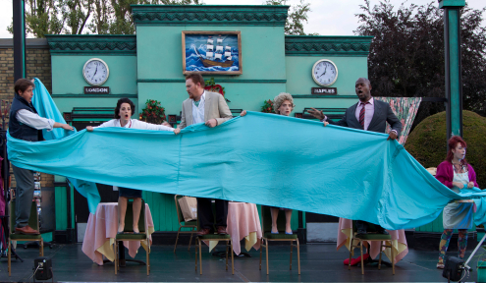
_MG_9513.pngThe finale of Act I

Although the commedia dell’arte stereotypes are rather two-dimensional, focused acting from the whole cast quickly established strong characterisation: Nicholas Merryweather demonstrated a typically sharp appreciation of comic timing and gesture, and Adam Tunncliffe made much of the rather ‘flat’ role of Sumers, engaging the audience’s attention effectively in well-acted, focused recitatives. He demonstrated a flexible, pleasing tenor as he introduced a much-needed touch of sobriety into the inane proceedings. Even the silent roles — Rosa French, as the hotel’s gum-chewing maid, and director Jeremy Gray, attempting to restore order with his police officer’s hand-cuffs — contributed considerably to the capers and drolleries.

The singers enjoyed Cimarosa’s graceful, shapely vocal lines; while there is little flamboyant coloratura, the well-crafted phrases do allow for textual clarity, and diction was uniformly clear. Merryweather excelled in this regard; moreover, he charmingly varied his tone to indicate the passionate Italian’s whims and wiles — his crafty whispered asides, with perfect intonation and crisp enunciation, were particularly impressive. As a poised and dignified Livia, Irish soprano Kim Sheehan produced a pleasing round tone, never strident at the top, and conveyed tender pathos when destined for imprisonment.

Bass Robert Winslade Anderson (Milord) seemed a little hesitant at first, and on occasion strayed from conductor Thomas Blunt’s beat, but to be fair, placed in front of the orchestra and without a monitor to aid them, all the cast had to work hard in this regard. And, in an explosive jealous outburst in his Act 2 aria, Anderson presented a confident portrait of blustering pomposity, making excellent use of the text to develop characterisation. As the knowing, worldly Madama Brillante, Caryl Hughes’ Act 2 cavatina was particularly lively and bright.

Placed centrally on raked staging behind the singers, Bampton Classical Orchestra delivered a neat, precise performance, understated and accurate, never overwhelming the young voices. Textures were elegant, articulation appropriately nimble, and Charlotte Forrest’s continuo accompaniments were elegantly decorative. Blunt judged the tempi well, particularly in the galloping Act-finales; after a series of solo arias he confidently led cast and players as the momentum accumulated towards the cheerful, buoyant conclusion.

Claire Seymour

Send to a friend

Send a link to this article to a friend with an optional message.

Friend's Email Address: (required)

Your Email Address: (required)

Message (optional):