12 Oct 2011
Britten’s War Requiem, London
‘Requiescant in pace. Amen.’
English Touring Opera are delighted to announce a season of lyric monodramas to tour nationally from October to December. The season features music for solo singer and piano by Argento, Britten, Tippett and Shostakovich with a bold and inventive approach to making opera during social distancing.
This tenth of ten Live from London concerts was in fact a recorded live performance from California. It was no less enjoyable for that, and it was also uplifting to learn that this wasn’t in fact the ‘last’ LfL event that we will be able to enjoy, courtesy of VOCES8 and their fellow vocal ensembles (more below …).
Ever since Wigmore Hall announced their superb series of autumn concerts, all streamed live and available free of charge, I’d been looking forward to this song recital by Ian Bostridge and Imogen Cooper.
The Sixteen continues its exploration of Henry Purcell’s Welcome Songs for Charles II. As with Robert King’s pioneering Purcell series begun over thirty years ago for Hyperion, Harry Christophers is recording two Welcome Songs per disc.
Although Stile Antico’s programme article for their Live from London recital introduced their selection from the many treasures of the English Renaissance in the context of the theological debates and upheavals of the Tudor and Elizabethan years, their performance was more evocative of private chamber music than of public liturgy.
In February this year, Albanian soprano Ermonela Jaho made a highly lauded debut recital at Wigmore Hall - a concert which both celebrated Opera Rara’s 50th anniversary and honoured the career of the Italian soprano Rosina Storchio (1872-1945), the star of verismo who created the title roles in Leoncavallo’s La bohème and Zazà, Mascagni’s Lodoletta and Puccini’s Madama Butterfly.
Evidently, face masks don’t stifle appreciative “Bravo!”s. And, reducing audience numbers doesn’t lower the volume of such acclamations. For, the audience at Wigmore Hall gave soprano Elizabeth Llewellyn and pianist Simon Lepper a greatly deserved warm reception and hearty response following this lunchtime recital of late-Romantic song.
Collapsology. Or, perhaps we should use the French word ‘Collapsologie’ because this is a transdisciplinary idea pretty much advocated by a series of French theorists - and apparently, mostly French theorists. It in essence focuses on the imminent collapse of modern society and all its layers - a series of escalating crises on a global scale: environmental, economic, geopolitical, governmental; the list is extensive.
For this week’s Live from London vocal recital we moved from the home of VOCES8, St Anne and St Agnes in the City of London, to Kings Place, where The Sixteen - who have been associate artists at the venue for some time - presented a programme of music and words bound together by the theme of ‘reflection’.
'Such is your divine Disposation that both you excellently understand, and royally entertaine the Exercise of Musicke.’
Amongst an avalanche of new Mahler recordings appearing at the moment (Das Lied von der Erde seems to be the most favoured, with three) this 1991 Mahler Second from the 2nd Kassel MahlerFest is one of the more interesting releases.
‘And there was war in heaven: Michael and his angels fought against the dragon; and the dragon fought and his angels, And prevailed not; neither was their place found any more in heaven … that old serpent … Satan, which deceiveth the whole world: he was cast out into the earth, and his angels were cast out with him.’
If there is one myth, it seems believed by some people today, that probably needs shattering it is that post-war recordings or performances of Wagner operas were always of exceptional quality. This 1949 Hamburg Tristan und Isolde is one of those recordings - though quite who is to blame for its many problems takes quite some unearthing.
There was never any doubt that the fifth of the twelve Met Stars Live in Concert broadcasts was going to be a palpably intense and vivid event, as well as a musically stunning and theatrically enervating experience.
‘Love’ was the theme for this Live from London performance by Apollo5. Given the complexity and diversity of that human emotion, and Apollo5’s reputation for versatility and diverse repertoire, ranging from Renaissance choral music to jazz, from contemporary classical works to popular song, it was no surprise that their programme spanned 500 years and several musical styles.
The Academy of St Martin in the Fields have titled their autumn series of eight concerts - which are taking place at 5pm and 7.30pm on two Saturdays each month at their home venue in Trafalgar Square, and being filmed for streaming the following Thursday - ‘re:connect’.
The London Symphony Orchestra opened their Autumn 2020 season with a homage to Oliver Knussen, who died at the age of 66 in July 2018. The programme traced a national musical lineage through the twentieth century, from Britten to Knussen, on to Mark-Anthony Turnage, and entwining the LSO and Rattle too.
With the Live from London digital vocal festival entering the second half of the series, the festival’s host, VOCES8, returned to their home at St Annes and St Agnes in the City of London to present a sequence of ‘Choral Dances’ - vocal music inspired by dance, embracing diverse genres from the Renaissance madrigal to swing jazz.
Just a few unison string wriggles from the opening of Mozart’s overture to Le nozze di Figaro are enough to make any opera-lover perch on the edge of their seat, in excited anticipation of the drama in music to come, so there could be no other curtain-raiser for this Gala Concert at the Royal Opera House, the latest instalment from ‘their House’ to ‘our houses’.
"Before the ending of the day, creator of all things, we pray that, with your accustomed mercy, you may watch over us."
‘Requiescant in pace. Amen.’
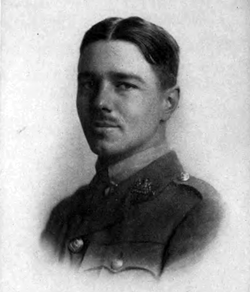
The final words of Benjamin Britten’s War Requiem are words of peace and hope, but recent and on-going conflicts in Rwanda, Liberia, Iraq, Afghanistan and Libya suggest that although almost fifty years have passed since the work was first performed, to celebrate the rebuilding and re-consecration in May 1962 of the bomb-blasted Coventry Cathedral, the sentiments of Wilfred Owen, voiced in the epigraph, have lost none of their impact or relevance: “My subject is War, and the pity of War. The Poetry is in the pity. All a poet can do today is warn.”
Much of the power of the work lies in its innate contrasts. Owen’s dark, distressing war poems form a counterpoint to the consolations of the requiem mass, and the interweaving of secular and sacred, vernacular and Vulgate, is often challenging, surprising and deeply ironic. A resonant, full orchestral clamour contrasts with delicate, finely fashioned chamber sonorities; soloists and chorus intertwine and counterpoise. Brightness interrupts the darkness, and is then once more overwhelmed by horror and terror.
Conductor Gianandrea Noseda, deputising for the indisposed Sir Colin Davis, was ever alert to such contrasts. Thus, in the opening ‘Requiem aeternam’, the lustre of high trebles of Eltham College Choir – placed distantly, as Britten requested, in the gallery – thrillingly broke through the solemn, funereal tolling of the orchestral accompaniment; similarly, the gentle phrasing of the women’s voices in the choral ‘Recordare’ was abruptly and dramatically superseded by the energetic, bellicose assertions of the men’s ‘Confutatis maledictis’. Elsewhere, the very quietness was itself imbued with ominous, discomforting resonances: the whispered conclusion to the fugal ‘Quam olim Abrahae’, following the terror of the lines, ‘the old man would not so, but slew his son, – And half the seed of Europe one by one’, was spine-chilling. Throughout the London Symphony Chorus were on fine form, enunciating the text clearly and attentive to all the significance musical details.
A cast of impressive soloists had been assembled. Ian Bostridge may have more than fifty performances of the War Requiem behind him but he is clearly not about to let any element of routine enter into his interpretation. In a recent interview he asked, “Which war, whose Requiem?” and his intense engagement with this question underpinned a remarkably committed performance, one which judiciously conveyed every nuance and inflection of the text. Never afraid to use the grain and catches of the voice to highlight the bitterness and ugliness expressed by Owen, Bostridge is totally attuned to the musical and poetic expression, uniting the power of both in his delivery. He produced a disturbing vehemence in ‘What passing bells for these who die as cattle?’ but created an exquisite, poised stillness in the ‘Agnus Dei’.
Baritone Simon Keenlyside was less overtly dramatic but he provided an effective base or grounding for the more extrovert tenor. Singing with sincerity and considerable beauty of tone, Keenlyside communicated authoritatively, especially in ‘Be slowly lifted up, thou long back arm’. In their duet passages, as the men sing with ironic cheerfulness of death, or chillingly relate the story of Abraham and Isaac, both singers displayed an admirable feeling for the text. Every word pulsed with meaning and import, especially in the final extract from Owen’s ‘Strange Meeting’.
The solo soprano is separated from the two male soloists, musically and textually, and here Slovenian Sabina Cvilak was spatially distanced too, placed in the choir. Singing the Latin text, ‘Liber scriptus’, which sets out day of judgement, Cvilak was perhaps a little too placid, not making full use of her undoubted rich tone, although the declamatory phrases of the ‘Sanctus’ were well-shaped and she displayed a pure tone and a well-supported pianissimo.
The players of the London Symphony Orchestra were on tremendous form, guided skilfully by Noseda who illuminated all the details of the score. Noseda’s control of the musico-dramatic form was exemplary and his galvanising of his forces in the big moments superb: thus the chilling distant fanfares which herald the outbreak of violent combat at the start of the ‘Dies Irae’ built to an explosive force. The full fury of the orchestral forces were sparingly employed and the turbulent outbursts perfectly judged, as in the frighteningly precipitous ‘Libera me’ in which the stifled percussion eventually detonated in a terrifying climax with the entry of the organ. In contrast, Noseda paced the more grave moments with controlled deliberation. The chamber ensemble which virtuosically accompanies the songs sensitively supported the intimate drama and dialogue of Owen’s verses.
In a recent essay in the Guardian newspaper, Bostridge wrote that, “The War Requiem is a masterpiece of the deepest emotional and moral depth. It is also an enormous contraption of musical ingenuity”. This was a purposeful and impressively crafted performance, one which powerfully expounded the human truths and elemental emotions exposed by Britten and by Owen; time does not lessen their importance or impact.
Claire Seymour