![Rinat Shaham as Carmen and David Pomeroy as Don Jose [Photo by Kelly & Massa Photography courtesy of Opera Company of Philadelphia]](http://www.operatoday.com/fullres_2011_09_28_KM1475.gif)
07 Oct 2011
Carmen, Philadelphia
There are two ways to sing the role of Carmen: as a “grand opera” heroine and as a character from opéra-comique.
English Touring Opera are delighted to announce a season of lyric monodramas to tour nationally from October to December. The season features music for solo singer and piano by Argento, Britten, Tippett and Shostakovich with a bold and inventive approach to making opera during social distancing.
This tenth of ten Live from London concerts was in fact a recorded live performance from California. It was no less enjoyable for that, and it was also uplifting to learn that this wasn’t in fact the ‘last’ LfL event that we will be able to enjoy, courtesy of VOCES8 and their fellow vocal ensembles (more below …).
Ever since Wigmore Hall announced their superb series of autumn concerts, all streamed live and available free of charge, I’d been looking forward to this song recital by Ian Bostridge and Imogen Cooper.
The Sixteen continues its exploration of Henry Purcell’s Welcome Songs for Charles II. As with Robert King’s pioneering Purcell series begun over thirty years ago for Hyperion, Harry Christophers is recording two Welcome Songs per disc.
Although Stile Antico’s programme article for their Live from London recital introduced their selection from the many treasures of the English Renaissance in the context of the theological debates and upheavals of the Tudor and Elizabethan years, their performance was more evocative of private chamber music than of public liturgy.
In February this year, Albanian soprano Ermonela Jaho made a highly lauded debut recital at Wigmore Hall - a concert which both celebrated Opera Rara’s 50th anniversary and honoured the career of the Italian soprano Rosina Storchio (1872-1945), the star of verismo who created the title roles in Leoncavallo’s La bohème and Zazà, Mascagni’s Lodoletta and Puccini’s Madama Butterfly.
Evidently, face masks don’t stifle appreciative “Bravo!”s. And, reducing audience numbers doesn’t lower the volume of such acclamations. For, the audience at Wigmore Hall gave soprano Elizabeth Llewellyn and pianist Simon Lepper a greatly deserved warm reception and hearty response following this lunchtime recital of late-Romantic song.
Collapsology. Or, perhaps we should use the French word ‘Collapsologie’ because this is a transdisciplinary idea pretty much advocated by a series of French theorists - and apparently, mostly French theorists. It in essence focuses on the imminent collapse of modern society and all its layers - a series of escalating crises on a global scale: environmental, economic, geopolitical, governmental; the list is extensive.
For this week’s Live from London vocal recital we moved from the home of VOCES8, St Anne and St Agnes in the City of London, to Kings Place, where The Sixteen - who have been associate artists at the venue for some time - presented a programme of music and words bound together by the theme of ‘reflection’.
'Such is your divine Disposation that both you excellently understand, and royally entertaine the Exercise of Musicke.’
Amongst an avalanche of new Mahler recordings appearing at the moment (Das Lied von der Erde seems to be the most favoured, with three) this 1991 Mahler Second from the 2nd Kassel MahlerFest is one of the more interesting releases.
‘And there was war in heaven: Michael and his angels fought against the dragon; and the dragon fought and his angels, And prevailed not; neither was their place found any more in heaven … that old serpent … Satan, which deceiveth the whole world: he was cast out into the earth, and his angels were cast out with him.’
If there is one myth, it seems believed by some people today, that probably needs shattering it is that post-war recordings or performances of Wagner operas were always of exceptional quality. This 1949 Hamburg Tristan und Isolde is one of those recordings - though quite who is to blame for its many problems takes quite some unearthing.
There was never any doubt that the fifth of the twelve Met Stars Live in Concert broadcasts was going to be a palpably intense and vivid event, as well as a musically stunning and theatrically enervating experience.
‘Love’ was the theme for this Live from London performance by Apollo5. Given the complexity and diversity of that human emotion, and Apollo5’s reputation for versatility and diverse repertoire, ranging from Renaissance choral music to jazz, from contemporary classical works to popular song, it was no surprise that their programme spanned 500 years and several musical styles.
The Academy of St Martin in the Fields have titled their autumn series of eight concerts - which are taking place at 5pm and 7.30pm on two Saturdays each month at their home venue in Trafalgar Square, and being filmed for streaming the following Thursday - ‘re:connect’.
The London Symphony Orchestra opened their Autumn 2020 season with a homage to Oliver Knussen, who died at the age of 66 in July 2018. The programme traced a national musical lineage through the twentieth century, from Britten to Knussen, on to Mark-Anthony Turnage, and entwining the LSO and Rattle too.
With the Live from London digital vocal festival entering the second half of the series, the festival’s host, VOCES8, returned to their home at St Annes and St Agnes in the City of London to present a sequence of ‘Choral Dances’ - vocal music inspired by dance, embracing diverse genres from the Renaissance madrigal to swing jazz.
Just a few unison string wriggles from the opening of Mozart’s overture to Le nozze di Figaro are enough to make any opera-lover perch on the edge of their seat, in excited anticipation of the drama in music to come, so there could be no other curtain-raiser for this Gala Concert at the Royal Opera House, the latest instalment from ‘their House’ to ‘our houses’.
"Before the ending of the day, creator of all things, we pray that, with your accustomed mercy, you may watch over us."
There are two ways to sing the role of Carmen: as a “grand opera” heroine and as a character from opéra-comique.
The grand opera version requires a voluptuous dramatic mezzo voice with a menacing flash of steel and booming chest tones. This musical style lends itself to a dramatic portrayal of the gypsy as a dangerous, snarling man-eater—a tigress capable of drawing a knife on Don José, had he not drawn one on her first. In the end, this Carmen seeks to seduce us by overwhelming us. This ideal is approximated by Grace Bumbry, Maria Ewing, Marilyn Horne, and, though she is always unique, Maria Callas.
The second type of Carmen, which reflects Georges Bizet’s roots in the French opéra-comique, calls for a smaller, more lyrical voice with a gentler timbre, smooth projection, and precise attention to delicate inflections of language and line. On this view, the gypsy is not a tigress but (as the libretto says of love) a bird. This Carmen is less blatantly threatening than her dramatic twin, yet her flirtatious, exotic, distantly self-absorbed manner poses just as great a danger to our hearts. She seduces not by overpowering but by mesmerizing. This approach is taken by Victoria de los Angeles and Teresa Berganza.
Most who sing Carmen these days aspire to the dramatic ideal, but Rinat Shaham, Philadelphia’s choice, fits the lyric model. Shaham is a Haifa-born mezzo who trained at the local Curtis Institute, debuted with the company as Zerlina in 1994, and has sung the role of Carmen to acclaim in theaters across the world, notably Glyndebourne. Shaham’s voice is not enormous, but it is focused, possesses an attractive sheen, and is articulated very evenly top to bottom. She phrases with understatement, a virtue lamentably absent among modern-day Carmen’s. Some quieter moments were memorable: the interposed “L’amour” in the “Toreador Aria” comes to mind, as does the Act III (“card”) trio, which suits her lovely low notes and contemplative manner. With black curls, flashing eyes, and slender curves popping out of the corset all Carmen’s seem to wear these days, she cuts an alluring figure on stage—and on posters throughout Philadelphia.
The result was in many respects agreeable. Absent throughout, however, were musical-dramatic subtleties essential for a lyric portrayal of Bizet’s gypsy to aspire to artistic greatness: the delicate use of glissando, rubato, rhythmic accent, idiomatic diction, timbre and color, and phrasing through the line. The “Habanera” was deadened by breathiness and an unyielding tempo, whether the fault of the conductor or singer. Shaham seemed to focus in the “Seguidilla” more on movement than voice, concluding with a needlessly strident cry. In the final scene, Shaham did not—vocally speaking—push herself to the edge of either desperation or fatalism. Without the extra interpretive effort, the performance seemed much blander than this artist’s potential, let alone the very best historical counterparts.
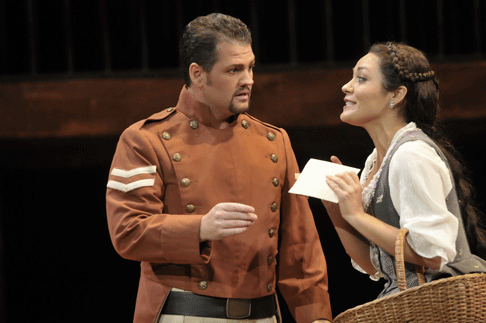 David Pomeroy as Don Jose and Ailyn Perez as Micaela
Ailyn Pérez, the young Academy of Vocal Arts-trained soprano, posed a striking contrast as Michaëla. Pérez’s voice, pleasant and precise if slightly metallic, is no match for Shaham’s. Moreover, the plot turns in part on the obvious fact that neither the personality or music of Michaëla, the nice god-fearing girl from the country, can match that of Carmen. Yet Pérez imbued every line with creative imagination, especially the famous aria, where subtle dynamics, precise diction and firm sense of the where it was all going conjured up the evening’s most memorable moments and greatest applause.
Canadian tenor David Pomeroy made a solid Don José. Though his voice lacks the ring, precision or the sweetness some bring to the part, he phrased with intelligence and precision, improving as the night went on, and he looks the part of a proud, if unimaginative, Basque. Another young Curtis alum, Jonathan Beyer, cut an imposing figure as Escamillo, though his voice, though well-produced, is a bit less grand—a problem in a part where one wants to be overpowered by testosterone. Well-trained if uneven young voices, mostly the products of local institutions, appeared in the smaller roles.
The conducting by Philadelphia’s music director, Bergamo-born Corrado Rovaris, displayed what I have come to think are his characteristic strengths and weaknesses. He imbues performances with energy. The music moves along, and achieves a certain excitement in hard-driving, straight-forward passages—as in the famous Prélude. Yet the result can sound unimaginative where the score calls for flexibility, ambiguity, or shifts in mood.
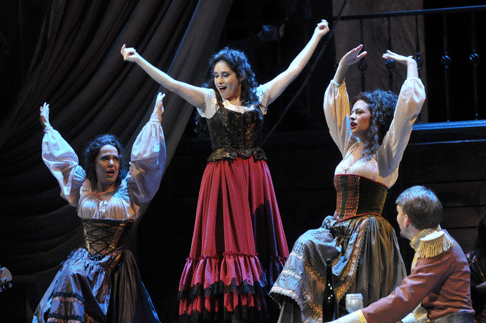 Rinat Shaham (center) as Carmen, Tammy Coil (left) as Mercedes and Greta Ball (right) as Frasquita, with Jeremy Milner as Zuniga
Visually, the production by Allen Charles Klein cleaves to a formula that has helped to make opera in Philadelphia popular and financially solvent: a grand unit set in traditional style, accessorized for each act with different props, costumes, and lighting—the latter sometimes tending toward slightly garish blues and oranges, courtesy of Drew Billiau. Outside of Act I, none of this adds much atmosphere or insight, but the audience seems to enjoy it. The stage direction, by David Gately, follows the formulas of previous productions, but enlivens them with a few fine touches: several suggestions of Carmen as a caged animal and liberty with the libretto, whereby she never finds the second-act castanets, dancing the duet instead with the (usually discarded) pieces of cracked plate.
Andrew Moravcsik