![Lucas Meacham as Don Giovanni [Photo by Cory Weaver courtesy of San Francisco Opera]](http://www.operatoday.com/DG--Don.gif)
26 Oct 2011
Don Giovanni in San Francisco
Ossia Maestro Watching in Fog City. Ten years ago it was German provincialism, now it is the Italian sort wanting to take root in the War Memorial Opera House.
English Touring Opera are delighted to announce a season of lyric monodramas to tour nationally from October to December. The season features music for solo singer and piano by Argento, Britten, Tippett and Shostakovich with a bold and inventive approach to making opera during social distancing.
This tenth of ten Live from London concerts was in fact a recorded live performance from California. It was no less enjoyable for that, and it was also uplifting to learn that this wasn’t in fact the ‘last’ LfL event that we will be able to enjoy, courtesy of VOCES8 and their fellow vocal ensembles (more below …).
Ever since Wigmore Hall announced their superb series of autumn concerts, all streamed live and available free of charge, I’d been looking forward to this song recital by Ian Bostridge and Imogen Cooper.
Although Stile Antico’s programme article for their Live from London recital introduced their selection from the many treasures of the English Renaissance in the context of the theological debates and upheavals of the Tudor and Elizabethan years, their performance was more evocative of private chamber music than of public liturgy.
Evidently, face masks don’t stifle appreciative “Bravo!”s. And, reducing audience numbers doesn’t lower the volume of such acclamations. For, the audience at Wigmore Hall gave soprano Elizabeth Llewellyn and pianist Simon Lepper a greatly deserved warm reception and hearty response following this lunchtime recital of late-Romantic song.
For this week’s Live from London vocal recital we moved from the home of VOCES8, St Anne and St Agnes in the City of London, to Kings Place, where The Sixteen - who have been associate artists at the venue for some time - presented a programme of music and words bound together by the theme of ‘reflection’.
'Such is your divine Disposation that both you excellently understand, and royally entertaine the Exercise of Musicke.’
‘And there was war in heaven: Michael and his angels fought against the dragon; and the dragon fought and his angels, And prevailed not; neither was their place found any more in heaven … that old serpent … Satan, which deceiveth the whole world: he was cast out into the earth, and his angels were cast out with him.’
There was never any doubt that the fifth of the twelve Met Stars Live in Concert broadcasts was going to be a palpably intense and vivid event, as well as a musically stunning and theatrically enervating experience.
‘Love’ was the theme for this Live from London performance by Apollo5. Given the complexity and diversity of that human emotion, and Apollo5’s reputation for versatility and diverse repertoire, ranging from Renaissance choral music to jazz, from contemporary classical works to popular song, it was no surprise that their programme spanned 500 years and several musical styles.
The Academy of St Martin in the Fields have titled their autumn series of eight concerts - which are taking place at 5pm and 7.30pm on two Saturdays each month at their home venue in Trafalgar Square, and being filmed for streaming the following Thursday - ‘re:connect’.
The London Symphony Orchestra opened their Autumn 2020 season with a homage to Oliver Knussen, who died at the age of 66 in July 2018. The programme traced a national musical lineage through the twentieth century, from Britten to Knussen, on to Mark-Anthony Turnage, and entwining the LSO and Rattle too.
With the Live from London digital vocal festival entering the second half of the series, the festival’s host, VOCES8, returned to their home at St Annes and St Agnes in the City of London to present a sequence of ‘Choral Dances’ - vocal music inspired by dance, embracing diverse genres from the Renaissance madrigal to swing jazz.
Just a few unison string wriggles from the opening of Mozart’s overture to Le nozze di Figaro are enough to make any opera-lover perch on the edge of their seat, in excited anticipation of the drama in music to come, so there could be no other curtain-raiser for this Gala Concert at the Royal Opera House, the latest instalment from ‘their House’ to ‘our houses’.
"Before the ending of the day, creator of all things, we pray that, with your accustomed mercy, you may watch over us."
The doors at The Metropolitan Opera will not open to live audiences until 2021 at the earliest, and the likelihood of normal operatic life resuming in cities around the world looks but a distant dream at present. But, while we may not be invited from our homes into the opera house for some time yet, with its free daily screenings of past productions and its pay-per-view Met Stars Live in Concert series, the Met continues to bring opera into our homes.
Music-making at this year’s Grange Festival Opera may have fallen silent in June and July, but the country house and extensive grounds of The Grange provided an ideal setting for a weekend of twelve specially conceived ‘promenade’ performances encompassing music and dance.
There’s a “slide of harmony” and “all the bones leave your body at that moment and you collapse to the floor, it’s so extraordinary.”
“Music for a while, shall all your cares beguile.”
The hum of bees rising from myriad scented blooms; gentle strains of birdsong; the cheerful chatter of picnickers beside a still lake; decorous thwacks of leather on willow; song and music floating through the warm evening air.
Ossia Maestro Watching in Fog City. Ten years ago it was German provincialism, now it is the Italian sort wanting to take root in the War Memorial Opera House.
San Francisco Opera unveiled a new Don Giovanni just now in nearly direct competition with the new Giovanni from the Met (you can see it soon on Live in HD). Of course the Met has avoided an American take on this old story as well, preferring to impose still more British artistic imperialism on Americans.
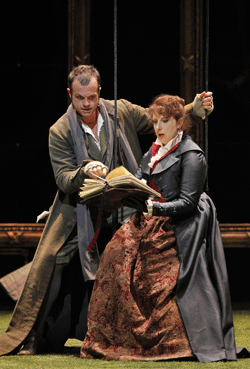 Marco Vinco as Leporello and Serena Farnocchia as Donna Elvira
The SFO Giovanni is all about egoism, and we are not talking just about the libidinous Don. We are of course talking about SFO music director Nicola Luisotti. Like the Don, this maestro is much larger than life, and equally astonishing in his powers. But the Luisotti Don Giovanni is not about sex as it is for most stage directors, it is about how Luisotti can take you to the brink of lyric orgasm and hold you there longer than maybe you ever thought possible.
Of course the maestro did need some collaborators to support his lyric blowout, specifically a general director willing to suspend artistic judgement and engage a stage director who is at home on secondary Italian stages where standards are parochial to say the least. One Gabriele Lavia was Luisotti’s collaborator for his Salome in Bologna shortly after the San Francisco one (if in Bologna it was orchestrally more brilliant the staging was even cornier than in San Francisco).
The comedy of Mozart’s sublime tragicommedia in San Francisco was watching Sig. Lavia keep the maestro’s singers on a plain about 4 feet wide across the stage apron where no one could escape the maestro’s thrall. And still tell the story. It sometimes worked, sort of, belying the not-too-distant link of Mozartian dramaturgy to the linear and static placement of singers for Baroque opera seria.
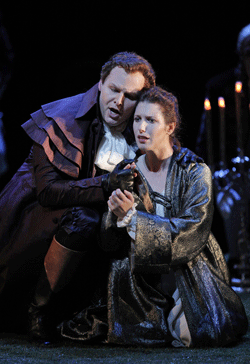 Shawn Mathey as Don Ottavio and Ellie Dehn as Donna Anna
General Director Gockley as well engaged a small scale, very Italiate diva, the splendid Serena Farnocchia whose bright lyric voice is on the small side for Donna Elvira, and light enough to negotiate, almost, Elvira’s very difficult music at the speed of light. The maestro succeeded in upstaging Sig.ra Farnocchia’s “Mi tradi” with a hyper emotional orchestral accompaniment to its recit (grotesque heaving).
Donna Anna was the American soprano Ellie Dehn who had made little impression as the Figaro Countess last fall. But she glowed vocally as a retiring Donna Anna, her just ample enough voice blended perfectly in ensembles, having shown with hanging beauty and fine musicianship in her first act aria "Or sai chi l'onore.” American tenor Shawn Mathey was Don Ottavio, but not the usual impotent one. Turning the tables he was the singer with the coglioni rather than the usual Giovanni heroines. Both Don Ottavio arias were blockbusters, exposing forceful, detached tones in quick passages and fioratura, and letting tone and feeling explode in lyric passages. Both Ms. Dehn and Mr. Mathey managed a synergy with the maestro to sublime effect.
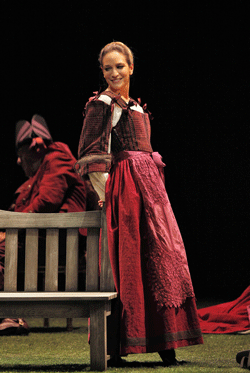 Kate Lindsey as Zerlina
Ignoring all potential complexities of relationship to his master, Italian bass Marco Vinco made Leporello a cute, almost expendable character, needed but not wanted. Though he, like most all Leporellos earned the biggest ovation. Like Leporello, Zerlina and Masetto were needed only for the maestro’s beautifully wrought ensembles, but not much more. Zerlina was ably and musically sung by Kate Lindsey, Adler Fellow Ryan Kuster made a cute Masetto.
San Francisco regular, bass baritone Lucas Meachem filled the shoes of Don Giovanni with aplomb and even charm. Mozart did not endow his most loved character with arias of consequence, and a stage director must dig way beneath the surface to intuit any complexity of personality, obviously not the scope of this production. But the Don is always big, and he lets it all hang out in his explosion at the end of the first act. Needless to say this was the meat of the maestro who turned it into an absolute frenzy. Mr. Meachem could not possibly compete, though he gave it a good try. The real Don would have thrown this maestro the very graphic up-yours gesture and walked off the stage.
From the downbeat of the overture Mo. Luisotti stated that this Mozart opera was an orchestral and musical process, its very sound groaning with importance, reminding us that the maestro has made his orchestra into one of the world’s fine pit ensembles. The beginning foretold the absolutely literal ending with the Commendatore, ably delivered by bass Morris Robinson, wreaking his vengeance on the Don in gigantic symphonic terms. We discovered last fall that after the maestro’s over-the-top musical dénouement in The Marriage of Figaro that he could not touch the quiet Mozartian humanity that ends Figaro. And here he does not even look for Mozart’s humanity, ending Giovanni with the Don’s noisy descent into hell rather than letting the quietly splendid Prague sextet wipe up the mess.
It was a fun evening. However Mozart and San Francisco might equally enjoy a bit of operatic integrity.
Michael Milenski