![Egils Silins as Der Holländer and Anja Kampe as Senta [Photo by Mike Hoban courtesy of The Royal Opera House]](http://www.operatoday.com/Dutchman_ROH_03.gif)
24 Oct 2011
Der fliegende Holländer, Royal Opera
Wagner’s Flying Dutchman returns to the Royal Opera House, London.
English Touring Opera are delighted to announce a season of lyric monodramas to tour nationally from October to December. The season features music for solo singer and piano by Argento, Britten, Tippett and Shostakovich with a bold and inventive approach to making opera during social distancing.
This tenth of ten Live from London concerts was in fact a recorded live performance from California. It was no less enjoyable for that, and it was also uplifting to learn that this wasn’t in fact the ‘last’ LfL event that we will be able to enjoy, courtesy of VOCES8 and their fellow vocal ensembles (more below …).
Ever since Wigmore Hall announced their superb series of autumn concerts, all streamed live and available free of charge, I’d been looking forward to this song recital by Ian Bostridge and Imogen Cooper.
Although Stile Antico’s programme article for their Live from London recital introduced their selection from the many treasures of the English Renaissance in the context of the theological debates and upheavals of the Tudor and Elizabethan years, their performance was more evocative of private chamber music than of public liturgy.
Evidently, face masks don’t stifle appreciative “Bravo!”s. And, reducing audience numbers doesn’t lower the volume of such acclamations. For, the audience at Wigmore Hall gave soprano Elizabeth Llewellyn and pianist Simon Lepper a greatly deserved warm reception and hearty response following this lunchtime recital of late-Romantic song.
For this week’s Live from London vocal recital we moved from the home of VOCES8, St Anne and St Agnes in the City of London, to Kings Place, where The Sixteen - who have been associate artists at the venue for some time - presented a programme of music and words bound together by the theme of ‘reflection’.
'Such is your divine Disposation that both you excellently understand, and royally entertaine the Exercise of Musicke.’
‘And there was war in heaven: Michael and his angels fought against the dragon; and the dragon fought and his angels, And prevailed not; neither was their place found any more in heaven … that old serpent … Satan, which deceiveth the whole world: he was cast out into the earth, and his angels were cast out with him.’
There was never any doubt that the fifth of the twelve Met Stars Live in Concert broadcasts was going to be a palpably intense and vivid event, as well as a musically stunning and theatrically enervating experience.
‘Love’ was the theme for this Live from London performance by Apollo5. Given the complexity and diversity of that human emotion, and Apollo5’s reputation for versatility and diverse repertoire, ranging from Renaissance choral music to jazz, from contemporary classical works to popular song, it was no surprise that their programme spanned 500 years and several musical styles.
The Academy of St Martin in the Fields have titled their autumn series of eight concerts - which are taking place at 5pm and 7.30pm on two Saturdays each month at their home venue in Trafalgar Square, and being filmed for streaming the following Thursday - ‘re:connect’.
The London Symphony Orchestra opened their Autumn 2020 season with a homage to Oliver Knussen, who died at the age of 66 in July 2018. The programme traced a national musical lineage through the twentieth century, from Britten to Knussen, on to Mark-Anthony Turnage, and entwining the LSO and Rattle too.
With the Live from London digital vocal festival entering the second half of the series, the festival’s host, VOCES8, returned to their home at St Annes and St Agnes in the City of London to present a sequence of ‘Choral Dances’ - vocal music inspired by dance, embracing diverse genres from the Renaissance madrigal to swing jazz.
Just a few unison string wriggles from the opening of Mozart’s overture to Le nozze di Figaro are enough to make any opera-lover perch on the edge of their seat, in excited anticipation of the drama in music to come, so there could be no other curtain-raiser for this Gala Concert at the Royal Opera House, the latest instalment from ‘their House’ to ‘our houses’.
"Before the ending of the day, creator of all things, we pray that, with your accustomed mercy, you may watch over us."
The doors at The Metropolitan Opera will not open to live audiences until 2021 at the earliest, and the likelihood of normal operatic life resuming in cities around the world looks but a distant dream at present. But, while we may not be invited from our homes into the opera house for some time yet, with its free daily screenings of past productions and its pay-per-view Met Stars Live in Concert series, the Met continues to bring opera into our homes.
Music-making at this year’s Grange Festival Opera may have fallen silent in June and July, but the country house and extensive grounds of The Grange provided an ideal setting for a weekend of twelve specially conceived ‘promenade’ performances encompassing music and dance.
There’s a “slide of harmony” and “all the bones leave your body at that moment and you collapse to the floor, it’s so extraordinary.”
“Music for a while, shall all your cares beguile.”
The hum of bees rising from myriad scented blooms; gentle strains of birdsong; the cheerful chatter of picnickers beside a still lake; decorous thwacks of leather on willow; song and music floating through the warm evening air.
Wagner’s Flying Dutchman returns to the Royal Opera House, London.
When this production of Wagner’s Der fliegende Holländer premiered at the Royal Opera House in February 2009, (review here), Bryn Terfel was its raison d’être. His absence was sorely felt, even by those who aren’t usually seduced by his charms. In this revival, the draw was Jeffrey Tate’s return to Covent Garden after nearly 20 years.
Minimal stagings can work when they highlight meaning and music. Tim Albery’s production (designed by Michael Levine) is a blank canvas, which styles The Flying Dutchman rather than suggests much about who he is. No portrait of any kind in sight. Instead, a toy boat. The boat itself is wonderfully staged, and it’s a masterstroke to see real water on stage, lit so its reflection shines magically into the auditorium. But it doesn’t convey the wildness of the open ocean, nor the turbulent psychic storm around which this opera predicates.
Perhaps Albery’s interpretation is that the opera predicates on Senta and her frustratons, the Dutchman being a projection of her fantasies. Anja Kempe’s Senta was extremely impressive in 2009. Then, she was a perfect foil to Terfel’s solid, taciturn Dutchman. Kempe’s energy created Senta as driven to extremes to escape what to her might have seemed mind numbing conformity. The Dutchman is her ticket out of town, rather than a cursed soul. It’s a valid interpretation, given Albery’s factory staging of the spinning scene, and marginal references to the haunted ship. The concept is worth exploring, though here it’s rather too simplistic. Senta’s not Tosca. Wildness is tricky to sing into this part, and occasionally Kempe relied more on forcefulness than finesse. Nonetheless, she can do it well, and should settle further into the run.
Egils Silins was a late replacement for Falk Struckmann as The Dutchman. This was his Covent Garden debut, and possibly his highest profile performance to date. Although his voice isn’t particularly distinctive, he’s secure vocally and does seem to have a feel for the part. In a production where the singer has more to work with and is less exposed, he’d make a bigger impact. Part of this stems from Albery’s approach, where the Dutchman is reduced to little more than Senta’s dreams. It takes an unusually powerful and charismatic singer to counterbalance these limitations.
Stephen Milling’s Daland was forcefully secure, even too noble, given that the character has an unpleasant streak of venality, which would work well in Albery’s concept, but wasn’t developed. Still, it’s enough that he sang well. Endrik Wottrich’s Erik had problems with pitch and intonation, but was reasonably well acted. Clare Shearer’s Mary was excellent — no fault of hers that the role here was a cipher.
The role of Steersman is much bigger, and critical to the plot, for the Steersman is guides the ship into the distance. Both Senta and the Steersman dream, but Senta can’t think past the present. John Tessier has to sing suspended up a rope ladder, but hasn’t quite the character to make the part as compelling as it might be. But then many productions don’t make enough of the role, and this production doesn’t, either. It’s odd, given Albery’s interest in images of conformity as the Steersman is part of the crew. As always, the Royal Opera House choruses sing and move perfectly. The vocal battle between the Dutchman’s crew and Daland’s crew isn’t quite as horrific as it might be, but the “Steuermann, laß die Wacht!” refrain was sung with such jaunty zest that it left no doubt that these sailors and their families had no time for spooks and neurosis.
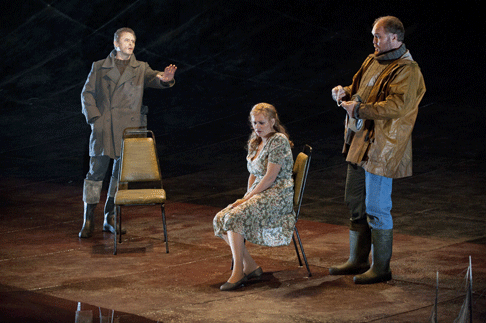 Egils Silins as Der Holländer, Anja Kampe as Senta and Stephen Milling as Daland
And so to Jeffrey Tate’s long awaited return to London. Fortunately Albery did not stage the protracted Overture, so we could concentrate on the orchestra. Tate’s pace was electric, injecting the malevolent atmosphere the staging tried so hard to suppress. The energy dissipated at other points, which was a kindness to the singers, who didn’t have to compete, and to Albery’s staging, which was so much at odds with the demonic, elemental fury in the music. When the Dutchman’s crew descend back into the bowels of their ship, Tate lets the orchestra burst forth again. They’re back on the ocean again, metaphorically defying storms and tribulations.
For more details, please see the Royal Opera House website.
Anne Ozorio