The Turn of the Screw and Heart of Darkness might
seem to belong in this category; but, as Britten so supremely demonstrated in
the case of Henry James’ novella, and Tarik O’Regan has skilfully
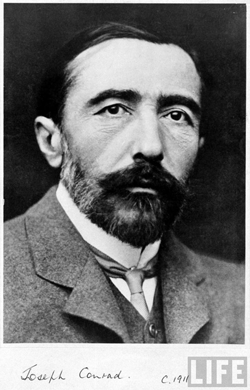
shown in this adaptation of Joseph Conrad’s tale of exploration,
obsession and morality, we would be wrong to make such assumptions. Indeed,
Conrad himself described the novella in musical terms in his 1917 Preface:
“… like another art altogether. That sombre theme had to be given
a sinister resonance, a tonality of its own, a continued vibration that, I
hoped, would hang in the air and dwell on the ear after the last note had been
struck.”
Echoes of Britten loom large in Tarek’s new opera, performed in the
Linbury Studio at the Royal Opera House by Opera East, directed inventively by
Edward Dick. The (almost) exclusively male cast, the ship-bound setting, the
exposure of dark, compelling psychological forces, the exploration of guilt and
silence, all recall Britten’s Billy Budd. Marlow’s
soul-searching self-interrogation parallels the moral dilemmas and regret of
Captain Vere. Similarly, O’Regan’s musical means — a fluent
melodic idiom which serves the text effectively and expressively, an eclectic
chamber instrumentation, the musical articulation and intimation of mysteries
and the ‘unknown’ — are reminiscent of Britten’s style
and techniques.
Drawing the economical but resonant text exclusively from Conrad’s own
words (both the novella and his diaries), librettist Tom Phillips has retained
the original device of relating events through a ‘frame’, as Marlow
reveals his history to his fellow seafarers as they wait aboard ship for a mist
to clear from the Thames and allow them to continue their homeward journey.
But, Phillips has also provided a second ‘frame’ to envelope the
first, in which Marlow visit’s Kurtz’s European fiancée, the
opening brief fragment remaining obscure until the meaning of Marlow’s
mysterious encounter is revealed at the close.
Robert Innes Hopkins’ stage designs and Rick Fisher’s lighting
skilfully allow for slick, convincing shift between times and locations, the
Thames estuary and the Central African interior. The predominantly darkened set
is occasionally illuminated or washed by a disturbing glow, as when, for
example, a luminous miasma hovers eerily and ominously above the stage. The
water-borne platform of the ship’s deck rolls and lurches to the lapping
rhythms of the river.
As was the case with The Turn of the Screw, O’Regan and
Phillips have had both to distil and clarify some of the ambiguities of the
literary text, to achieve a coherent form suited for dramatic presentation, and
to create space for musical presentation and expansion of the rich inferences
of the original.
O’Regan’s varied and atmospheric orchestration certainly
achieves the latter. Avoiding clichés but making use of some sufficiently
familiar melodical and timbral associations, the composer has skilfully evoked
place and ambience with precision and impact. Harp, celeste, guitar and
energetic percussion underscore the heat and mystery of the Congolese jungle.
In contrast, the arrival of the long-awaited “rivets” which will
enable Marlow and his shipmates to continue their journey to the heart of the
interior heralds a riotous dance of glee, a momentary alleviation of the
oppressive spirit of anxiety and danger which overshadows their passage.
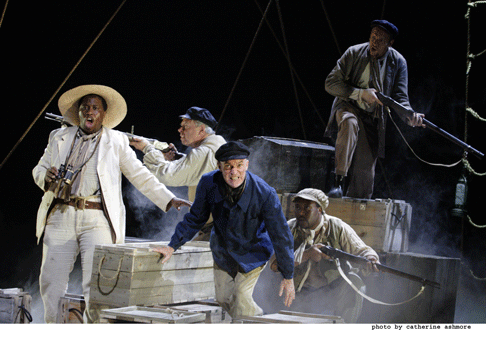 The cast of The Heart of Darkness [Photo by Catherine Ashmore courtesy of the Royal Opera House]
The handling of form and pace is superb. Marlow’s journey is swift but
the composer allows for moments of repose and reflection, effortlessly and
almost imperceptibly altering tempo and metre, register and colour. The
complicated score was impressively conducted by Oliver Gooch, who was in full
command of the musico-dramatic structure of the work, and alert to the
emotional ‘weight’ of significant moments. Gooch was superbly
served by the instrumentalists of Chroma, whose accuracy, energy and mastery of
various idioms, and sensitivity to the singers and the text, was exemplary.
As Marlow, tenor Alan Oke had the lion’s share of the work, and gave a
powerful, moving performance. His diction was clear and eloquent, and he
employed contrasting tones to convey the ambivalence of his action and his own
moral evaluation of them. Oke was supported by a fine cast. Bass Donald Maxwell
was a suspicious-looking Doctor, and a buoyant, lively Boilermaker; Jaewoo
Kim’s Harlequin was athletic and intriguing, both physically and orally.
A committed performance by Danish bass Morten Lassenius Kramp depicted the full
horror and despair of Kurtz’s disintegration. The soaring, wordless
vocalisation of Gwenneth-Ann Jeffers, as the River Woman who mournfully laments
Kurtz’s passing, provided a welcome timbral counterpart to the lower
registers of the male voices, and conjured an ambience of suffering, extremity
and the limits of human endurance.
The opera builds to a powerful climactic scene: Kurtz’s death —
inarticulate, raving, disillusioned — brings Marlow to the realisation
that, “His intelligence was perfectly clear, but his soul was mad”.
Here, the vocal expressiveness of O’Regan’s melodic line was
expertly utilised by Oke to reveal Marlow’s painful recognition of human
failing.
A final frame reveals the significance and meaning of the opening
‘frame’: Marlow is unable to reveal the truth of Kurtz’s
ultimate horrific vision to the latter’s fiancée — it is simply
“too dark”. This chilling scene is followed by what is perhaps the
opera’s only structural weakness; for Marlow commences a short
‘explanation’, offered to his crew and to the audience, of the role
played by the exploiting colonialists in Kurtz’s tragedy, explication
which adds a slightly distracting ‘footnote’ (highlighting the
colonial theme of the original) to what has up until that point been a
single-focused “musical psychodrama”, as the creators themselves
describe the work.
But that is a minor observation. This is a thrilling new work, in a
brilliantly realised production. I hope I get the opportunity to see it again
soon.
Claire Seymour