Subscribe to
Opera Today

Receive articles and news via RSS feeds or email subscription.


twitter_logo[1].gif


9780521746472.png

Recently in Performances

The Importance of Being Earnest, Covent Garden

The Importance of Being Earnest , Gerald Barry’s fifth opera, was commissioned by the Los Angeles Philharmonic Orchestra and the Barbican, and was first performed in concert, Thomas Adès conducting the London premiere.

Death in Venice by ENO

‘Beauty is the one form of spirituality that we experience through the senses.’ In Thomas Mann’s, Death in Venice, Plato’s axiom stirs the hopes of the aging, intellectually stale poet, Gustav von Aschenbach, that he may rekindle his creativity.

Madama Butterfly, Opera Holland Park

There is a sense in which it all began in London, Puccini having been seized in 1900 with the idea of an opera on this subject after watching David Belasco’s play here.

An Evening of Zarzuela and Latin American Music at Los Angeles Opera

The tenor that the audience most wanted to hear, Plácido Domingo, opened the vocal program with “Junto al puente de la peña” (Next to the rock bridge) from La Canción del Olvido (The song of Oblivion) by José Serrano. He sounded rested and his voice soared majestically over the orchestra.

Così fan tutte in San Francisco

Tucked away somewhere in the San Francisco Opera warehouse was an old John Cox production of Così fan tutte from Monte Carlo. Well, not that old by current standards at San Francisco Opera.

Rossini Maometto Secondo Garsington Opera at Wormsley

Rossini's Maometto Secondo is a major coup for Garsington Opera at Wormsley, confirming its status as the leading specialist Rossini house in Britain. Maometto Secondo is a masterpiece, yet rarely performed because it's formidably difficult to sing. It's a saga with some of the most intense music Rossini ever wrote, expressing a drama so powerful that one can understand why early audiences needed "happy endings" to water down its impact

Peter Grimes in Concert

I suppose it was inevitable that, in this Britten Centenary year, the 66th Aldeburgh Festival would open with Peter Grimes.

Die Entführung aus dem Serail, Garsington Opera at Wormsley

Die Entführung aus dem Serail at Garsington Opera at Wormsley isn’t Mozart as you’d expect but it’s true to the spirit of Mozart who loved witty, madcap japes.

Le nozze di Figaro, Glyndebourne

What a pity! On a glorious — well, by recent English standards — summer’s day, there can be few more beautiful English countryside settings than Glyndebourne, with the added bonus, as alas much of the audience appears to understand it, of an opera house attached.

Queens, Heroines and Ladykillers

Described by one critic as “cosmically gifted”, during her tragically short career, American mezzo-soprano Lorraine Hunt Lieberson amazed and delighted audiences with the spellbinding beauty of her singing and the astonishing honesty of her performances.

Alzira by Chelsea Opera Group

“I wrote it almost without noticing.” So Verdi declared when reminded of his eighth — and perhaps least frequently performed, opera, Alzira. One might say that, since he composed the work, no-one else has much noticed either.

Les Contes d’Hoffmann in San Francisco

Just when you thought the protagonist was Hoffmann! Who, rather what stole the show?

La Tosca in Los Angeles

When is verismo verily veristic? Or what is a virginal girl dressed in communion white doing in the two murderous acts of the Los Angeles Opera’s current production of Tosca? And why does she sing the shepherd's song?

Lohengrin, Welsh National Opera

Wagner’s Lohengrin is not an unfamiliar visitor to the UK thanks, in the main, to Elijah Moshinsky’s perennial production at Covent Garden.

Philip Glass: The Perfect American

Philip Glass's The Perfect American at the ENO in London is a visual treat, but the libretto is mind-numbingly anodyne.

Jonathan Dove’s Mansfield Park

Jonathan Dove's Mansfield Park, with libretto by his regular collaborator Alasdair Middleton, has the remarkable distinction of being the first completed operatic adaptation of any Jane Austen novel to be staged.

Wagner 200th Anniversary Concert

London’s two principal opera companies have offered a baffling near-silence as their response to Wagner’s two-hundredth anniversary.

Toronto’s Triple Success

If a recent trio of musically superlative performances at Canadian Opera Company is indicative of their norm, the casting director should get a hefty bonus.

Alessandro Scarlatti’s Il Trionfo dell’Onore

Just when you imagine you’ve got the operatic time-line fixed in your mind in a clean sweep of what goes where and when and how, you hear another work from another forgotten corner of the repertory that upends one’s conclusions.

Handel’s Rodrigo by Operamission

Nothing inspires fable quite like defeat. The great riddle of Spanish history is how the Christian Visigoths managed to lose the Iberian peninsula to the Moors in one small battle in 711 and took eight hundred years to get it back.

OPERA TODAY ARCHIVES »

Performances

Eglise Gutiérrez as Amina [Photo by Bill Cooper courtesy of The Royal Opera House]
05 Nov 2011

La sonnambula, Royal Opera

Bellini’s La sonnambula does not have the most gripping or convincing of opera plots: a young girl sleepwalks into a stranger’s room, where she is discovered by her fiancé; disbelieving her pleas of innocence, he jilts her and plans to wed another; but, she is vindicated when she is spied on a nocturnal wander, and the lovers are reconciled.

Vincenzo Bellini: La sonnambula

Elvino: Celso Albelo; Amina: Eglise Gutiérrez; Lisa: Elena Xanthoudakis; Count Rodolfo: Michele Pertusi; Alessio: Jihoon Kim; Teresa: Elizabeth Sikora; Notary: Elliot Goldie. Director: Marco Arturo Marelli. Conductor: Daniel Oren. Orchestra of the Royal Opera House. Royal Opera Chorus. Set designs: Marco Arturo Marelli. Lighting designs: Marco Arturo Marelli. Costume design: Dagmar Niefind-Marelli. Royal Opera House, Covent Garden, Wednesday, 2nd November 2011.

Above: Eglise Gutiérrez as Amina

Photos by Bill Cooper courtesy of The Royal Opera House


However, the wafer-thin text is more than compensated for by the composer’s ravishing score and reams of gorgeous melody.
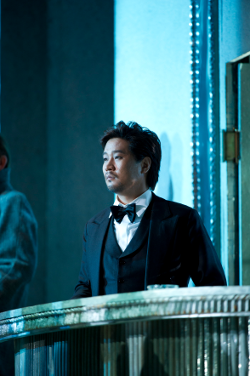
SONNAMBULA ©BC20111029238 - KIM AS ALESSIO (C) COOPER.pngJihoon Kim as Alessio

It’s a simple tale and needs a light touch. Sadly, in this revival of Marco Arturo Marelli’s 2002 production, both the presumptuous direction and Daniel Oren’s sluggish tempi weigh down the proceedings, and the result is narcotic.

Not trusting the music itself to provide depth and insight, Marelli has given the opera a ‘psychological makeover’. Thus, the Swiss village setting is replaced by an Alpine sanatorium (intended, we are told, to suggest the world of Thomas Mann’s The Magic Mountain) where Elvino – no longer a local landlord but a composer – has been undergoing treatment since the traumatic death of his mother. Bellini’s orphaned maid, Amina, to whom Elvino is betrothed, is now a waitress at the sanatorium. So, we have no gentle pastoral woods and byways, rather a sublime mountain-scape panorama, visible through vast atrium windows; sublime, that is, until an avalanche crashes through the windows and ruins the grand piano! And the site of the opera’s only really dramatic event – the narrow bridge over the rushing mill stream upon which the villager’s witness the precarious exploits of the sleepwalking, thereby proving her innocence – is also dispensed with. Instead, Anima has to navigate her way across the wreckage of the piano. Nineteenth-century village yokels are replaced with bustling nurses in crisp uniforms and wheelchair-bound patients sporting modern evening dress. It’s enough to send us all to the asylum.
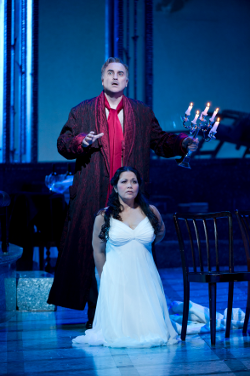
SONNAMBULA ©BC20111029200 - PERTUSI AS COUNT RODOLFO, GUTIERREZ AS AMINA (C) COOPER.pngMichele Pertusi as Count Rodolfo and Eglise Gutierrez as Amina

But, bel canto is all about the singing, so perhaps some high-class performances could rescue this production from insanity and inanity? Sadly, our Elvino, Spanish tenor Celso Albelo, could not provide the stature and presence required. While his diction was good and his tone sweet and pure, some incredible high notes and considerable vocal agility could not compensate for a total lack of charm. Albelo’s acting was leaden, and he needs to use his face more expressively to ensure a fully convincing sense of style.

As Amina, Eglise Gutiérrez demonstrated a beautifully tender pianissimo, floating, delicate upper notes, and an expressive vibrato. Crucially, however, her Italian is very poor, and occluded diction destroyed the inherent line of the melodies whose elegance is so intimately rooted in the language. Gutiérrez also adopted an overly fussy approach to the demanding coloratura. The florid passages stretched her technique to its limits, and she simply didn’t have the notes, especially in the final aria, in which she celebrates her lover’s return. Gutiérrez wasn’t helped by Marelli’s decision to bring the curtain down at the very moment she wakes, swap her demure, white nightgown for a plunging, scarlet velvet gown, and force her to stand on a table to deliver this fiendish number. With soloist and conductor wildly adrift, it made for an anticlimactic ending.

The rest of the cast were solid. Elena Xanthoudakis did a good job of conveying Lisa’s bitter jealousy, and mastered the stratospheric pyrotechnics (though why is she costumed as a lusty barmaid?); and as Count Rodolfo, Italian bass-baritone Michele Pertusi was appropriately authoritative and resonant. Elizabeth Sikora sang the role of Teresa, Amina’s foster mother, most impressively, making much of her powerful interjections. Jihoon Kim (Alessio), a Jette Parker Young Artist, and Elliot Goldie (Notary), a member of the ROH chorus, were reliable in their minor roles.
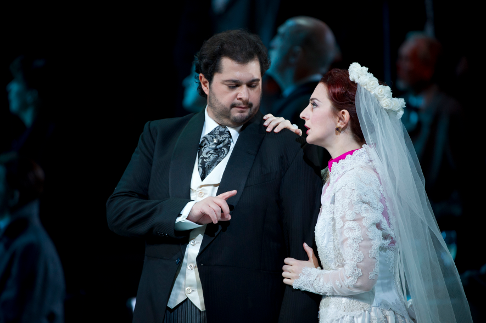
SONNAMBULA ©BC20111029261 - ALBELO AS ELVINO, XANTHOUDAKIS AS LISA (C) COOPER.pngCelso Albelo as Elvino and Elena Xanthoudakis as Lisa

Bellini composed the opera after a holiday in Como, where he admired the landscape and simple pastoral lifestyles of the inhabitants; the folk music he heard inspired him to create the beautiful, quite substantial, choruses which abound in the score. The Royal Opera chorus were a bit ragged, but they did have to endure Marelli’s silly stage antics; the instrumentalists of the ROH orchestra fared better, despite Oren’s uninspiring, tentative guidance.

But, although Marelli’s sweeping scenic designs are pleasing to look at, the production’s psychobabble is pretty unpalatable.

Claire Seymour

Send to a friend

Send a link to this article to a friend with an optional message.

Friend's Email Address: (required)

Your Email Address: (required)

Message (optional):