Those characters populating the stage from
start to finish include an incarnation of the writer Hoffmann and his Muse, the
latter figure appearing also as the confidante Niklausse. Hoffmann’s
recurring nemeses, or the villains of individual acts, add of course to the
sense of continuity throughout the piece. The lead roles in this production are
strongly cast with Matthew Polenzani as Hoffmann, Emily Fons as the Muse/
Niklausse, and James Morris assuming the personae of Hoffmann’s
opponents.
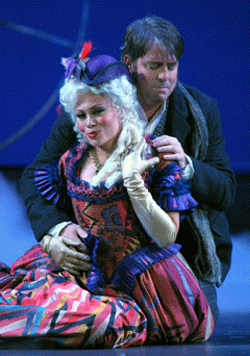 Alyson Cambridge as Giulietta and Matthew Polenzani as Hoffmann
As in comparable productions of Offenbach’s late opera the prologue
and first act are performed together. At the start of the prologue in this
conception pantomimic gestures show the inebriated Hoffmann being helped from
the stage by his Muse, just as Councillor Lindorf assumes his position before a
backdrop at the center. Lindorf’s rivalry with Hoffmann is now focused on
the diva Stella who currently sings in a local production of Mozart’s
Don Giovanni. As Lindorf bribes the diva’s servant to surrender
a communication intended for Hoffmann, the Councillor assures that he has the
advantage of a devilish spirit with an extended pitch on ”diable.”
In opposition to the “poète” Morris concludes his self-declaration
with an effectively declaimed “je suis vif.” This scene is
effective not only as a motivation for Hoffmann’s relating his amorous
adventures but also as a key to the opera’s conclusion when Stella indeed
leaves the stage accompanied by Lindorf.
During the remainder of the prologue the scene takes place in Luther’s
tavern. The collected male students, portrayed in a large tableau by the Lyric
Opera Chorus, are clearly inspired during intermission at the neighboring opera
and raise toasts to Stella. Once Hoffmann and Niklausse appear at the tavern,
the repartee with the students leads to Hoffmann’s well-known chanson
about the dwarf Kleinzach. As Hoffmann describes in his ballad the face of
Kleinzach his mind wanders to focus on his love for Stella. In this mixture of
musical styles and the subsequent veneration of Stella, Polenzani interspersed
a clear sense of legato with lyrical outbursts sung forte
(“figure,” “trois âmes dans une seule âme”) and showing
exquisite control of pitch. In his final cresting declaration before the close
of the prologue Polenzani introduces vocally Hoffmann’s emotional state
in preparation for the narratives of the following acts. (“Du bon
sens”)
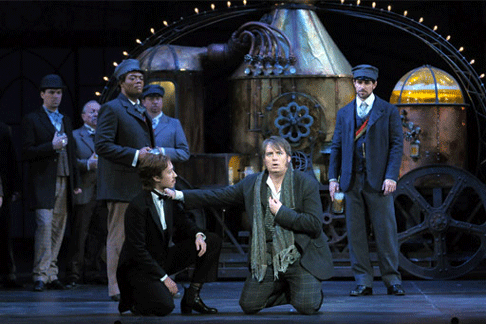 Emily Fons as Nicklausse and Matthew Polenzani as Hoffmann
In each of these subsequent acts an amorous entanglement leads to hope and
disappointment. The female objects of Hoffmann’s infatuation, Olympia,
Antonia, and Giulietta, are sung in this production by Anna Christy, Erin Wall,
and Alyson Cambridge. As Hoffmann first steals a glance at the mechanical doll
Olympia in Act I, Polenzani’s lyrical technique bloomed yet further
beyond his singing in the prologue. He sang at times piano with an
effective use of diminuendo as he described his devotion to the study
of physics primarily as a means to approaching the professor’s daughter
Olympia. These lines became even more credible for the persona of Hoffmann as
Polenzani’s characterization was delineated with effortless top notes.
Before the doll sings her famous aria Niklausse arrives and comments on
Hoffmann’s delusion and emotional distraction. Here Ms. Fons sang her
first solo piece with lyrical ease and presented an amusing caricature of the
doll as she mimicked it both vocally and with her own physically lithe
gestures. Hoffmann refuses to heed common sense and listens enraptured to the
doll Olympia’s voice. In this role Ms. Christy excelled at combining a
bright upper register in her melodic line with skillful coloratura decoration.
At the same time she sang in the spirit of the character so that her voice took
on the mechanical quality which her body communicated through gestures, as she
performed fixed in a rotating movable base. In his response to Olympia’s
movements and speech Polenzani depicts Hoffmann lost in his passion while he
casts off volleys of lyrical devotion. As Olympia’s identity is finally
revealed Polenzani concluded the act together with the chorus in alternating
cries of “Un automate” sung forte and with absolute control of
pitch.
In Act II the characters Antonia, her father Crespel, and the voice of her
deceased mother contribute to Hoffmann’s second involvement. Erin Wall
sang a touching rendition of Antonia’s wistful opening romance,
“Elle a fui” [“She has flown away”]. Ms. Wall varied
her approach so that her softest notes blended fittingly with more dramatic and
fully voiced lines. In the role of Crespel bass-baritone Christian Van Horn
made a strong impression as Antonia’s protective father. As he implored
his weakened child to sing no longer, even the simple phrase “Je
t’en prie” [“I beg of you”] was infused by Mr. Van Horn
with memorable resonance. When Hoffmann and Niklausse enter on this scene, the
servant Frantz — sung her by Rodell Rosel with comic delight — is
alone, having just finished a pantominic dance. Hoffmann begs to be admitted to
his beloved Antonia’s presence, a meeting which Frantz has been forbidden
to allow. In the following series of set pieces the characters reflect on both
the role of love and on their own emotions. As one of the highlights of this
productions Ms. Fons sang the second aria for Niklausse while she tries to
persuade Hoffmann to devote himself to love as art (“Vois sous
l’archet frémissant” [“See beneath the quivering
bow”]). Fons used her voice with its secure low notes to great effect in
expressing the dominant spirit of “l’amour vainqueur,” just
as she concluded the aria by drawing on the exciting upper extension of her
range. Niklausse makes himself scarce at the reappearance of Antonia who now
finally sings together with Hoffmann. In their duet Wall and Polenzani showed
refined passagework, their voices moving apart and, again, in unison with
emotional commitment. At the entrance of Dr. Miracle, sung by Morris, Crespel
expresses great concern for his daughter’s well-being. Ultimately Antonia
succumbs to the persuasions of Dr. Miracle and to the voice of her dead mother,
sung here with resonance and authority by mezzo-soprano Jamie Barton in her
debut at Lyric Opera. When Hoffmann attempts to summon help, his beloved
Antonia has already died.
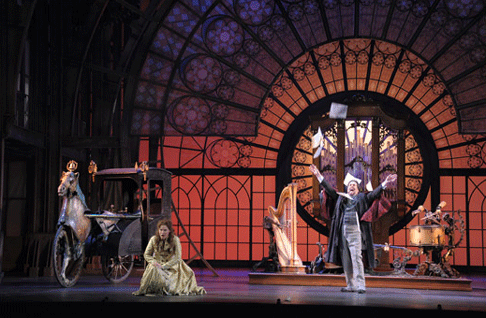 Erin Wall as Antonia and James Morris as Dr Miracle
The final involvement in the protagonist’s series of adventures
carries him to Giulietta’s palazzo in Venice. At the start of the final
act she and Niklausse sing the famous barcarolle; in this performance both
voices were distinctly audible as though both were woven into the melody. The
signature bass aria, “Scintille, diamante,” sung by Dapertutto to
tempt Giulietta, was sung by Morris with an attentive sense of line. Ms.
Cambridge fulfills well the vocal and dramatic challenges of her role, yet at
times her use of vibrato can lead to stylization.
In the epilogue to the opera Hoffmann has finished the narration of his
tales and is found, inebriated, together with the Muse. Even though Stella from
the prologue now appears for the assignation and leaves in the company of a
triumphant Lindorf, the audience presumes that Hoffmann will awaken in the
confident realm of Poetry.
Salvatore Calomino
![Matthew Polenzani as Hoffmann and Anna Christy as Olympia [Photo by Dan Rest courtesy of Lyric Opera of Chicago]](http://www.operatoday.com/Hoffmann_Chicago_2011_01.gif)