![Claire Rutter as Tosca and Gwyn Hughes Jones as Cavaradossi [Photo by Mike Hoban courtesy of English National Opera]](http://www.operatoday.com/Tosca_2011_Claire_Rutter_Gwyn_Hughes_Jones_4_Credit_Mike_Hoban.png)
27 Nov 2011
Tosca, ENO
The swift return to the Coliseum of Catherine Malfitano’s production of Tosca, premiered in 2010, contrasts strongly with the increasingly disposable nature of many recent ENO productions.
English Touring Opera are delighted to announce a season of lyric monodramas to tour nationally from October to December. The season features music for solo singer and piano by Argento, Britten, Tippett and Shostakovich with a bold and inventive approach to making opera during social distancing.
This tenth of ten Live from London concerts was in fact a recorded live performance from California. It was no less enjoyable for that, and it was also uplifting to learn that this wasn’t in fact the ‘last’ LfL event that we will be able to enjoy, courtesy of VOCES8 and their fellow vocal ensembles (more below …).
Ever since Wigmore Hall announced their superb series of autumn concerts, all streamed live and available free of charge, I’d been looking forward to this song recital by Ian Bostridge and Imogen Cooper.
Although Stile Antico’s programme article for their Live from London recital introduced their selection from the many treasures of the English Renaissance in the context of the theological debates and upheavals of the Tudor and Elizabethan years, their performance was more evocative of private chamber music than of public liturgy.
Evidently, face masks don’t stifle appreciative “Bravo!”s. And, reducing audience numbers doesn’t lower the volume of such acclamations. For, the audience at Wigmore Hall gave soprano Elizabeth Llewellyn and pianist Simon Lepper a greatly deserved warm reception and hearty response following this lunchtime recital of late-Romantic song.
For this week’s Live from London vocal recital we moved from the home of VOCES8, St Anne and St Agnes in the City of London, to Kings Place, where The Sixteen - who have been associate artists at the venue for some time - presented a programme of music and words bound together by the theme of ‘reflection’.
'Such is your divine Disposation that both you excellently understand, and royally entertaine the Exercise of Musicke.’
‘And there was war in heaven: Michael and his angels fought against the dragon; and the dragon fought and his angels, And prevailed not; neither was their place found any more in heaven … that old serpent … Satan, which deceiveth the whole world: he was cast out into the earth, and his angels were cast out with him.’
There was never any doubt that the fifth of the twelve Met Stars Live in Concert broadcasts was going to be a palpably intense and vivid event, as well as a musically stunning and theatrically enervating experience.
‘Love’ was the theme for this Live from London performance by Apollo5. Given the complexity and diversity of that human emotion, and Apollo5’s reputation for versatility and diverse repertoire, ranging from Renaissance choral music to jazz, from contemporary classical works to popular song, it was no surprise that their programme spanned 500 years and several musical styles.
The Academy of St Martin in the Fields have titled their autumn series of eight concerts - which are taking place at 5pm and 7.30pm on two Saturdays each month at their home venue in Trafalgar Square, and being filmed for streaming the following Thursday - ‘re:connect’.
The London Symphony Orchestra opened their Autumn 2020 season with a homage to Oliver Knussen, who died at the age of 66 in July 2018. The programme traced a national musical lineage through the twentieth century, from Britten to Knussen, on to Mark-Anthony Turnage, and entwining the LSO and Rattle too.
With the Live from London digital vocal festival entering the second half of the series, the festival’s host, VOCES8, returned to their home at St Annes and St Agnes in the City of London to present a sequence of ‘Choral Dances’ - vocal music inspired by dance, embracing diverse genres from the Renaissance madrigal to swing jazz.
Just a few unison string wriggles from the opening of Mozart’s overture to Le nozze di Figaro are enough to make any opera-lover perch on the edge of their seat, in excited anticipation of the drama in music to come, so there could be no other curtain-raiser for this Gala Concert at the Royal Opera House, the latest instalment from ‘their House’ to ‘our houses’.
"Before the ending of the day, creator of all things, we pray that, with your accustomed mercy, you may watch over us."
The doors at The Metropolitan Opera will not open to live audiences until 2021 at the earliest, and the likelihood of normal operatic life resuming in cities around the world looks but a distant dream at present. But, while we may not be invited from our homes into the opera house for some time yet, with its free daily screenings of past productions and its pay-per-view Met Stars Live in Concert series, the Met continues to bring opera into our homes.
Music-making at this year’s Grange Festival Opera may have fallen silent in June and July, but the country house and extensive grounds of The Grange provided an ideal setting for a weekend of twelve specially conceived ‘promenade’ performances encompassing music and dance.
There’s a “slide of harmony” and “all the bones leave your body at that moment and you collapse to the floor, it’s so extraordinary.”
“Music for a while, shall all your cares beguile.”
The hum of bees rising from myriad scented blooms; gentle strains of birdsong; the cheerful chatter of picnickers beside a still lake; decorous thwacks of leather on willow; song and music floating through the warm evening air.
The swift return to the Coliseum of Catherine Malfitano’s production of Tosca, premiered in 2010, contrasts strongly with the increasingly disposable nature of many recent ENO productions.
Malfitano’s staging makes a refreshing change both from the likes of the floundering first-time spoken theatre and film directors often recently engaged by the company, and from the ludicrous, dramatically-null vulgarity of the Zeffirelli brigade. It doubtless helps to have someone at the directorial helm who knows the work from the inside, having sung the title-role a good many times herself. There is nothing here — with the possible exception of the third act — to frighten self-appointed ‘traditionalists’, although in such repertoire and with respect the audiences it tends to attract, I cannot help but wish that someone would occasionally shock the horses. (Just imagine what Calixto Bieito might make of Tosca!) Despite the sometimes bizarre specificity of the libretto, there seems to me no reason why intelligent relocation or abstraction could not work: the opera is not in any meaningful sense ‘about’ the experience of the French Revolution in Rome. Malfitano, however, elects successfully to retain the settings and for the most part the attitudes of the work’s creators, respecting as do they the classical unities.
The first act is therefore set in S.Andrea della Valle at noon, convincingly represented in realistic fashion by Frank Philipp Schlössmann’s designs. The force of Cavaradossi’s painting registers straightforwardly, but none the worse for that. One strongly feels the menace of the Church as pillar of the (re-)established order at the entrance of clergy and acolytes for the “Te Deum”. (I cannot help but find the anti-clericalism shallow, verging on the puerile, but that is no fault of the production.) Likewise, the second act is set at evening in Scarpia’s quarters in the Palazzo Farnese, furnished as one might expect, though without excess. The third act therefore comes as a bit of a surprise, at least in terms of designs . Doubtless taking as its cue references in words and stage directions to the stars, perhaps even those to the saints in heaven, we see the skies as if from a space ship, though something akin to the battlements is still present. It did not bother me in the slightest, though nor, by the same token, did I find the image revelatory. Throughout, Malfitano’s direction of the characters on stage proves quietly accomplished, providing neither mishaps nor particular flashes of revelation. I do not mean to imply that it is dull, for it is not, but nor does this in any sense approach reinterpretation, for which many will doubtless be relieved. If I found the final melodrama as difficult to take as ever, a not-entirely-fitting conclusion to so well-crafted a score, then clearly I am in the minority; rightly or wrongly, it receives faithful treatment here.
Stephen Lord’s conducting was impressive. Lord is not a conductor I have previously heard, but I should certainly be interested to do so again. Despite the occasional instance of perhaps driving the score a little hard, the full yet variegated sound conjured from the orchestra was as fine as I have heard at the Coliseum for quite some time. Alert to Puccini’s Wagnerisms without overplaying them, there was a fine continuity to Lord’s traversal of the score, which here in both harmony and orchestration at times sounded, to its great benefit, appreciably more modernistic than one often hears. It was not for nothing that both Schoenberg and Berg were admirers. Even Mahler, in his scathing description of a Meistermachwerk, acknowledged the skill of orchestration — an undoubted advance upon so many of Puccini’s Italian forebears — though added that any cobbler nowadays could merely ‘orchestrate to perfection’.
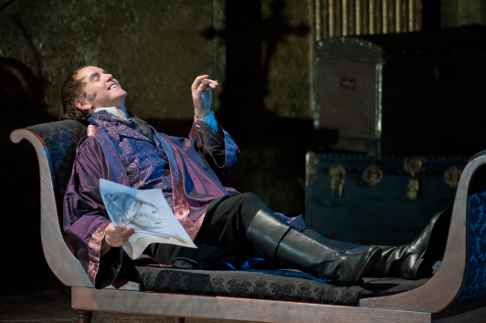 Anthony Michaels-Moore as Scarpia
If the singing did not truly scaled the heights, it was professionally despatched. No one is going to replicate Callas, and Claire Rutter wisely did not attempt to try: hers was an intelligent enough stage portrayal, a little lacking in charisma perhaps, likewise in creation of the diva-status of Floria Tosca as singer, but, despite occasional weakness in sustaining her line, there was nothing grievous to worry about. Gwyn Hughes-Jones’s Cavaradossi was not entirely free of crooning tendencies, nor did it revel in subtleties, but it was well enough sung, and would doubtless have sounded better in Italian. Anthony Michaels-Moore seemed to experience vocal difficulties in the first act but his Scarpia sharpened up in the second, albeit without ever quite capturing the sheer danger and malevolence of the most notable interpreters. The smaller parts were all well taken. Choral singing, not always the strongest point recently at the Coliseum, was similarly accomplished.
Mark Berry