![David Daniels as Arsamenes and Susan Graham as Xerxes [Photo by Cory Weaver courtesy of San Francisco Opera]](http://www.operatoday.com/Daniels_Graham_Xerxes.gif)
25 Nov 2011
Xerxes in San Francisco
No cuts, not a single one, nearly four hours of non-stop arias, and its only hit tune happens within the first five minutes.
English Touring Opera are delighted to announce a season of lyric monodramas to tour nationally from October to December. The season features music for solo singer and piano by Argento, Britten, Tippett and Shostakovich with a bold and inventive approach to making opera during social distancing.
This tenth of ten Live from London concerts was in fact a recorded live performance from California. It was no less enjoyable for that, and it was also uplifting to learn that this wasn’t in fact the ‘last’ LfL event that we will be able to enjoy, courtesy of VOCES8 and their fellow vocal ensembles (more below …).
Ever since Wigmore Hall announced their superb series of autumn concerts, all streamed live and available free of charge, I’d been looking forward to this song recital by Ian Bostridge and Imogen Cooper.
Although Stile Antico’s programme article for their Live from London recital introduced their selection from the many treasures of the English Renaissance in the context of the theological debates and upheavals of the Tudor and Elizabethan years, their performance was more evocative of private chamber music than of public liturgy.
Evidently, face masks don’t stifle appreciative “Bravo!”s. And, reducing audience numbers doesn’t lower the volume of such acclamations. For, the audience at Wigmore Hall gave soprano Elizabeth Llewellyn and pianist Simon Lepper a greatly deserved warm reception and hearty response following this lunchtime recital of late-Romantic song.
For this week’s Live from London vocal recital we moved from the home of VOCES8, St Anne and St Agnes in the City of London, to Kings Place, where The Sixteen - who have been associate artists at the venue for some time - presented a programme of music and words bound together by the theme of ‘reflection’.
'Such is your divine Disposation that both you excellently understand, and royally entertaine the Exercise of Musicke.’
‘And there was war in heaven: Michael and his angels fought against the dragon; and the dragon fought and his angels, And prevailed not; neither was their place found any more in heaven … that old serpent … Satan, which deceiveth the whole world: he was cast out into the earth, and his angels were cast out with him.’
There was never any doubt that the fifth of the twelve Met Stars Live in Concert broadcasts was going to be a palpably intense and vivid event, as well as a musically stunning and theatrically enervating experience.
‘Love’ was the theme for this Live from London performance by Apollo5. Given the complexity and diversity of that human emotion, and Apollo5’s reputation for versatility and diverse repertoire, ranging from Renaissance choral music to jazz, from contemporary classical works to popular song, it was no surprise that their programme spanned 500 years and several musical styles.
The Academy of St Martin in the Fields have titled their autumn series of eight concerts - which are taking place at 5pm and 7.30pm on two Saturdays each month at their home venue in Trafalgar Square, and being filmed for streaming the following Thursday - ‘re:connect’.
The London Symphony Orchestra opened their Autumn 2020 season with a homage to Oliver Knussen, who died at the age of 66 in July 2018. The programme traced a national musical lineage through the twentieth century, from Britten to Knussen, on to Mark-Anthony Turnage, and entwining the LSO and Rattle too.
With the Live from London digital vocal festival entering the second half of the series, the festival’s host, VOCES8, returned to their home at St Annes and St Agnes in the City of London to present a sequence of ‘Choral Dances’ - vocal music inspired by dance, embracing diverse genres from the Renaissance madrigal to swing jazz.
Just a few unison string wriggles from the opening of Mozart’s overture to Le nozze di Figaro are enough to make any opera-lover perch on the edge of their seat, in excited anticipation of the drama in music to come, so there could be no other curtain-raiser for this Gala Concert at the Royal Opera House, the latest instalment from ‘their House’ to ‘our houses’.
"Before the ending of the day, creator of all things, we pray that, with your accustomed mercy, you may watch over us."
The doors at The Metropolitan Opera will not open to live audiences until 2021 at the earliest, and the likelihood of normal operatic life resuming in cities around the world looks but a distant dream at present. But, while we may not be invited from our homes into the opera house for some time yet, with its free daily screenings of past productions and its pay-per-view Met Stars Live in Concert series, the Met continues to bring opera into our homes.
Music-making at this year’s Grange Festival Opera may have fallen silent in June and July, but the country house and extensive grounds of The Grange provided an ideal setting for a weekend of twelve specially conceived ‘promenade’ performances encompassing music and dance.
There’s a “slide of harmony” and “all the bones leave your body at that moment and you collapse to the floor, it’s so extraordinary.”
“Music for a while, shall all your cares beguile.”
The hum of bees rising from myriad scented blooms; gentle strains of birdsong; the cheerful chatter of picnickers beside a still lake; decorous thwacks of leather on willow; song and music floating through the warm evening air.
No cuts, not a single one, nearly four hours of non-stop arias, and its only hit tune happens within the first five minutes.
It was a fine evening in the War Memorial Opera House, a rare visit by one of opera’s greatest dramatists, G.F. Handel now 326 years-old. San Francisco Opera welcomed his 273 years-old Xerxes with a production that is 26 years-old.
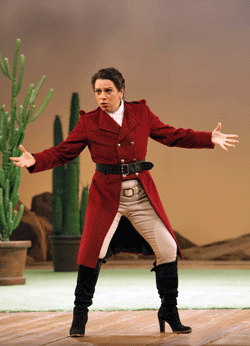 Sonia Prina as Amastris
While the mushy acoustic of San Francisco’s venerable opera house is not kind to the linear detail and sculptural shapes of Baroque opera an exemplary cast overcame this handicap with the help of the English National Opera production directed by Nicholas Hytner and designed by David Fielding — purely and simply a classic.
The Handel revival has been going on quite a while now, in fact nearly one hundred years though not so many of his operas find their way onto the big stages to play for broader audiences. That may be the reason that when the populist and always lively ENO took on Xerxes for the Handel 1985 anniversary it choose to play up the comic elements of this opera seria, in fact to make it an outright comedy, trappings it wears quite naturally.
Impeccable comic timing and deadpan humor rarely describe performances by mezzo-soprano Susan Graham (whose roles at SFO include Iphigénie, Ariodante and Sister Helen [Dead Man Walking]). As the Persian king Serse (Xerxes) these attributes are as appropriate as the more usual phrases like impeccable musicianship and superb delivery. Her trouser acting technique does not attempt masculinity leaving us gratefully unconfused in the usual gender confusion.
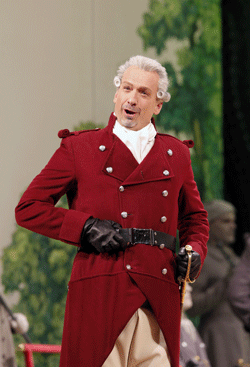 Wayne Tigges as Ariodates
Almost the same things can be said about countertenor David Daniels who was her/his (Serse’s) rival in love, though in the case of Mr. Daniels the gender confusion became a part of the comedy with his maleness exaggerated by the addition of a beard — all the while singing in a male voice in a female register. Mr. Daniels has a quite beautiful falsetto that is evenly colored throughout his range, and exposes his mastery of Baroque style with every note.
To a man all the other pro- and antagonists were scene stealers. Heidi Stober and Lisette Oropesa were the sisters, Atalanta and Romilda, very lyric singers and beguiling actresses, complemented by the delightfully outraged Sonia Prina as Serse’s forgotten fiance Amastris, now disguised as a soldier. She earned a huge ovation for her dynamite, end of first act explosion “Saprà delle mie offese, ben vendicarsi il cor.”
Well, to a man it was hopeless, tormented love finally resolved by the dumb coyness of lovesick Serse aided by the very real charm of the servant Elviro sung by baritone Michael Samuel and by the pomposity of the general Ariodates adroitly served up by bass Wayne Tigges.
The greatest pleasure of the evening was however the finished staging accomplished by stage director Michael Walling. Its imposed precise movements were confidently executed by the cast. This finish alone allowed the comedy to shine as well as to expose gracefully the considerable personal charms of the seven principals. Not to mention the huge presence of 24 choristers (but only two brief choruses) and 17 tireless supernumeraries as the very slightly defined Persian society (disguised in period European dress) — totally gray, shadowy, barely visible gentle commentators on the shenanigans of Handel’s brightly dressed lovers — that added very welcome action and context to the countless arias.
David Fielding’s set on which Serse and Ariodates plot their invasion of Europe was a Baroque room with a garden superimposed (recognizing that Xerxes is really a pastorale) with a back wall that flew out to reveal some witty Middle Eastern vistas and side panels that opened to admit some monumental Persian sculpture in museum cases. Together with the cheap lawn chairs and newspapers there was plenty of nifty confusion of time and place to complement the amusing gender confusions mixed up in the silly romantic convolutions.
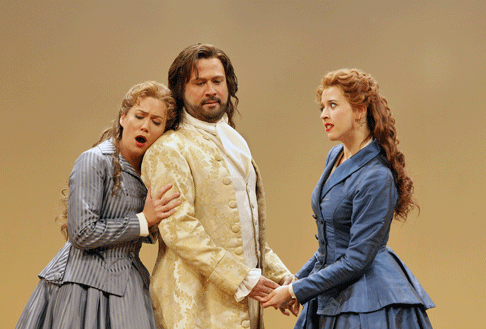 Lisette Oropesa as Romilda, Michael Sumuel as Elviro and David Daniels as Arsamenes
Conductor Patrick Summers allowed all this to happen without imposing musical extravagances, choosing instead to indulge in his sympathy for the needs of his singers. There was no real attempt or for that matter possibility or even need to create a Baroque sound in the vast expanse of the War memorial.
This production from twenty-six years ago reflects the tastes and challenges of that time, a particularly innovative period at the ENO. A new production now of this problematic opera might attempt to underscore the depth of emotion in its exposition of these tragic (genuinely unhappy) stories. The feelings are musically quite real. The heady humor of the Hytner production kept us outside and above the much of the potential musical depth and maybe some of the pleasures of this Handel score.
Michael Milenski