13 Dec 2011
Drapes ‘n’ Drops in Paris Forza
Paris Opera has lavished quite a monumental staging on Verdi’s musically rich (and Piave’s dramatically vapid) La Forza del Destino.
English Touring Opera are delighted to announce a season of lyric monodramas to tour nationally from October to December. The season features music for solo singer and piano by Argento, Britten, Tippett and Shostakovich with a bold and inventive approach to making opera during social distancing.
This tenth of ten Live from London concerts was in fact a recorded live performance from California. It was no less enjoyable for that, and it was also uplifting to learn that this wasn’t in fact the ‘last’ LfL event that we will be able to enjoy, courtesy of VOCES8 and their fellow vocal ensembles (more below …).
Ever since Wigmore Hall announced their superb series of autumn concerts, all streamed live and available free of charge, I’d been looking forward to this song recital by Ian Bostridge and Imogen Cooper.
Although Stile Antico’s programme article for their Live from London recital introduced their selection from the many treasures of the English Renaissance in the context of the theological debates and upheavals of the Tudor and Elizabethan years, their performance was more evocative of private chamber music than of public liturgy.
Evidently, face masks don’t stifle appreciative “Bravo!”s. And, reducing audience numbers doesn’t lower the volume of such acclamations. For, the audience at Wigmore Hall gave soprano Elizabeth Llewellyn and pianist Simon Lepper a greatly deserved warm reception and hearty response following this lunchtime recital of late-Romantic song.
For this week’s Live from London vocal recital we moved from the home of VOCES8, St Anne and St Agnes in the City of London, to Kings Place, where The Sixteen - who have been associate artists at the venue for some time - presented a programme of music and words bound together by the theme of ‘reflection’.
'Such is your divine Disposation that both you excellently understand, and royally entertaine the Exercise of Musicke.’
‘And there was war in heaven: Michael and his angels fought against the dragon; and the dragon fought and his angels, And prevailed not; neither was their place found any more in heaven … that old serpent … Satan, which deceiveth the whole world: he was cast out into the earth, and his angels were cast out with him.’
There was never any doubt that the fifth of the twelve Met Stars Live in Concert broadcasts was going to be a palpably intense and vivid event, as well as a musically stunning and theatrically enervating experience.
‘Love’ was the theme for this Live from London performance by Apollo5. Given the complexity and diversity of that human emotion, and Apollo5’s reputation for versatility and diverse repertoire, ranging from Renaissance choral music to jazz, from contemporary classical works to popular song, it was no surprise that their programme spanned 500 years and several musical styles.
The Academy of St Martin in the Fields have titled their autumn series of eight concerts - which are taking place at 5pm and 7.30pm on two Saturdays each month at their home venue in Trafalgar Square, and being filmed for streaming the following Thursday - ‘re:connect’.
The London Symphony Orchestra opened their Autumn 2020 season with a homage to Oliver Knussen, who died at the age of 66 in July 2018. The programme traced a national musical lineage through the twentieth century, from Britten to Knussen, on to Mark-Anthony Turnage, and entwining the LSO and Rattle too.
With the Live from London digital vocal festival entering the second half of the series, the festival’s host, VOCES8, returned to their home at St Annes and St Agnes in the City of London to present a sequence of ‘Choral Dances’ - vocal music inspired by dance, embracing diverse genres from the Renaissance madrigal to swing jazz.
Just a few unison string wriggles from the opening of Mozart’s overture to Le nozze di Figaro are enough to make any opera-lover perch on the edge of their seat, in excited anticipation of the drama in music to come, so there could be no other curtain-raiser for this Gala Concert at the Royal Opera House, the latest instalment from ‘their House’ to ‘our houses’.
"Before the ending of the day, creator of all things, we pray that, with your accustomed mercy, you may watch over us."
The doors at The Metropolitan Opera will not open to live audiences until 2021 at the earliest, and the likelihood of normal operatic life resuming in cities around the world looks but a distant dream at present. But, while we may not be invited from our homes into the opera house for some time yet, with its free daily screenings of past productions and its pay-per-view Met Stars Live in Concert series, the Met continues to bring opera into our homes.
Music-making at this year’s Grange Festival Opera may have fallen silent in June and July, but the country house and extensive grounds of The Grange provided an ideal setting for a weekend of twelve specially conceived ‘promenade’ performances encompassing music and dance.
There’s a “slide of harmony” and “all the bones leave your body at that moment and you collapse to the floor, it’s so extraordinary.”
“Music for a while, shall all your cares beguile.”
The hum of bees rising from myriad scented blooms; gentle strains of birdsong; the cheerful chatter of picnickers beside a still lake; decorous thwacks of leather on willow; song and music floating through the warm evening air.
Paris Opera has lavished quite a monumental staging on Verdi’s musically rich (and Piave’s dramatically vapid) La Forza del Destino.
Forza is performed seldom enough that my one and only other encounter with it was Houston's 1973 production. I figure that once about every forty years, I can sit through the illogicalities of — why not say it — a patently stupid story with plot holes big enough to drive a Lamborghini through, in order to savor some of Verdi's auspicious writing. Oddly enough, there were two surprising similarities between the two versions I encountered. Both were played on a raked rectangular platform unit set that twisted up to form a back wall to the playing space, and both opted to begin the piece with Scene One and interpolate the overture after it.
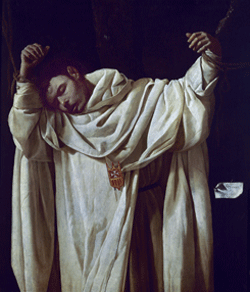
Set designer Alain Chambon has skillfully managed to create an epic sense of stagecraft with economy of means, and has drawn on a color palette and textures that evoke the Golden Age of Spanish painting (Murillo, Velasquez, Zurbaran). This was largely achieved with beautifully painted drops and artfully draped heavy curtains. A singularly haunting Corpus Christi hovered over one scene above center stage (with its back to us) only to later have the same over-sized plaster image discarded absently on the mountainside as Leonora huddles under a huge fabric (her "cave") on the opposite site. Gorgeous imagery. The opening scene was not in the heroine's bedroom, but rather played out at the conclusion of a stiff, tense family formal dinner. The stunningly painted drop backing the impossibly long dining table seemed to announce that we would be seeing a traditional theatrical presentation. However, when the Marchese returned to discover the lovers, he angrily ripped the whole thing down off its pipe, and visually the piece was jump started into a splendidly suggestive approximation of subsequent locales.
Laurent Castaingt designed elegantly atmospheric soft-edged lighting, which contributed mightily to the chiaroscuro effect. Maria-Chiara Donato devised uncommonly flattering costumes for her principals, notably for Violeta Urmana's Leonora whom was first treated to a sumptuous, figure flattering dark federal blue gown, with a draped shawl conveying social status and femininity. Her male disguise was similarly well-tailored, aptly representing the effect without being slavishly "masculine." I have never seen the soprano costumed to better effect. While the Dons and the Calatrava household were all muted, jewel-toned elegance and the clerics all earth-toned, sober penitence, Ms. Donato unleashed a welcome extravagant riot of colors for the crowd scenes including a vividly clad, uninhibited Preziosilla.
For his part, director Jean-Claude Auvray told the implausible story as though he was totally convinced by it. In service to the characters, Mr. Auvray mined whatever drama was in the given situation and presented it clearly and with focus. He managed the traffic in the crowd scenes with considerable skill, and for once, we always knew where we should be looking. If characterizations were a little generic, well, the creators made them so. And if Jean-Claude slipped into a cliché or two or operatic groupings, well, they became clichés because they worked! The only truly ineffective moment of the night came with the ineffectual sword fight between the tenor and baritone which was little more than a half-hearted, clinking purse fight. (Actually, that is to insult purse fights, so lame the effort was.) The staging was all that was needed, then, and the technical elements were more surpassingly beautiful than expected, but where the company scored biggest was where it really counted. Prima la musica!
Conductor Philippe Jordan just goes from strength to strength. His passionately felt, resplendent reading urged all concerned to summon up one of the most musically exciting nights I have spent in the Bastille. The thrice-familiar overture crackled, popped, churned and soared with a burning intensity, and it elicited such a sustained roar of approval that it threatened to keep us from ever hearing the rest of the score! And so it went all evening long, Maestro Jordan giving the impression that the piece might have been written to the strengths of his responsive orchestra and his first rate soloists.
Marcelo Alvarez was indeed a forza to be reckoned with as Don Alvaro. His meaty tone soared above the staff with full, gleaming Verdian presence. He also commands a rich middle voice that was put to excellent use in this tricky role. Everything about his technique seemed hooked up and well founded, and he brought a seamless beauty to the numerous phrases that arc through the passaggio to above the staff. I don't know who the leading Verdi tenor might be these days, but Marcelo deserves serious consideration. Violeta Urmana may have staked her Fach transition from mezzo to soprano on the gamble that we needed more accomplished divas who could sing these spinto parts. She was right. And Leonora fits her like a glove. Having admired her in Vienna's Chenier I was less happy with last year's Paris Macbeth. But no equivocation here, Ms. Urmana has all the ripe low notes in place, her middle is vibrant, and her forays in higher territory encompass every demand from floating, pure pianos, to the hurled curse at the end of Pace, mio Dio. What a shame the composer gave the lovers so little to sing together, since Violeta and Marcello were exceptionally well-paired.
As Don Carlo, Vladimir Stoyanov showed off a forward-placed, imposing baritone that excelled in all but the highest notes. Here, he used a ‘poosh-em-uppa-Tony’ sort of approach that was more about reliable volume than complete control. A little rounding of the tone might stand him in better stead, but Mr. Stoyanov was nevertheless a solid Carlo. Kwangchul Youn brought his warm, mellifluous bass to Padre Guardiano, and his accomplished vocalism helped make the final trio one of the show's high points. The animated Nicola Alaimo wrung every bit of buffo humor out of Fra Melitone as he dominated his every scene. His solid, brassy bass was a nice contrast to Mr. Youn. Nadia Krasteva's ripe, sultry mezzo was a perfect fit for Preziosilla and she knew every inch of the role, giving it her all in an assured portrayal. However, I always feel that the poor mezzo sings her lungs out, prances and pouts, ‘rat-a-plans’ herself into a stupor and in the end, nothing adds up to anything substantial. Mario Luperi's authoritative, secure bass sounded appropriately paternal as the Marchese. Rodolphe Briand contributed a memorable turn as Trabuco.
No one will ever make La Forza del Destino work completely. But thanks to Paris Opera's exciting design concepts, no-nonsense direction, and abundant musical wealth, this is surely as good as it gets.
James Sohre