![Marina Poplavskaya as Marguerite and Jonas Kaufmann as Faust [Photo by Ken Howard/Metropolitan Opera]](http://www.operatoday.com/Faust_Met_2011_01.png)
02 Dec 2011
Faust, Metropolitan Opera
At one point in The Met’s history, Faust was performed so frequently that one critic in mocking reference to Wagner’s opera house at Bayreuth coined the theater Faustophilhaus.
English Touring Opera are delighted to announce a season of lyric monodramas to tour nationally from October to December. The season features music for solo singer and piano by Argento, Britten, Tippett and Shostakovich with a bold and inventive approach to making opera during social distancing.
This tenth of ten Live from London concerts was in fact a recorded live performance from California. It was no less enjoyable for that, and it was also uplifting to learn that this wasn’t in fact the ‘last’ LfL event that we will be able to enjoy, courtesy of VOCES8 and their fellow vocal ensembles (more below …).
Ever since Wigmore Hall announced their superb series of autumn concerts, all streamed live and available free of charge, I’d been looking forward to this song recital by Ian Bostridge and Imogen Cooper.
Although Stile Antico’s programme article for their Live from London recital introduced their selection from the many treasures of the English Renaissance in the context of the theological debates and upheavals of the Tudor and Elizabethan years, their performance was more evocative of private chamber music than of public liturgy.
Evidently, face masks don’t stifle appreciative “Bravo!”s. And, reducing audience numbers doesn’t lower the volume of such acclamations. For, the audience at Wigmore Hall gave soprano Elizabeth Llewellyn and pianist Simon Lepper a greatly deserved warm reception and hearty response following this lunchtime recital of late-Romantic song.
For this week’s Live from London vocal recital we moved from the home of VOCES8, St Anne and St Agnes in the City of London, to Kings Place, where The Sixteen - who have been associate artists at the venue for some time - presented a programme of music and words bound together by the theme of ‘reflection’.
'Such is your divine Disposation that both you excellently understand, and royally entertaine the Exercise of Musicke.’
‘And there was war in heaven: Michael and his angels fought against the dragon; and the dragon fought and his angels, And prevailed not; neither was their place found any more in heaven … that old serpent … Satan, which deceiveth the whole world: he was cast out into the earth, and his angels were cast out with him.’
There was never any doubt that the fifth of the twelve Met Stars Live in Concert broadcasts was going to be a palpably intense and vivid event, as well as a musically stunning and theatrically enervating experience.
‘Love’ was the theme for this Live from London performance by Apollo5. Given the complexity and diversity of that human emotion, and Apollo5’s reputation for versatility and diverse repertoire, ranging from Renaissance choral music to jazz, from contemporary classical works to popular song, it was no surprise that their programme spanned 500 years and several musical styles.
The Academy of St Martin in the Fields have titled their autumn series of eight concerts - which are taking place at 5pm and 7.30pm on two Saturdays each month at their home venue in Trafalgar Square, and being filmed for streaming the following Thursday - ‘re:connect’.
The London Symphony Orchestra opened their Autumn 2020 season with a homage to Oliver Knussen, who died at the age of 66 in July 2018. The programme traced a national musical lineage through the twentieth century, from Britten to Knussen, on to Mark-Anthony Turnage, and entwining the LSO and Rattle too.
With the Live from London digital vocal festival entering the second half of the series, the festival’s host, VOCES8, returned to their home at St Annes and St Agnes in the City of London to present a sequence of ‘Choral Dances’ - vocal music inspired by dance, embracing diverse genres from the Renaissance madrigal to swing jazz.
Just a few unison string wriggles from the opening of Mozart’s overture to Le nozze di Figaro are enough to make any opera-lover perch on the edge of their seat, in excited anticipation of the drama in music to come, so there could be no other curtain-raiser for this Gala Concert at the Royal Opera House, the latest instalment from ‘their House’ to ‘our houses’.
"Before the ending of the day, creator of all things, we pray that, with your accustomed mercy, you may watch over us."
The doors at The Metropolitan Opera will not open to live audiences until 2021 at the earliest, and the likelihood of normal operatic life resuming in cities around the world looks but a distant dream at present. But, while we may not be invited from our homes into the opera house for some time yet, with its free daily screenings of past productions and its pay-per-view Met Stars Live in Concert series, the Met continues to bring opera into our homes.
Music-making at this year’s Grange Festival Opera may have fallen silent in June and July, but the country house and extensive grounds of The Grange provided an ideal setting for a weekend of twelve specially conceived ‘promenade’ performances encompassing music and dance.
There’s a “slide of harmony” and “all the bones leave your body at that moment and you collapse to the floor, it’s so extraordinary.”
“Music for a while, shall all your cares beguile.”
The hum of bees rising from myriad scented blooms; gentle strains of birdsong; the cheerful chatter of picnickers beside a still lake; decorous thwacks of leather on willow; song and music floating through the warm evening air.
At one point in The Met’s history, Faust was performed so frequently that one critic in mocking reference to Wagner’s opera house at Bayreuth coined the theater Faustophilhaus.
Currently, what was once Gounod’s most popular opera is now rarely performed at The Metropolitan Opera. With any luck, that is all about to change. On Tuesday, November 29th, The Met unfurled its first new production of Faust in quite some time. Despite some nerve wracking press in regards to the vision of its director, Des McAnuff, this production, which features a star-studded and extremely talented cast, put a modern face on a tried and true repertory staple. Despite occasional flaws, I hope to see this opera presented more often.
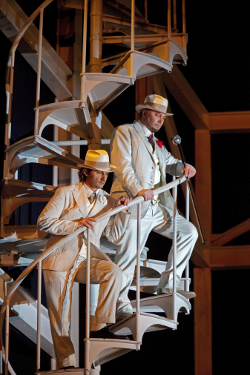 Jonas Kaufmann as Faust and René Pape as Méphistophélès
The orchestra was led adroitly by Yanick Nézet-Séguin. Given the current turmoil surrounding the orchestra and the fate of its beloved conductor, James Levine, it was a joy to see that the ensemble was still capable of performing with the artistry that Levine has so meticulously instilled in the players. Nézet-Séquin made his debut a few years ago conducting the debut of Richard Eyre’s production of Carmen. Those performances showcased his penchant for extracting the quintessentially French qualities of French opera. It was wonderful to experience his ability to bring out the same qualities in Faust. His reading was replete with tension, passion, and lyricism; in short, everything needed to show the brilliance of this opera when performed at its best.
The stellar cast was headed by Jonas Kaufmann. This tenor, who has made a name for himself in French, German, and Italian repertoire, is still riding on the heels of his success in last year’s run of Tosca. The applause that occurred in the second act of Tosca at his cry of “Victoria, Victoria”, was an event never before seen at The Met that has reached something of a fabled status. A similar event occurred during Faust, after he sang his Act II show piece; he received not only the traditional mix of bravos and applause, but also hooting and hollering. As someone who has experienced countless operas, this overwhelming crowd reaction was a first for me. And it was heartwarming to behold. Needless to say, such a reaction was warranted in every sense of the word. His rendition of the aria showcased his adept management of dynamics. In addition, he is the vilest Faust I have ever had the pleasure of witnessing. For instance, at the end of the fairground scene, which comprises the first meeting of Faust and Marguerite, he forced himself into a waltz with Marguerite despite the fact that she had just moments ago declined his flattery. Such a contrast between Marguerite’s innocence and Faust’s cruelty elevated the relationship of the two characters to that of Don Giovanni and Donna Elvira. In the Act III love duet, when faced with Marguerite’s initial refusal, he forcefully tackled her to the ground. Needless to say, his strong acting was married perfectly to his masterful singing.
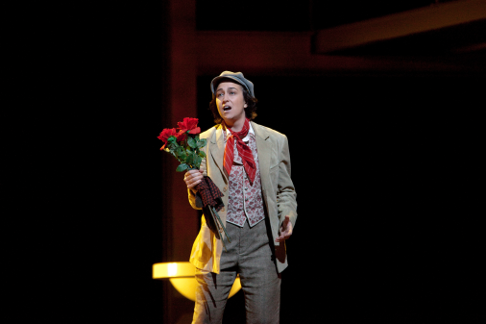 Michèle Losier as Siebel
Since her debut as Liu in Turandot, Marina Poplavskaya has created an impressive list of new Met productions. Now Faust joins Willy Decker’s Traviata, and Nicholas Hytner’s Don Carlo. Despite the split press for these two productions, she was ideally suited for Marguerite. Her rendition was replete with the innocence and naivety of the character as previously epitomized by Victoria de Los Angeles. However, unlike the great Diva, Poplavskaya’s Marguerite had the hint of a narcissistic teenager floating just below the surface. The way she played with her sweater and her hair during the ballad of the King of Thule suggested that she knew that men could find her attractive but was trying not to admit this to herself. Additionally, her capable physical acting came into focus in the second half of the opera when she was pregnant with Faust’s child.
René Pape who played Mephistopheles is a consummate performer. His work as the lead in last year’s production of Boris Godunov was dynamic in every sense of the word. His performance meshed the evil and comic aspects of the character beautifully. He was able to give a thrilling performance of “Le Veau D’Or”, while at the same time doing enacting a tap dance routine during his serenade to Marguerite.
Other noteworthy performers include Michele Losier whose Siébel was appropriately naïve. Russell Braun gave a stirring portrayal of Valentin. His first act aria was intensely the prayer it should be. Also, his dying curse on Marguerite was all the more heart wrenching because it was obvious that despite his words, he still loved his sister. As Martha, Wendy White showcased her comic talents to a marvelous degree.
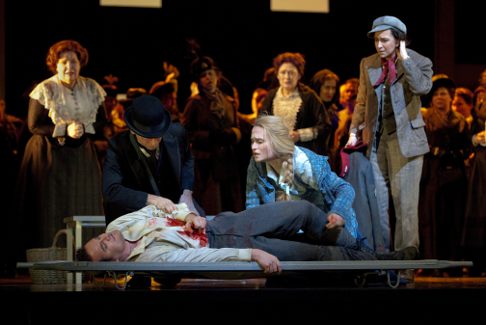 Russel Braun as Valentin and Marina Poplavskaya as Marguerite
This production was directed by Des McAnuff, whose credits include Jersey Boys as well as the movie Rocky and Bullwinkle. He desired to set the opera in the post atomic age. The beginning was to take place shortly after the detonation of the atomic bombs over Hiroshima and Nagasaki. The production would then go back to Faust’s youth around the time of World War I and then slowly makes its return to the present. McAnuff’s goal was to allow Faust to examine where humanity went wrong and why the atomic bomb was dropped over Japan. This was slightly misguided. While appropriate to other settings of the Faust legend, such as the play, Dr. Faustis, by Christopher Marlow, emphasizing the atomic bomb would eschew Faust’s relationship with Marguerite which is the focus of the opera. Ironically, this production should be lauded for what it did not achieve. The atomic bomb was present in frequent flashes of light as well as an image of a mushroom cloud which began the Black Sabbath. But these instances were trivial, and the mushroom cloud could have been easily construed as a puff of smoke billowing out of a witch’s cauldron. Thankfully, for the sake of the opera, Marguerite remained the focal point. If anything, due to the use of a curtain during intermission which displayed changing images of Marguerite, her position in the opera was intensified. Like other recent operas, such as Rossini’s Armida, Faust contains a substantial amount of magic. Mr. McAnuff can congratulate himself for keeping the mystery and the magic alive.
Another significant innovation of this production was its portrayal of Mephistopheles as an extension of Faust’s character. This harkens back to the line in the original German play in which Faust in conversation with his student, Wagner, refers to himself as having two personalities. He says “you know one, may you never know the other”. Unfortunately, McAnuff’s decision to portray the whole opera as Faust’s fantasy after he had poisoned himself is problematic. To begin with, Faust is a two part drama. Although the second part is never alluded to within the course of Gounod’s opera, based on the inherent villainy of Kaufman’s, I would be willing to bet that if given the opportunity to live, to experience more debauchery, he would easily avoid dying. Secondly, the fact that the action of the opera was portrayed as Faust’s fantasy as conjured up by Mephistopheles created incongruences in the stage action. True, everything in this opera is an extension of Faust’s fantasy as made possible by Mephistopheles, but Faust has to be able to participate in that fantasy. At times he was not able to. Also, the action of the opera took place within Faust’s laboratory. While colorful, dreamlike scenery was introduced after the first act, until the end of the fairgrounds scene, the set was sparse and monochromatic. Lastly, the unidimensional nature of the rather bare set did not help the singers to project to the back of the theater. This was at times evident in Kaufman’s performance.
This production by McAnuff showed every aspect Faust from the music to the story in its best light. Despite occasional blemishes, the opera which opened the Met in 1893 has a made a triumphant return.
Gregory Moomjy