![Salome Poster [Manitoba Opera]](http://www.operatoday.com/Salome_Manitoba_Poster.gif)
01 Dec 2011
Salome, Manitoba Opera
Opera has never been an art form to hold anything back. But even within the genre itself, Salome is — literally — one tough, depraved act to follow.
English Touring Opera are delighted to announce a season of lyric monodramas to tour nationally from October to December. The season features music for solo singer and piano by Argento, Britten, Tippett and Shostakovich with a bold and inventive approach to making opera during social distancing.
This tenth of ten Live from London concerts was in fact a recorded live performance from California. It was no less enjoyable for that, and it was also uplifting to learn that this wasn’t in fact the ‘last’ LfL event that we will be able to enjoy, courtesy of VOCES8 and their fellow vocal ensembles (more below …).
Ever since Wigmore Hall announced their superb series of autumn concerts, all streamed live and available free of charge, I’d been looking forward to this song recital by Ian Bostridge and Imogen Cooper.
Although Stile Antico’s programme article for their Live from London recital introduced their selection from the many treasures of the English Renaissance in the context of the theological debates and upheavals of the Tudor and Elizabethan years, their performance was more evocative of private chamber music than of public liturgy.
Evidently, face masks don’t stifle appreciative “Bravo!”s. And, reducing audience numbers doesn’t lower the volume of such acclamations. For, the audience at Wigmore Hall gave soprano Elizabeth Llewellyn and pianist Simon Lepper a greatly deserved warm reception and hearty response following this lunchtime recital of late-Romantic song.
For this week’s Live from London vocal recital we moved from the home of VOCES8, St Anne and St Agnes in the City of London, to Kings Place, where The Sixteen - who have been associate artists at the venue for some time - presented a programme of music and words bound together by the theme of ‘reflection’.
'Such is your divine Disposation that both you excellently understand, and royally entertaine the Exercise of Musicke.’
‘And there was war in heaven: Michael and his angels fought against the dragon; and the dragon fought and his angels, And prevailed not; neither was their place found any more in heaven … that old serpent … Satan, which deceiveth the whole world: he was cast out into the earth, and his angels were cast out with him.’
There was never any doubt that the fifth of the twelve Met Stars Live in Concert broadcasts was going to be a palpably intense and vivid event, as well as a musically stunning and theatrically enervating experience.
‘Love’ was the theme for this Live from London performance by Apollo5. Given the complexity and diversity of that human emotion, and Apollo5’s reputation for versatility and diverse repertoire, ranging from Renaissance choral music to jazz, from contemporary classical works to popular song, it was no surprise that their programme spanned 500 years and several musical styles.
The Academy of St Martin in the Fields have titled their autumn series of eight concerts - which are taking place at 5pm and 7.30pm on two Saturdays each month at their home venue in Trafalgar Square, and being filmed for streaming the following Thursday - ‘re:connect’.
The London Symphony Orchestra opened their Autumn 2020 season with a homage to Oliver Knussen, who died at the age of 66 in July 2018. The programme traced a national musical lineage through the twentieth century, from Britten to Knussen, on to Mark-Anthony Turnage, and entwining the LSO and Rattle too.
With the Live from London digital vocal festival entering the second half of the series, the festival’s host, VOCES8, returned to their home at St Annes and St Agnes in the City of London to present a sequence of ‘Choral Dances’ - vocal music inspired by dance, embracing diverse genres from the Renaissance madrigal to swing jazz.
Just a few unison string wriggles from the opening of Mozart’s overture to Le nozze di Figaro are enough to make any opera-lover perch on the edge of their seat, in excited anticipation of the drama in music to come, so there could be no other curtain-raiser for this Gala Concert at the Royal Opera House, the latest instalment from ‘their House’ to ‘our houses’.
"Before the ending of the day, creator of all things, we pray that, with your accustomed mercy, you may watch over us."
The doors at The Metropolitan Opera will not open to live audiences until 2021 at the earliest, and the likelihood of normal operatic life resuming in cities around the world looks but a distant dream at present. But, while we may not be invited from our homes into the opera house for some time yet, with its free daily screenings of past productions and its pay-per-view Met Stars Live in Concert series, the Met continues to bring opera into our homes.
Music-making at this year’s Grange Festival Opera may have fallen silent in June and July, but the country house and extensive grounds of The Grange provided an ideal setting for a weekend of twelve specially conceived ‘promenade’ performances encompassing music and dance.
There’s a “slide of harmony” and “all the bones leave your body at that moment and you collapse to the floor, it’s so extraordinary.”
“Music for a while, shall all your cares beguile.”
The hum of bees rising from myriad scented blooms; gentle strains of birdsong; the cheerful chatter of picnickers beside a still lake; decorous thwacks of leather on willow; song and music floating through the warm evening air.
Opera has never been an art form to hold anything back. But even within the genre itself, Salome is — literally — one tough, depraved act to follow.
Manitoba Opera’s new production of Richard Strauss’ staged tone poem sung in German (with English surtitles) took its viewers into the blackest heart of darkness as a daring choice to open its new season. Based on Hedwig Lachmann’s translation of Oscar Wilde’s play Salomé, the 110-minute production (no intermission) directed by MO general director/CEO Larry Desrochers featured an expanded Winnipeg Symphony Orchestra led by the company’ principal conductor/music advisor, maestro Tyrone Paterson. The three-show run held November 19 to 25, 2011 at Winnipeg’s Centennial Concert Hall notably marks only the company’s second staging of the 20th century classic in 23 years.
The gritty, one-act opera based on the New Testament story of the beheading of John the Baptist deals with incest, prophecy, and madness — and yes, ultimately, love. Young Princess Salome has become obsessed with prophet Jokannan who is imprisoned by her stepfather/uncle, King Herod. He, in turn, lusts for her and cajoles her to dance for him. She agrees only after he promises he will give her whatever she desires — in this case, the Baptist’s head on a silver platter.
Russian-born soprano Mlada Khudoley has performed the title role approximately a dozen times over the past 13 years. Her riveting portrayal displayed her impressive dramatic range that had her pounding her fists like a tempestuous teenager before morphing into a hell bent, vengeful woman on the brink of insanity. The US-based powerhouse’s well-paced vocal delivery allowed her to save her last breath — if it were possible — for her final declamatory “If you had seen me, you would have loved me” that is the impetus for this opera. Strauss’ dissonant, through-composed score proved no match for this dynamo, with her soaring voice effortlessly projecting over the knotty, Wagnerian-scale orchestration.
Tenor Dennis Petersen crafted his lecherous Herod, at times, as a sickeningly juvenile ruler who plays peek-a-boo with Salome during her erotic “Dance of the Seven Veils” choreographed by Brenda Gorlick. His penetrating voice grew more desperate as he lured his stepdaughter in “Dance for me, Salome,” later stamping his feet in a sudden, volatile outburst after the princess insists on her prize. His wife/sister-in-law Herodias sung by the incomparable Canadian mezzo-soprano Judith Forst sputtered as a long-suffering partner, attempting to pierce her husband’s growing obsession for Salome like a knife.
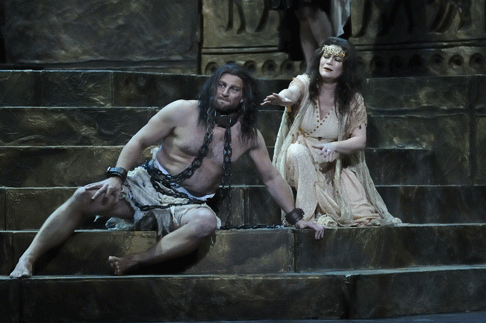 lada Khudoley as Salome and Gregory Dahl as Jokanaan [Photo by R. Tinker courtesy of Manitoba Opera]
Special mention must be made of Winnipeg baritone Gregory Dahl’s chain-shackled Jokanaan, who immediately asserted his booming presence even from the depths of the cistern with his first vocal entry, “After me, will come one.” The charismatic singer brought both requisite strength and nobility to the role, with his robust voice trembling with fury as he foretold the coming of the Son of Man.
Lyric tenor Michael Colvin performed Captain of the Guard, Narraboth with focused clarity, growing increasingly agitated as Salome ignores his advances for Jokanaan. Mezzo-soprano Marcia Whitehead’s Page set the stage for the entire tragedy to unfold with her ominous “Something terrible will happen.”
The chorus of five Jews (Mark Thomsen; Michel Corbeil; P.J. Buchan; Keith Klassen; David Watson) brought contrapuntal might to the stage with the two Nazarenes (Mark Bodden; Peter Klymkiw) telling of miracles.
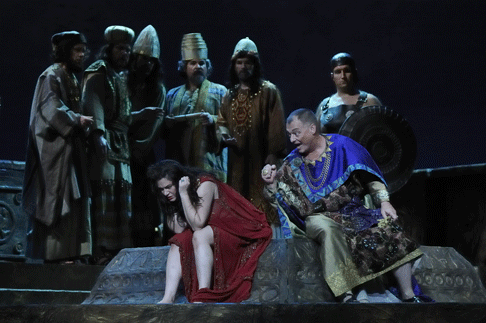 Mlada Khudoley as Salome and Dennis Petersen as Herod [Photo by R. Tinker courtesy of Manitoba Opera]
Several intriguing directorial choices underscored the love triangle — if you will — between Herod, Salome and Jokanaan, with Salome quietly slipping a veil into the cistern while also gravitating towards it during her famous striptease, creating multiple layers of sub-text. The closing image of Salome bathed in white light after being killed by Herod’s guards also suggested her own redemption (by love?); a purifying baptism of sorts that made her a sympathetic character to be pitied, not abhorred.
The production featured Boyd Ostroff’s set design created for the Opera Company of Philadelphia with a large, luminous moon radiating throughout the show, as well as blood red lighting effects by Bill Williams. Costumes designed by Richard St. Clair included jewel-encrusted robes for Herod and his wife and a series of voluminous veils for Salome’s seductive dance.
Salome is not an opera for the faint of heart — nor is it the safest box office draw. There are no jocular drinking songs or bands of dancing gypsies for levity. Salome’s chilling aria “Ah, you would not let me kiss your mouth” sung to the bloodied, severed head before she does just that still resonates with horror even in the 21st century. Salome remains a fiercely relentless opera that deserves to be seen by any serious opera lover. After nearly a quarter century hiatus, MO audiences were finally given that chance.
Holly Harris