![William Burden as Nikolaus Sprink [Photo 2011 © Michal Daniel courtesy of Minnesota Opera]](http://www.operatoday.com/MNO_1819.gif)
06 Dec 2011
Silent Night, Minnesota Opera
At the November 12, 2011 world premiere of Silent Night at the Ordway Theatre in St. Paul, a buzz of energy filled the audience.
English Touring Opera are delighted to announce a season of lyric monodramas to tour nationally from October to December. The season features music for solo singer and piano by Argento, Britten, Tippett and Shostakovich with a bold and inventive approach to making opera during social distancing.
This tenth of ten Live from London concerts was in fact a recorded live performance from California. It was no less enjoyable for that, and it was also uplifting to learn that this wasn’t in fact the ‘last’ LfL event that we will be able to enjoy, courtesy of VOCES8 and their fellow vocal ensembles (more below …).
Ever since Wigmore Hall announced their superb series of autumn concerts, all streamed live and available free of charge, I’d been looking forward to this song recital by Ian Bostridge and Imogen Cooper.
Although Stile Antico’s programme article for their Live from London recital introduced their selection from the many treasures of the English Renaissance in the context of the theological debates and upheavals of the Tudor and Elizabethan years, their performance was more evocative of private chamber music than of public liturgy.
Evidently, face masks don’t stifle appreciative “Bravo!”s. And, reducing audience numbers doesn’t lower the volume of such acclamations. For, the audience at Wigmore Hall gave soprano Elizabeth Llewellyn and pianist Simon Lepper a greatly deserved warm reception and hearty response following this lunchtime recital of late-Romantic song.
For this week’s Live from London vocal recital we moved from the home of VOCES8, St Anne and St Agnes in the City of London, to Kings Place, where The Sixteen - who have been associate artists at the venue for some time - presented a programme of music and words bound together by the theme of ‘reflection’.
'Such is your divine Disposation that both you excellently understand, and royally entertaine the Exercise of Musicke.’
‘And there was war in heaven: Michael and his angels fought against the dragon; and the dragon fought and his angels, And prevailed not; neither was their place found any more in heaven … that old serpent … Satan, which deceiveth the whole world: he was cast out into the earth, and his angels were cast out with him.’
There was never any doubt that the fifth of the twelve Met Stars Live in Concert broadcasts was going to be a palpably intense and vivid event, as well as a musically stunning and theatrically enervating experience.
‘Love’ was the theme for this Live from London performance by Apollo5. Given the complexity and diversity of that human emotion, and Apollo5’s reputation for versatility and diverse repertoire, ranging from Renaissance choral music to jazz, from contemporary classical works to popular song, it was no surprise that their programme spanned 500 years and several musical styles.
The Academy of St Martin in the Fields have titled their autumn series of eight concerts - which are taking place at 5pm and 7.30pm on two Saturdays each month at their home venue in Trafalgar Square, and being filmed for streaming the following Thursday - ‘re:connect’.
The London Symphony Orchestra opened their Autumn 2020 season with a homage to Oliver Knussen, who died at the age of 66 in July 2018. The programme traced a national musical lineage through the twentieth century, from Britten to Knussen, on to Mark-Anthony Turnage, and entwining the LSO and Rattle too.
With the Live from London digital vocal festival entering the second half of the series, the festival’s host, VOCES8, returned to their home at St Annes and St Agnes in the City of London to present a sequence of ‘Choral Dances’ - vocal music inspired by dance, embracing diverse genres from the Renaissance madrigal to swing jazz.
Just a few unison string wriggles from the opening of Mozart’s overture to Le nozze di Figaro are enough to make any opera-lover perch on the edge of their seat, in excited anticipation of the drama in music to come, so there could be no other curtain-raiser for this Gala Concert at the Royal Opera House, the latest instalment from ‘their House’ to ‘our houses’.
"Before the ending of the day, creator of all things, we pray that, with your accustomed mercy, you may watch over us."
The doors at The Metropolitan Opera will not open to live audiences until 2021 at the earliest, and the likelihood of normal operatic life resuming in cities around the world looks but a distant dream at present. But, while we may not be invited from our homes into the opera house for some time yet, with its free daily screenings of past productions and its pay-per-view Met Stars Live in Concert series, the Met continues to bring opera into our homes.
Music-making at this year’s Grange Festival Opera may have fallen silent in June and July, but the country house and extensive grounds of The Grange provided an ideal setting for a weekend of twelve specially conceived ‘promenade’ performances encompassing music and dance.
There’s a “slide of harmony” and “all the bones leave your body at that moment and you collapse to the floor, it’s so extraordinary.”
“Music for a while, shall all your cares beguile.”
The hum of bees rising from myriad scented blooms; gentle strains of birdsong; the cheerful chatter of picnickers beside a still lake; decorous thwacks of leather on willow; song and music floating through the warm evening air.
At the November 12, 2011 world premiere of Silent Night at the Ordway Theatre in St. Paul, a buzz of energy filled the audience.
Silent Night had been highly anticipated in the Twin Cities for over the past year, which the company had work-shopped the opera with its Resident Artist singers, tweaking vocal parts, shoring up orchestral textures, as well as readying the Minnesota Opera’s fan base for a different kind of opera outside of its more traditional programming. Anticipation was also high for this particular performance, as only the Opera Company of Philadelphia had contributed to the commission, and several representatives of interested companies were in the audience to scout this opera for their prospective seasons.
Based upon a true World War I story, Christian Carion’s 2005 film Joyeux Noël, depicted an incident during World War I near the French border. Three encampments, Scottish, French and German, encircled a battlefield. After bloody fighting, soldiers called an unofficial truce for Christmas day, 1914. The film’s compelling message of religious unity and the commonality of the human condition, all in the midst of waging war, inspired Dale Johnson, artistic director of the Minnesota Opera, to commission Kevin Puts to translate the film into operatic form.
Silent Night is Puts’s first opera, though his career boasts a variety of orchestral and chamber works commissioned and performed by leading orchestras, ensembles and soloists throughout North America, Europe and the Far East. Johnson provided Puts with significant dramaturgical support partnering the composer with veteran librettist Mark Campbell and director Eric Simonson. “Eric’s not only a wonderful director, he’s an accomplished writer himself,” Johnson said. “So we put him and Mark in the mix to really make sure this young composer had the kind of support he needed to create the piece.” (Opera News, 2011)
Despite the gamble of hiring a composer with no operatic compositional experience, Silent Night is arguably one of Minnesota Opera’s most masterful achievements in recent years. The company’s $1.5 million budget for this work was 50 percent larger than a normal season production, supported by their New Work’s Initiative. The production thus boasted polished performers across the board, as well as a visually realistic yet imaginative set, including a shockingly violent battle scene that opens the opera. Francis O’Connor’s ingenious staging, Kärin Kopischke’s military costumes hit the mark, with Marcus Dilliard’s lighting and Andrzej Goulding’s digital projections tastefully inserted to heighten the dramatic effect.
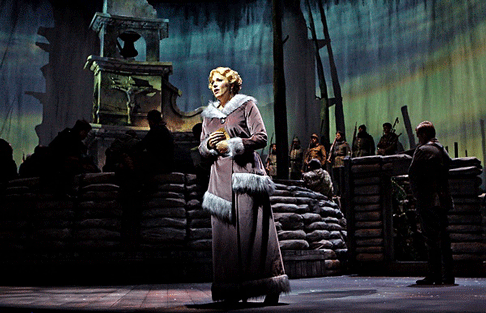 Karin Wolverton as Anna Sørensen
The one drawback of the premiere performance was the illness of the lead tenor, William Burden, in the role of Nikolaus Sprink. Burden was able to walk the role of Sprink, while former resident artist Brad Benoit, who had work-shopped the role last year, sang from the wings. Benoit gave a solid performance, despite having received the call only hours before the performance. It was clear, however, that there lacked some finesse and power in many of the soaring musical lines, as Benoit was eager to end the phrase while the orchestra clung to ritardandos originally dictated by Burden. The character of Sprink is a German opera singer manning the front lines, and Puts places much of the musical emphasis and beauty on this character vocal lines, which were unfortunately not delivered to their fullest on opening night.
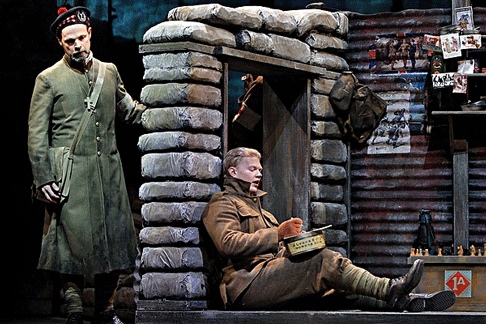 Troy Cook as Father Palmer and John Robert Lindsey as Jonathan Dale
However, John Robert Lindsey’s Jonathan, Andrew Wilkowske’s Ponchel and the trio of lieutenant (performed by Liam Bonner, Craig Irvin, and Gabriel Preisser) achieved the most captivating musical moments. Bonner’s clarion baritone and grounded stage presence was of special note. With his flexible yet full instrument rising to the role’s high dramatic tasks, Lindsey is a young tenor to watch,
Though the production and performers delivered an outstanding performance, the composition itself lacked many things that make opera opera. As an accomplished orchestral composer, Puts’ orchestral writing knows no bounds, and encompasses high emotional ranges with striking instrumental colors and textures. The opening battle scene evokes the rhythmic intensity and sharpness of Bernstein’s Westside Story and the harmonic clash and tension of Gustav Holst’s Mars.
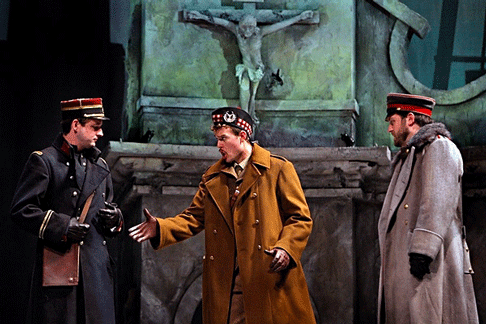 Liam Bonner as Lieutenant Audebert, Gabriel Preisser as Lieutenant Gordon and Craig Irvin as Lieutenant Horstmayer
But, there seem to be no real musical moments in the vocal writing. There is no pivotal aria that lingers in the mind after the performance finishes, and most of the vocal writing is more of a recitative style, with fewer soaring lines. The writing is more through-composed, dramatically trucking along at a good pace in Act I, but losing steam in Act II. There are also many silences in the vocal parts, and Puts seems to give the orchestra the heavier lifting to carry the drama.
Puts will obviously learn from his experience writing his first opera. His compositional style, especially in the orchestra, is attractive to a more modern ear, evoking orchestral soundtracks of this generation. If he can better apply his knowledge for color, harmonic tension, and rhythmic intensity to his vocal writing, he will be formidable.
Sarah Luebke