Recently in Performances
English Touring Opera are delighted to announce a season of lyric monodramas to tour nationally from October to December. The season features music for solo singer and piano by Argento, Britten, Tippett and Shostakovich with a bold and inventive approach to making opera during social distancing.
This tenth of ten Live from London concerts was in fact a recorded live performance from California. It was no less enjoyable for that, and it was also uplifting to learn that this wasn’t in fact the ‘last’ LfL event that we will be able to enjoy, courtesy of VOCES8 and their fellow vocal ensembles (more below …).
Ever since Wigmore Hall announced their superb series of autumn concerts, all streamed live and available free of charge, I’d been looking forward to this song recital by Ian Bostridge and Imogen Cooper.
Although Stile Antico’s programme article for their Live from London recital introduced their selection from the many treasures of the English Renaissance in the context of the theological debates and upheavals of the Tudor and Elizabethan years, their performance was more evocative of private chamber music than of public liturgy.
Evidently, face masks don’t stifle appreciative “Bravo!”s. And, reducing audience numbers doesn’t lower the volume of such acclamations. For, the audience at Wigmore Hall gave soprano Elizabeth Llewellyn and pianist Simon Lepper a greatly deserved warm reception and hearty response following this lunchtime recital of late-Romantic song.
For this week’s Live from London vocal recital we moved from the home of VOCES8, St Anne and St Agnes in the City of London, to Kings Place, where The Sixteen - who have been associate artists at the venue for some time - presented a programme of music and words bound together by the theme of ‘reflection’.
'Such is your divine Disposation that both you excellently understand, and royally entertaine the Exercise of Musicke.’
‘And there was war in heaven: Michael and his angels fought against the dragon; and the dragon fought and his angels, And prevailed not; neither was their place found any more in heaven … that old serpent … Satan, which deceiveth the whole world: he was cast out into the earth, and his angels were cast out with him.’
There was never any doubt that the fifth of the twelve Met Stars Live in Concert broadcasts was going to be a palpably intense and vivid event, as well as a musically stunning and theatrically enervating experience.
‘Love’ was the theme for this Live from London performance by Apollo5. Given the complexity and diversity of that human emotion, and Apollo5’s reputation for versatility and diverse repertoire, ranging from Renaissance choral music to jazz, from contemporary classical works to popular song, it was no surprise that their programme spanned 500 years and several musical styles.
The Academy of St Martin in the Fields have titled their autumn series of eight concerts - which are taking place at 5pm and 7.30pm on two Saturdays each month at their home venue in Trafalgar Square, and being filmed for streaming the following Thursday - ‘re:connect’.
The London Symphony Orchestra opened their Autumn 2020 season with a homage to Oliver Knussen, who died at the age of 66 in July 2018. The programme traced a national musical lineage through the twentieth century, from Britten to Knussen, on to Mark-Anthony Turnage, and entwining the LSO and Rattle too.
With the Live from London digital vocal festival entering the second half of the series, the festival’s host, VOCES8, returned to their home at St Annes and St Agnes in the City of London to present a sequence of ‘Choral Dances’ - vocal music inspired by dance, embracing diverse genres from the Renaissance madrigal to swing jazz.
Just a few unison string wriggles from the opening of Mozart’s overture to Le nozze di Figaro are enough to make any opera-lover perch on the edge of their seat, in excited anticipation of the drama in music to come, so there could be no other curtain-raiser for this Gala Concert at the Royal Opera House, the latest instalment from ‘their House’ to ‘our houses’.
"Before the ending of the day, creator of all things, we pray that, with your accustomed mercy, you may watch over us."
The doors at The Metropolitan Opera will not open to live audiences until 2021 at the earliest, and the likelihood of normal operatic life resuming in cities around the world looks but a distant dream at present. But, while we may not be invited from our homes into the opera house for some time yet, with its free daily screenings of past productions and its pay-per-view Met Stars Live in Concert series, the Met continues to bring opera into our homes.
Music-making at this year’s Grange Festival Opera may have fallen silent in June and July, but the country house and extensive grounds of The Grange provided an ideal setting for a weekend of twelve specially conceived ‘promenade’ performances encompassing music and dance.
There’s a “slide of harmony” and “all the bones leave your body at that moment and you collapse to the floor, it’s so extraordinary.”
“Music for a while, shall all your cares beguile.”
The hum of bees rising from myriad scented blooms; gentle strains of birdsong; the cheerful chatter of picnickers beside a still lake; decorous thwacks of leather on willow; song and music floating through the warm evening air.
Performances
![Wolfgang Koch as Hans Sachs and Emma Bell As Eva [Photo © ROH 2011 / Clive Barda]](http://www.operatoday.com/MEISTERSINGER-111216_0229.gif)
23 Dec 2011
Die Meistersinger von Nürnberg, Royal Opera House
Perhaps it’s no accident that Graham Vick’s Die Meistersinger von Nürnberg returns to the Royal Opera House for the Christmas season. Red, green, gold, sumptuous colours that warm a long, grey evening.
Die Meistersinger von Nürnberg is a comedy and here’s it’s
presented as the ultimate up market Xmas show. It’s extremely enjoyable, and
an ideal introduction to the opera experience. Richard Wagner, though, gets
sidelined.
Sir John Tomlinson is a definite reason for catching this revival. The days
when he could sing Hans Sachs are past, but he creates an unusually vivid Veit
Pogner. Tomlinson plays Pogner powerfully, as if he was a former Sachs, whose
reasons for committing his daughter to this bizarre marriage make sense. He’s
dedicating his daughter to art, not too shabby politics. Luckily for him, and
for Eva, Walter von Stolzing arrives in the nick of time. Indeed, Beckmesser
very nearly persuades the Meistersingers to drive Walter out of town. Things
could so easily have turned out quite differently. Die Meistersinger von
Nürnberg may be comic, but it evolves against a background of tension. At
any moment anarchy could breakout. Unless the Meistersingers adapt, they might
not survive.
Wagner builds tension into the music. The Meistersingers sing at cross
purposes, and in the riot scene, the turbulence of the chorus evokes the
violence which comes with all revolution. That’s why the Night Watchman sings
“bewahrt euch vor Gespenstern und Spuk, dass kein böser Geist eu’r Seel’
beruck’!” The music for the apprentice boys is energetic, a warning for
those who remember Wagner’s protosocialism. This time, however, no dangerous
ideas. We’re treated to a good natured Meistersinger, where the
apprentices dance with little vigour, and the blows Sachs throws at David have
no menace. Antonio Pappano received the longest applause of all on the first
night,. Most audiences can relate better to joyful Romaticism in music better
than to Wagner-on-edge, so it’s understandable. He clearly enjoys the
life-affirming elements in this opera, which come over well. Christmas is not
the right time for radical ideas, and this is not a production that would
support them.
Graham Vicks’s riot scene is classic because it’s so well imagined. The
townsfolk pop out of windows and hang precariously upside down over the stage.
One man looks like he’s about to lose his footing (this happened in earlier
productions, so it was planned) In their nightshirts the townsfolk look like
escapees from an asylum, a good idea but not developed. The Festweise
scene is masterfully blocked, so each guild is clearly defined. I liked
the acrobats in the background, too. But these scenes aren’t for
entertainment but emphasize the traumas in Nürnberg’s past.
Because John Tomlinson so dominates the first Act, Wolfgang Koch’s Hans
Sach might be overlooked, but Koch understands the role. Sachs is an observer,
who stands apart from the crowd, and who thinks before he acts. Koch’s Sachs
is sung with sensitivity, and would be very effective in a more perceptive
production which focuses on Sachs and not the scenery. Koch looks and sounds
younger than the other Meistersingers and is rather more lyrical than Simon
O’Neill’s Walther von Stolzing who is more hoch dramatisch than
true Heldentenor. This was the best performance I’ve ever heard from
O’Neill, and he was good, but it’s a part better suited to a more luminous
timbre. O’Neill was, however, a good match for Emma Bell’s Eva, joyfully
created though perhaps more Italianate than Wagnerian. In a cheerful,
non-idiomatic production like this, it didn’t matter, and they conveyed the
story. Popular favourite, Toby Spence, sang a very good David, but he’s more
upper class than roustabout.
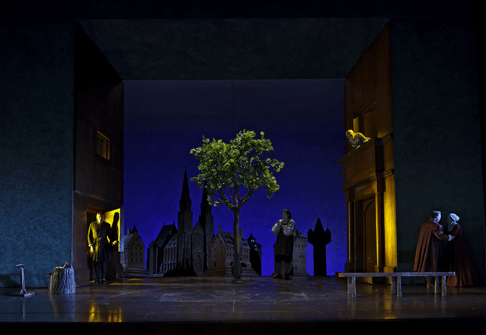 (L-R) Peter Coleman-Wright as Beckmesser, Wolfgang Koch as Hans Sachs, Heather Shipp as Magdalene, Simon O’Neill as Walther and Emma Bell as Eva
It was good to see many teenagers in the audience, another good reason for
having a show like this in holiday time. Last week, David Chandler took his
daughter to Kurt Weill’s Magical Night at the Linbury, (reviewed
here) and she was ecstatic. We can give kids toys anytime, but the gift of
a magical experience is beyond compare. And the same goes for adults, new to
opera. This Meistersinger may not tell us much about the opera or
about Wagner, but it’s an excellent night out.
Anne Ozorio