Subscribe to
Opera Today

Receive articles and news via RSS feeds or email subscription.


twitter_logo[1].gif


9780521746472.png

Recently in Performances

The Importance of Being Earnest, Covent Garden

The Importance of Being Earnest , Gerald Barry’s fifth opera, was commissioned by the Los Angeles Philharmonic Orchestra and the Barbican, and was first performed in concert, Thomas Adès conducting the London premiere.

Death in Venice by ENO

‘Beauty is the one form of spirituality that we experience through the senses.’ In Thomas Mann’s, Death in Venice, Plato’s axiom stirs the hopes of the aging, intellectually stale poet, Gustav von Aschenbach, that he may rekindle his creativity.

Madama Butterfly, Opera Holland Park

There is a sense in which it all began in London, Puccini having been seized in 1900 with the idea of an opera on this subject after watching David Belasco’s play here.

An Evening of Zarzuela and Latin American Music at Los Angeles Opera

The tenor that the audience most wanted to hear, Plácido Domingo, opened the vocal program with “Junto al puente de la peña” (Next to the rock bridge) from La Canción del Olvido (The song of Oblivion) by José Serrano. He sounded rested and his voice soared majestically over the orchestra.

Così fan tutte in San Francisco

Tucked away somewhere in the San Francisco Opera warehouse was an old John Cox production of Così fan tutte from Monte Carlo. Well, not that old by current standards at San Francisco Opera.

Rossini Maometto Secondo Garsington Opera at Wormsley

Rossini's Maometto Secondo is a major coup for Garsington Opera at Wormsley, confirming its status as the leading specialist Rossini house in Britain. Maometto Secondo is a masterpiece, yet rarely performed because it's formidably difficult to sing. It's a saga with some of the most intense music Rossini ever wrote, expressing a drama so powerful that one can understand why early audiences needed "happy endings" to water down its impact

Peter Grimes in Concert

I suppose it was inevitable that, in this Britten Centenary year, the 66th Aldeburgh Festival would open with Peter Grimes.

Die Entführung aus dem Serail, Garsington Opera at Wormsley

Die Entführung aus dem Serail at Garsington Opera at Wormsley isn’t Mozart as you’d expect but it’s true to the spirit of Mozart who loved witty, madcap japes.

Le nozze di Figaro, Glyndebourne

What a pity! On a glorious — well, by recent English standards — summer’s day, there can be few more beautiful English countryside settings than Glyndebourne, with the added bonus, as alas much of the audience appears to understand it, of an opera house attached.

Queens, Heroines and Ladykillers

Described by one critic as “cosmically gifted”, during her tragically short career, American mezzo-soprano Lorraine Hunt Lieberson amazed and delighted audiences with the spellbinding beauty of her singing and the astonishing honesty of her performances.

Alzira by Chelsea Opera Group

“I wrote it almost without noticing.” So Verdi declared when reminded of his eighth — and perhaps least frequently performed, opera, Alzira. One might say that, since he composed the work, no-one else has much noticed either.

Les Contes d’Hoffmann in San Francisco

Just when you thought the protagonist was Hoffmann! Who, rather what stole the show?

La Tosca in Los Angeles

When is verismo verily veristic? Or what is a virginal girl dressed in communion white doing in the two murderous acts of the Los Angeles Opera’s current production of Tosca? And why does she sing the shepherd's song?

Lohengrin, Welsh National Opera

Wagner’s Lohengrin is not an unfamiliar visitor to the UK thanks, in the main, to Elijah Moshinsky’s perennial production at Covent Garden.

Philip Glass: The Perfect American

Philip Glass's The Perfect American at the ENO in London is a visual treat, but the libretto is mind-numbingly anodyne.

Jonathan Dove’s Mansfield Park

Jonathan Dove's Mansfield Park, with libretto by his regular collaborator Alasdair Middleton, has the remarkable distinction of being the first completed operatic adaptation of any Jane Austen novel to be staged.

Wagner 200th Anniversary Concert

London’s two principal opera companies have offered a baffling near-silence as their response to Wagner’s two-hundredth anniversary.

Toronto’s Triple Success

If a recent trio of musically superlative performances at Canadian Opera Company is indicative of their norm, the casting director should get a hefty bonus.

Alessandro Scarlatti’s Il Trionfo dell’Onore

Just when you imagine you’ve got the operatic time-line fixed in your mind in a clean sweep of what goes where and when and how, you hear another work from another forgotten corner of the repertory that upends one’s conclusions.

Handel’s Rodrigo by Operamission

Nothing inspires fable quite like defeat. The great riddle of Spanish history is how the Christian Visigoths managed to lose the Iberian peninsula to the Moors in one small battle in 711 and took eight hundred years to get it back.

OPERA TODAY ARCHIVES »

Performances

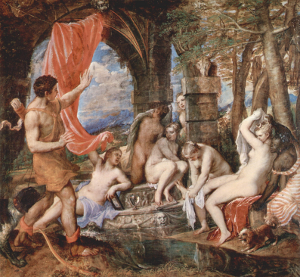
Actaeon Surprising Diana by Titian (1556-59)
25 Jan 2012

Charpentier and Purcell by Early Opera Company

Composed during the spring hunting season of 1684, for a patron and performance venue unknown, Marc-Antoine Charpentier’s brief six-scene Opera de Chasse (‘Hunting Opera’), Actéon, has remained seldom performed and something of a mystery.

Marc-Antonie Charpentier: Actéon; Henry Purcell: Dido and Aeneas

Actéon — Actéon: Ed Lyon; Diane: Claire Booth; Junan: Hilary Summers; Daphne: Ciara Hendrick; Hyale/Arthébuze: Elizabeth Weisburg; Deux Chasseurs: Jeremy Budd, Philip Tebb.

Dido and Aeneas — Aeneas: Marcus Farnsworth; Dido: Susan Bickley; Belinda: Claire Booth; Sorceress: Hilary Summers; First Witch/Second Woman: Elizabeth Weisberg; Second Witch: Ciara Hendrick; Spirit/Sailor: Ed Lyon.

Early Opera Company. Director/harpsichord: Christopher Curnyn. Wigmore Hall, London, Thursday 12 January 2012.

Above: Actaeon Surprising Diana by Titian (1556-59)


Based upon a story from Ovid’s Metamorphoses, this ‘pastorale en musique’ tells the tragic tale of the unfortunate eponymous hunter who unwittingly stumbles upon the secluded bathing haunt of the goddess Diana and her attendant nymphs. He attempts to conceal himself but to no avail, and he is punished severely for his trespass by the angry goddess. Diana transforms him into a stag and Actéon is pursued and torn apart by his own hunting hounds.

It is a fairly lightweight piece, with some dramatic variety and pleasing emotional contrasts; Charpentier’s score is typically elegant, with regard to melodic phrasing, and rhythmically robust, most especially in the bucolic scenes enlivened by dance-like instrumental forms and textures. Here, the assembled soloists emerged from the one-per-part chorus, deftly moving to the forestage at appropriate points, skilfully diverting and sustaining the audience’s attention. All produced a fairly idiomatic pronunciation of the French text; but, while a graceful phrasing of the exquisite yearning phrases was achieved, there was little attempt to render the authentic ornamentation of the French baroque style.

Charpentier, an accomplished tenor, probably composed the title role for himself. Here, Ed Lyon, singing confidently and with obvious commitment to the drama, produced a beautiful youthful tenor, surely sufficiently warm and tender to melt even the most glacial goddess’s heart. If Lyon’s upper register sometimes lacked a little weight and substance, the touching vulnerability of his tender pianissimo in his transformation scene more than compensated; and, he exalted Diana’s loveliness with wondrous awe. His transformation aria was followed by a trio sonata for violins and continuo, exquisitely played by violinists Kati Debretzeni and Huw Daniel supported by Reiko Ichise on viola da gamba.

As Diana, Claire Booth sang with focus and clarity, but while she was admirably reliable in pitch and tone, at times she seemed a little too forceful for the role. The heart-rending action was rudely interrupted by the interjections of Juno (Hilary Summers), who confesses that, in a jealous rage aroused by Jupiter’s infidelity, she has brought about Actéon’s death. Summers enjoyed the extravagant dramatic aspects of the part, projecting powerfully from the Wigmore Hall balcony; but, her tone was rather strident and somewhat undid the mood of elegiac pathos.

Ciara Hendrick and Elizabeth Weisberg completed the line up of competent soloists; the seven singers joined to form a chorus characterised by neat ensemble, and clean, airy textures. After Actéon’s death, his hunting companions lament “the beautiful days cut short” of this invincible hero “in the springtime of his age”; unfortunately some poor flute intonation unsettled the overall tuning at the close of what had been an appealing and convincing performance of an attractive and stirring score.

Charpentier’s Actéon is an unusual yet complementary pairing with Purcell's Dido and Aeneas, the latter being inconveniently succinct and requiring a partnering work. Yet, Charpentier’s score preceded Purcell’s by only five years, and there are many affinities between them, not only of musical style - Purcell’s dance-textures and rhythms often sound distinctly French - but also of situation and mythic context, for Charpentier’s narrative is also related by one of Dido’s ladies-in-waiting in the aria “Oft she visits this lone mountain” in Purcell’s opera.

If Charpentier’s pastoral drama is ultimately rather frivolous, Purcell inspires considerably greater emotional weight and intensity. With Anna Stephany, the advertised Dido, indisposed, Susan Bickley stepped into the role at short notice, presenting a controlled, poised interpretation of regal bearing, betrayal and distress. If her early arias seemed overly guarded and reserved, a little lacking in affective gesture, by the closing lament her noble dignity was firmly established and her portrayal deeply poignant.

Claire Booth was a deliciously rich-toned Belinda, and Hilary Summers’ vocal exaggerations were more apt for the disconcerting devilry of the Sorceress. As Aeneas, baritone Marcus Farnsworth, made as much as is possible of the slim part.

Christian Curmyn led the ensemble in typically controlled and elegant fashion; perhaps his rendering was a little too restrained, more suitable for Charpentier’s relatively inconsequential drama, than for the emotional peaks and troughs of Purcell. There was grace and discipline, but few musical or dramatic surprises; in the Purcell especially, the emotional peaks were somewhat muted, the protagonists a little too self-possessed. Even in the Charpentier the dances lacked spontaneity; one longed for a looser rein which would permit the instrumental players the necessary freedom to inject an improvisatory quality. Purcell’s drunken sailors and grotesque witches were distinctly reserved.

Although we don’t know the circumstances and venue of the first performance of Charpentier’s Actéon, its brevity and intimacy, and the courtly ambience of the French baroque idiom, suggest a private setting. Similarly, while it was once firmly believed that Purcell’s opera was composed for girls’ school in Chelsea run by dancing master Josiah Priest, critics now question whether it was not in fact modelled upon John Blow’s masque, Venus and Adonis, and first performed at court in the 1680s. Whatever their origins, both works are ideally suited to the intimacy of the Wigmore Hall, and the Early Opera Group’s thoughtful, if rather conservative, performance, heightened the grace and eloquence of these elegant, affecting scores.

Claire Seymour
Send to a friend

Send a link to this article to a friend with an optional message.

Friend's Email Address: (required)

Your Email Address: (required)

Message (optional):