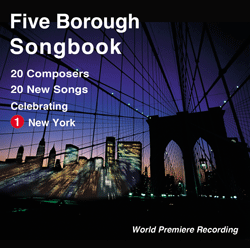
These twenty songs by as many composers are largely concerned with the city as an abstraction, a beloved object, a universal core, or else they address the outer boroughs. Composers, poets, songwriters can no longer afford Manhattan perhaps. They live in Brooklyn’s lovely and not-so-lovely neighborhoods, or in the recuperating Bronx, or even Staten Island. They no longer even dream about Manhattan. Larry Hart wouldn’t recognize the place. Greenwich Village was not mentioned all evening—nor Chinatown, nor Harlem, nor even Inwood. Times Square, in Richard Pearson Thomas’s “The Center of the Universe,” was invoked to “remember the bad old days.” It is no use asking (though I do ask) how much longer New York will be “the center of the country, the world, the universe,” when none of the young, the adventurous, the energetic and creative immigrants can afford to live closer in than Bushwick or Newark.
This has an understandable effect on song output. In the gaudy days of Tin Pan Alley, songwriters stumped for inspiration could look out the window and come up with “Lullaby of Broadway” or “Way Out West on West End Avenue” or “When Love Beckoned on Fifty-Second Street.” But there is no Tin Pan Alley any more. Musically, there’s barely a Broadway. Few of the twenty composers on this program write that kind of theater (at least four of them have composed operas), but on this occasion they often seemed to channel the wisecracking New York wit and the nostalgic art largely missing from Broadway for the last generation. Requested by the Five Boroughs Music Festival to write about some aspect of New York, they have not been parochial in their choice of subject or text—some were old, some were modern, some were the composers themselves. Two of the songs were poems by the ever-exultant Walt Whitman, who retired in New Jersey but drew his universal point of view from his Brooklyn youth.
A lot of numbers in the Songbook boasted rumbling piano accompaniments to symbolize the constant basso continuo throb of the city. There were jazz inflections and dance rhythms, passing in and out of a song as if overheard while ambling by in the darkness. There were songs made up of fragments—fragments of overheard conversations, fragments of overheard melody (Harold Arlen, Giuseppe Verdi), fragments of dying or undying love affairs, fragmentary impressions of Brooklyn on a summer night or the odor of the garbage dumps on Staten Island, fragments of gnomic subway announcements.
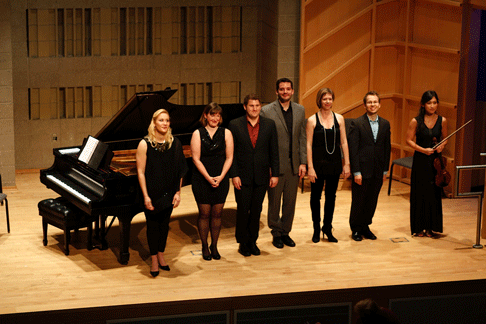 Van Eyck, Guth, Richardson, McFerrin, Bagwell, Dueck and Rhodes
There seemed to be quite a lot of songs about the subway. Glen Roven’s “F from DUMBO” seemed to consist of glances at the crowds by a numbly daydreaming straphanger. Gilda Lyons’ “rapid transit” invoked and celebrated the whole crazy system, its changeable schedules and half-audible warnings. Tom Cipullo’s “G is for Grimy: An Ode to the G Train” celebrated (and trashed) the one line in the system that never enters Manhattan at all. John Glover’s “8:46 AM, Five Years Later” unsensationally presented memories of being caught on the N train beneath the city on the morning of 9/11. There had to be one such song, just one, and this was one’s felt unforced and meaningful.
Yotam Haber’s exquisite setting of “On Leaving Brooklyn” made the very syllables of Julia Kasdorf’s revision of Psalm 137 into musical tones, “borough” and “Babylon” and “Jerusalem” becoming harmonized values and nostalgic wisps of melody. Scott Wheeler’s “At Home in Staten Island,” from an old poem by Charles Mackay, became a parlor ballad concealing its ache in an old-fashioned tune. Mohammed Fairouz’s ambitious “Refugee Blues” (which describes a more general situation rather than one specific to New York), builds on W.H. Auden’s use of a repetitive, folk song-like refrain, to achieve a gathering power. Jorge Martin set Whitman’s “City of Orgies, Walks and Joys!” to an irresistible boogie-woogie rich with the delight of simply romping about the town, while a solo violin gave the fantasy a piquant turn by chiming in just “off” the harmonies we had been led to expect.
Harumi Rhodes was the violinist. The pianists, Thomas Bagwell and Jocelyn Dueck, were both fine, but Rhodes played with almost vocal inflections of intricate participation rather than accompaniment: the violin as lieder singer. This speaks well of the composers who provided for her as well as her own poetic technique.
The songs were arranged for four contrasting voices, and the program varied and balanced their duties. Soprano Martha Guth and mezzo Jamie Van Eyck partnered well in the deadpan wit of “rapid transit.” Guth, having plumbed near-alto depths earlier, suddenly became a high, keening opera soprano for the melancholy of “At Home In Staten Island,” mated here with Rhodes’s violin, and (on the other side of that large borough) deplored the air of Christina Courtin’s “Fresh Kills.” Van Eyck brought drama to the mourning, accusing “Refugee Blues” and wistfulness to Renée Favand-See’s “Looking West on a Humid Summer Evening,” and lightly aired the brittle wit of Gabriel Kahane’s “Coney Island Avenue.” Tenor Alex Richardson was the yearning, regretting lover of Russell Platt’s “The Avenue” and Christopher Berg’s “OuLiPo in the Bronx.” David McFerrin’s grainy baritone gave us Martin Hennessy’s love song to the mothering city itself, “The City’s Love,” partnered Guth in Ricky Ian Gordon’s setting of Whitman’s invocation, “City of Ships,” and quietly made the point of “8:46 AM.” Texts were provided but the diction of all four was impeccable in the intimate confines of the Baruch Performing Arts Center.
The Songbook was recorded at an earlier performance with different singers, and the two-CD set is available from GPR Records on the Five Boroughs Music Festival web site.
John Yohalem
Click here to purchase the CD.