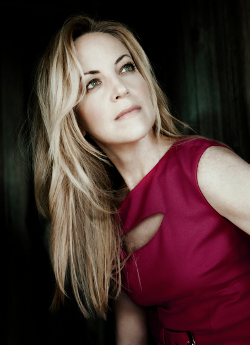
San Diego, whose
opera lovers saw her Turandot last year, will have the good fortune to see and
hear her Salome this season. I had the opportunity to speak to Ms. Lindstrom
about these roles at the San Diego opera during a lunch break from her Salome
rehearsals. The soprano is tall, about six feet, slim, blonde, thoughtful,
articulate and wonderfully quick to laugh. At 1PM she is eating soup, which she
assures me will sustain her through the end of her rehearsal at 5 PM. Though
she has specialized in Turandot, Ms. Lindstrom could almost claim a birthright
to the role of Minnie in Puccini’s Fanciulla del West. Born in
California’s Bay area and raised in Sonora, its gold country, with two
grandmothers named Minnie, I suspect Lindstrom is capable of galloping to the
rescue of her operatic lover. And as a Puccini fan, she would be happy to do
the role. “Not everybody feels Puccini.” she is quoted as saying. “One
must surrender oneself to it in order to feel it. There is something so
inherently passionate and alive in the writing that encourages me to find the
living, breathing heart of the character.”
Although Lindstrom had not previously sung on the Met stage, or had even
tried on Turandot’s elaborate Oriental costume before her unexpected debut,
the New York Post reported that “the tall, slender Lindstrom wielded the icy
glamour of a ‘30s film star, working the trains and veils of her elaborate
costumes with the panache of a runway model.” I was surprised to learn from
the soprano, who has appeared in over thirty productions of Turandot
throughout the world, that despite Puccini’s use of “Chinese harmonies”
and of the exotic Ping,Pang and Pong threesome, the opera is not always set in
China. “I did one in the German republic recently,” she said, “who knows
where it was set! It was very modern, very bland. In fact,” she added, “the
Americans tend to set it in China and the Europeans hardly every do.”
Wherever she has sung the role, it has showcased her insights into
Turandot’s surrender to love, as well as a unique ability to demonstrate that
surrender vocally. Writing in Opera News, Scott Barnes recalled that Lise
Lindstrom, “was the first Ice Princess I could actually sense melting,
vocally and physically; it was as if the color worked its way from her
fingertips to her cheeks until she appeared to be consumed by fever.”
But while the frigid Turandot’s heart is softened by love, the lusting
Salome’s explodes in a paroxysm of passion. Both women are man killers —
decapitators. “I have issues,” Lindstrom laughs when we broach this
subject. Turandot has every potential lover who cannot answer three riddles
killed, until an unknown prince answers the riddles in Act Two. By the time
Turandot finally senses the meaning of love, having been persuaded by the
intensity of the prince’s love for her and of a slave girl’s love for the
unknown prince, the curtain is about to descend on Act Three.
Salome kills only one man. And she does it in one Act. The man is Jochanaan,
John the Baptist, who has refused to look at her, and who is the prisoner of
her step-father Herod. After acceding to Herod’s request that she dance for
him, Salome’s lust for the prophet suddenly turns homicidal. She insists that
Herod give her Jochanaan’s head so that she can kiss him.
Whereas Turandot melts slowly over three hours. Salome is a one and a half
hour show in which Salome is constantly on stage, dances for ten minutes, and
sings over the blaring dissonances of Straussian orchestration. Birgit Nilsson
feared that Turandot might be a voice killer. Opera lore has it that Salome did
eventually destroy Ljuba Wellitsch’s voice. When I ask Lise Lindstrom about
the toll these roles might take, her response is lengthy and considered.
“Everyone has an opinion about that. There’s no doubt that singing —
period — takes a toll on a body and a voice because it’s a physical act.
But singers need to be smart about how they use their instruments. If the voice
responds positively or negatively, then the singer has to be smart enough to
know how to deal with that — not do the role as often — not do the role
again — or do it all the time if it works well. Turandot doesn’t cost me a
whole lot, which is fantastic because I tend to do it a lot. Salome is a very
different role and it is something that is more challenging to me, but it’s
because physically it’s a much more demanding role. This is opera on
steroids. It is condensed it is intense. There isn’t a gesture, a minute, a
second where anybody, including the audience gets a chance to take a deep
breath.”
Marie Wittich, Strauss’s first Salome, refused both to dance and to kiss
the prophet’s severed head. “I’m a decent woman,” she explained. Many
subsequent Salome’s were not capable of doing their own dances. Like most
present day Salome’s Lindstrom will do her own dance. “I am the dancer in
Salome,” she laughs, adding, “I find it more interesting and also more
collaborative particularly, to do the dance that’s interesting to the
director because then it’s within the production, the same fabric of the
production.”
I’ve heard various interpretations as to why Salome suddenly asks for
Johkanaan’s head.
One theory has to do with sight of the blood of the young soldier,
Narraboth, who kills himself when he realizes that Salome is infatuated with
the prophet. When I raise the question with Ms. Lindstrom, she rephrases it
before answering. “The sight of Narraboth’s blood is what brings the idea
of how to exert that power? I think that it’s possible. But.” she
continues, “I think really that she’s a young girl who’s been raised in a
very strange environment and I imagine her experience is she has seen people
beheaded. I imagine she has seen what happens to people that say “no” And
this is what happens to the people who say no.”
Lindstrom’s Turandot was a woman who changed even vocally, and I wondered
about her Salome.
“I’m always looking for a transformation,” she observes, “some sort
of journey for the character, and for me too. I think ultimately what’s
compelling about Salome, perhaps not about Turandot, is that Salome…in the
very end realizes that it wasn’t a good idea. Trying to control the
environment in that way is not the way it works. “
What makes her say that?
“Well, the last page of dialogue where she [Salome] says, ‘Oh, I kissed
your mouth. There’s a bitter taste. Was that the taste of blood, no maybe
that’s love. They tell me that love has a bitter taste.’” Lindstrom’s
voice is now a whisper, “’But what does that mean?’ And she asks, ‘what
does THAT mean?’ And then,” Lindstrom continues, “I think she realizes,
in that moment when she repeats that question. ‘Allein was tut’s.’”
Whispering again “ ‘Was tut’s?’ What does it mean? And she realizes
then that she has really gone all the way down the wrong path.”
“Is there a way to show that on stage? To reflect that? “I ask.
“I try. You’ll have to tell me.” Lise Lindstrom leans back in her seat
and smiles.
Estelle Gilson