![Ermonela Jaho as Violetta and Stephen Costello as Alfredo [Photo © ROH 2011 / Catherine Ashmore]](http://www.operatoday.com/LA-TRAVIATA-2513ashm_040-JA.gif)
05 Jan 2012
La Traviata: The 454th Performance at the Royal Opera House
This performance of La Traviata was the 454th at the Royal Opera House, and the first performance in the 3rd revival this season of Richard Eyre’s production.
English Touring Opera are delighted to announce a season of lyric monodramas to tour nationally from October to December. The season features music for solo singer and piano by Argento, Britten, Tippett and Shostakovich with a bold and inventive approach to making opera during social distancing.
This tenth of ten Live from London concerts was in fact a recorded live performance from California. It was no less enjoyable for that, and it was also uplifting to learn that this wasn’t in fact the ‘last’ LfL event that we will be able to enjoy, courtesy of VOCES8 and their fellow vocal ensembles (more below …).
Ever since Wigmore Hall announced their superb series of autumn concerts, all streamed live and available free of charge, I’d been looking forward to this song recital by Ian Bostridge and Imogen Cooper.
Although Stile Antico’s programme article for their Live from London recital introduced their selection from the many treasures of the English Renaissance in the context of the theological debates and upheavals of the Tudor and Elizabethan years, their performance was more evocative of private chamber music than of public liturgy.
Evidently, face masks don’t stifle appreciative “Bravo!”s. And, reducing audience numbers doesn’t lower the volume of such acclamations. For, the audience at Wigmore Hall gave soprano Elizabeth Llewellyn and pianist Simon Lepper a greatly deserved warm reception and hearty response following this lunchtime recital of late-Romantic song.
For this week’s Live from London vocal recital we moved from the home of VOCES8, St Anne and St Agnes in the City of London, to Kings Place, where The Sixteen - who have been associate artists at the venue for some time - presented a programme of music and words bound together by the theme of ‘reflection’.
'Such is your divine Disposation that both you excellently understand, and royally entertaine the Exercise of Musicke.’
‘And there was war in heaven: Michael and his angels fought against the dragon; and the dragon fought and his angels, And prevailed not; neither was their place found any more in heaven … that old serpent … Satan, which deceiveth the whole world: he was cast out into the earth, and his angels were cast out with him.’
There was never any doubt that the fifth of the twelve Met Stars Live in Concert broadcasts was going to be a palpably intense and vivid event, as well as a musically stunning and theatrically enervating experience.
‘Love’ was the theme for this Live from London performance by Apollo5. Given the complexity and diversity of that human emotion, and Apollo5’s reputation for versatility and diverse repertoire, ranging from Renaissance choral music to jazz, from contemporary classical works to popular song, it was no surprise that their programme spanned 500 years and several musical styles.
The Academy of St Martin in the Fields have titled their autumn series of eight concerts - which are taking place at 5pm and 7.30pm on two Saturdays each month at their home venue in Trafalgar Square, and being filmed for streaming the following Thursday - ‘re:connect’.
The London Symphony Orchestra opened their Autumn 2020 season with a homage to Oliver Knussen, who died at the age of 66 in July 2018. The programme traced a national musical lineage through the twentieth century, from Britten to Knussen, on to Mark-Anthony Turnage, and entwining the LSO and Rattle too.
With the Live from London digital vocal festival entering the second half of the series, the festival’s host, VOCES8, returned to their home at St Annes and St Agnes in the City of London to present a sequence of ‘Choral Dances’ - vocal music inspired by dance, embracing diverse genres from the Renaissance madrigal to swing jazz.
Just a few unison string wriggles from the opening of Mozart’s overture to Le nozze di Figaro are enough to make any opera-lover perch on the edge of their seat, in excited anticipation of the drama in music to come, so there could be no other curtain-raiser for this Gala Concert at the Royal Opera House, the latest instalment from ‘their House’ to ‘our houses’.
"Before the ending of the day, creator of all things, we pray that, with your accustomed mercy, you may watch over us."
The doors at The Metropolitan Opera will not open to live audiences until 2021 at the earliest, and the likelihood of normal operatic life resuming in cities around the world looks but a distant dream at present. But, while we may not be invited from our homes into the opera house for some time yet, with its free daily screenings of past productions and its pay-per-view Met Stars Live in Concert series, the Met continues to bring opera into our homes.
Music-making at this year’s Grange Festival Opera may have fallen silent in June and July, but the country house and extensive grounds of The Grange provided an ideal setting for a weekend of twelve specially conceived ‘promenade’ performances encompassing music and dance.
There’s a “slide of harmony” and “all the bones leave your body at that moment and you collapse to the floor, it’s so extraordinary.”
“Music for a while, shall all your cares beguile.”
The hum of bees rising from myriad scented blooms; gentle strains of birdsong; the cheerful chatter of picnickers beside a still lake; decorous thwacks of leather on willow; song and music floating through the warm evening air.
This performance of La Traviata was the 454th at the Royal Opera House, and the first performance in the 3rd revival this season of Richard Eyre’s production.
Each of this season’s revivals has been in the hands of a different revival director. This time, Paul Higgins oversaw Ermonela Jaho returning as Violetta and Stephen Costello making his Covent Garden role debut as Alfredo.
Since her last appearance here as Violetta, Jaho has made quite a stir with her performance as Suor Angelica in the new production of Puccini’s Il Trittico. Costello has previously appeared at the Royal Opera House in a concert performance of Donizetti’s Linda di Chamounix and as Rinuccio in Il Trittico, so that Alfredo represents the singers biggest stage role yet at Covent Garden.
Bob Crowley’s designs still look very well and the production remains very handsome. It was new in 1994 and this run seems to be its 15th revival, so that one of the items of interest would be how the production was holding up. One always expects the party scene in Act 1 to be something of a mess and Crowley’s design seems to intentionally crowd the partygoers, but I did wonder whether the chaos could be more organised, whether there had been quite enough rehearsal time.
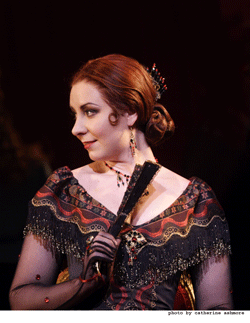 Justina Gringyte as Flora
Jaho is a slim, almost diminutive figure who has no problem at all looking fragile, which is always a help in this role. She was very studied dramatically, using a range of expressive but carefully choreographed movements. Not at all stiff or static, but rather as if Violetta had constructed a persona for herself; an interestingly valid point of view, though this may simply be Jaho’s natural style.
Technically Jaho is a lyric soprano with a tight vibrato and an attractively veiled quality to the voice. In Act 1 her coloratura was creditable rather than pin-sharp, and she had an occasional tendency to attack notes from below. But she also had the magical ability to thin her voice right down.
“Sempre libera” had a slightly desperate quality to it and you could almost feel Jaho saying thank goodness that was over at the end of the act. But then few sopranos manage all 3 acts of La Traviata with equal facility, that’s one of the role’s challenges.
Costello was nicely correct and callow as Alfredo, especially on his first entry into the party. Slim and good looking, his voice was a surprise being thicker and darker than expected, with a nicely focused Italianate tone. He brought a lovely lyric feel to the Brindisi. With both him and Jaho you felt that there was a good likelihood that their voices will move on to more dramatic roles.
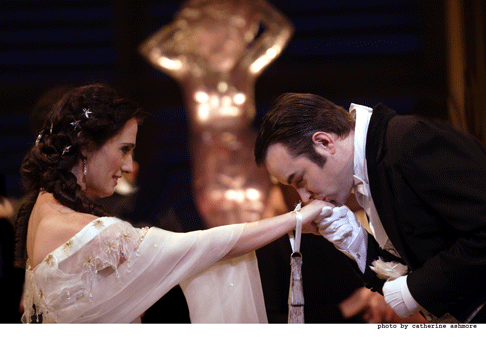 Ermonela Jaho as Violetta and Stephen Costello as Alfredo
Interaction between them was rather nervous and this seemed to reflect in their voices. You did not really believe that there was passion there. The intensity in Costello’s voice didn’t quite match his body language. Jaho seemed to find form in Act 2, expressing Violetta’s suffering with great expressiveness.
Jaho thinned her voice magically for “Dite alla giovine” and the duet with Gavanelli crackled with emotion in a way that hadn’t happened in Act 1. In Act 3, “Addio del passato” was beautifully sung and profoundly moving, but here and elsewhere in this act, Jaho did rather too much operatic staggering about; I happen to think that less is more here. Her death was dramatic and beautiful, but perhaps a little too ‘stagey’. Jaho’s performance was profoundly moving, but ultimately I found her to be a little too studied.
Costello was similarly impressive. I often feel that Alfredo is not the brightest button in the box and whether by accident or design Costello conveyed something of this. In the scene at Flora’s the duet between Jaho and Costello was thrilling, his anger blazed forth in a way that his passion did not. Unfortunately Costello reverted to looking stiff, though he sang with conviction and passion. He did spend a lot of times on his knees, which he seemed to find uncomfortable. Musically Costello turned in a passionate and stylish performance, but this was not always reflected in his body language. It seemed he would have benefited from greater rehearsal time with a strong director.
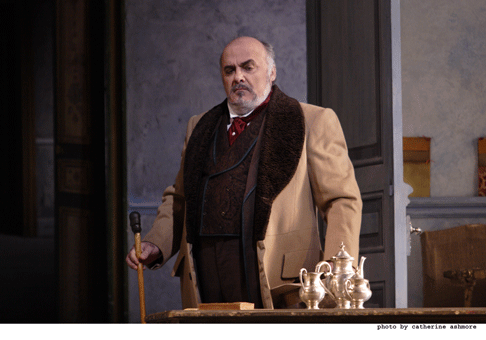 Paolo Gavanelli as Girogio Germont
It helped that Paolo Gavanelli’s Giorgio Germont was pure class. Every inch an aristocrat, severely controlled, not a blusterer, Gavanelli sang beautifully with profoundly expressive line. He conveyed the character’s breeding and inhibition, and it was lovely to hear it sung by a native Italian.
It was nice to see David Stout as the Baron and he turned in a stylish performance. The other smaller roles were well cast, with Justina Gingyte as Flora, Jeremy White as the Marquis and Ji Hyun Kim as Gastone. Robert Lloyd made a sympathetic Doctor and Hanna Hipp a strong Annina.
Maurizio Benini provided a safe pair of hands in the pit, with support for the singers and well placed flexible tempi. This wasn’t perhaps a vintage revival but it was certainly involving, with some strongly characterised performances.
Robert Hugill