Subscribe to
Opera Today

Receive articles and news via RSS feeds or email subscription.


twitter_logo[1].gif


UCP_9780226043425.gif

Recently in Reviews

Domingo Conducts Holdridge’s New Opera Dulce Rosa

Dulce Rosa, a brand new opera, had its world premiere Friday night, May 17, 2013 at the Broad Stage in Santa Monica, California. It was produced by Los Angeles Opera, but staged in the smaller theater.

Verdi’s Falstaff at Glyndebourne

Richard Jones’ 2009 production of Verdi’s Falstaff translates the action from the first Elizabethan age to the start of the second.

Gareth John, Wigmore Hall

Baritone Gareth John is rapidly accumulating a war-chest of honours. Winner of the 2013 Kathleen Ferrier Award, he recently won the Royal Academy of Music Patrons’ Award and was presented the Silver Medal by the Worshipful Company of Musicians.

La bohème at ENO

This second revival of Jonathan Miller’s La bohème was the first time I had caught the production.

Rolando Villazón: Verdi (International Opera Stars Series 2013)

It’s Verdi’s bicentenary year and Rolando Villazón has two new CDs to plug — titled somewhat confusingly, ‘Villazón: Verdi’ and ‘Villazón’s Verdi’, the latter a ‘personal selection’ of favourite numbers performed by stars of the past and present.

Brahms Third in San Francisco

Nicola Luisotti and the San Francisco Opera Orchestra climbed out of the War Memorial pit, braved the wind whipped bay and held spellbound an audience at Cal Performances’ Zellerbach Auditorium at UC Berkeley.

Ariane et Barbe-Bleue on Blu-Ray

Paul Dukas’ Ariane et Barbe-Bleue, first heard in 1907, once seemed important. Arturo Toscanini conducted the Met premiere in 1911 with Farrar and later arranged some of its music for a 1947 recording with his NBC Symphony.

Glyndebourne: Ariadne auf Naxos

Utterly mad but absolutely right — Richard Strauss’s Ariadne auf Naxos started the Glyndebourne 2013 season with an explosion. Strauss could hardly have made his intentions more clear. Ariadne auf Naxos is not “about” Greek myth so much as a satire on art and the way art is made.

Wozzeck at ENO

“Man is an abyss. It makes one dizzy to look into it.” So utters Georg Büchner’s Woyzeck, repeating what was also a recurring motif in the playwright’s own letters.

Mulhouse: Rare Britten Well Done

National Opera Company of the Rhine has marked this year’s Benjamin Britten celebration with a remarkably compelling, often gripping new production of the seldom-seen Owen Wingrave.

Frankfurt's Intriguing Idomeneo

Once upon a time, Frankfurt Opera had the baddest ass reputation in Germany as “the” cutting edge producer of must-see opera.

Rigoletto at Lyric Opera of Chicago

Productions of Giuseppe Verdi’s Rigoletto can serve as a vehicle for individual singers to make a strong impression and become afterward associated with specific roles in the opera.

Britten Sinfonia with Ian Bostridge

Just in case we were not aware that the evening’s programme was ‘themed’, the Britten Sinfonia designed a visual accompaniment to their musical exploration of night, sleep and dreams.

Aida, Manitoba Opera

Poor Aida! She never seems to have anything go her way.

Superlative singing: Don Carlo, Royal Opera House

Is it possible to upstage Jonas Kaufmann? Kaufmann was brilliant in this Verdi Don Carlo at the Royal Opera House, London, but the rest of the cast was so good that he was but first among equals. Don Carlo is a vehicle for stars, but this time the stars were everyone on stage and in the pit. Even the solo arias, glorious as they are, grow organically out of perfect ensemble. This was a performance that brought out the true beauty of Verdi's music.

Sarah Connolly: French Song at Wigmore Hall

The big names were absent: Duparc, D’Indy, Debussy, Ravel … and while Fauré, Chausson, Roussel and several members of Les Six put in an appearance, in less than familiar guises, this survey of French song of the early 20th century and interwar years deliberately took us on a journey through infrequently travelled terrain.

Rare restoration: Handel’s Esther 1720

Composed between 1718 and 1720, Handel’s Esther is sometimes described as the ‘first English Oratorio’, but is in fact a hybrid form, mixing elements of oratorio, masque, pastoral and opera.

The Damnation of Faust, London

Hector Berlioz's légende dramatique, La Damnation de Faust, exists somewhere between cantata and opera. Berlioz's flexible attitude to dramatic form made the piece unworkable on the stages of early 19th century Paris and his music is so vivid that you wonder whether the piece needs staging at all.

Elizabeth Connell Memorial Concert, St John's Smith Square

St. John’s Smith Square was the site of Elizabeth Connell’s final London concert, intended as a farewell to London on her moving to Australia. It was rendered ultimately final by her unexpected death.

Aida with all the Trimmings, Even a Blue Silk Elephant!

With the building of the Suez Canal, Egypt became more interesting to Western Europeans. Khedive Ismail Pasha wanted a hymn by Verdi for the opening of a new opera house in Cairo, but the composer said he did not write occasional pieces.

OPERA TODAY ARCHIVES »

Reviews

Jose Cura as Otello [Photo by Suzanne Schwiertz courtesy of Opernhaus Zurich]
25 Jan 2012

Otello in Zürich

War and destruction is everywhere these days, not least in Pesaro where Graham Vick staged a lethal Mosé in Egitto last August, nor less so in San Francisco where baritone Thomas Hampson perished as Rick Rescorla in Heart of a Soldier last September.

Giuseppe Verdi: Otello

Desdemona: Barbara Frittoli; Emilia: Judith Schmid; Otello: Jose Cura; Iago: Thomas Hampson; Cassio: Stefan Pop; Rodrigo: Benjamin Bernheim; Lodovico: Pavel Daniluk; Montano: Tomasz Slawinski; A herald: Evgeny Sevastyanov. Zurich Opera House. Zurich Opera Chorus and Orchestra. Conductor: Massimo Zanetti. Stage Director: Graham Vick. Production Designer: Paul Brown. Lighting: Jürgen Hoffmann. (January 8, 2012). Photos courtesy of Zurich Opera, copyright Suzanne Schwiertz.

Above: Jose Cura as Otello

Photos by Suzanne Schwiertz courtesy of Opernhaus Zürich


These two gentlemen were at it again just now in Zurich, Mr. Vick staging a new Verdi Otello and Mr. Hampson attempting its villain Iago, a late career role debut that did not even require him to change costume from his convincing, indeed moving portrayal of Rick, the professional soldier cum World Trade Center hero.

In Pesaro Graham Vick exploited the explosive hostilities of the Palestinians and Jews in such graphic detail that some audience fled the theater in terror. The Cyprus Greek Turkish tensions do not carry as much emotional baggage or fearsome consequences, at least in the international psyche, but like Mosé in Egitto the contemporary metaphor, here the on-going Cyprus problem, is too striking to ignore. All this is to say that Verdi’s old story, no longer old, was told in contemporary terms.

Unlike the huge ethnopolitical tragedies of Mosé in Egitto, Otello is a personal tragedy that unfolds in war torn Cyprus, though the visible ravages of war could be anywhere. Its opening chorus is not watching the battle but immersed in it by slathering black soot on their faces, stripping off clothes exposing white bodies parts as if wounded.
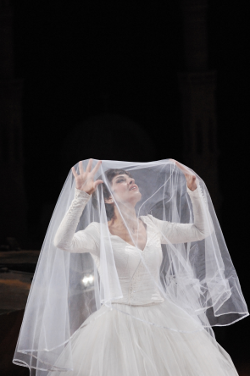
Otello_Zur_2.pngFiorenza Cedolins as Desdemona

To preface the opera however, Otello, not in blackface, presented himself alone on the stage thus forcing himself into our close focus for the duration. Maybe it was the lack of the expected blackface that planted the seeds of racism in our minds, and Vick finally allowed overt racism to burst forth only in Act III when a suddenly exposed back-of-a-stage flat said “nigger.” But Vick had made it a black and white opera long before, and on multiple levels. Desdemona appeared in Act I as a phantom bride, a white veiled wife, who moved as if in an Otello dream, his dream of a world of beauty and purity, a sanctuary from the burned black colors of war.

Act IV, the Desdemona act, placed Desdemona in the center of a black stage. She re-entered the wedding dress, covered herself with the bridal veil and became again Otello’s dream as she sang her song and prayer, standing and immobile. We now knew and felt with certainty that this was Verdi’s opera as the Othello tragedy and not the melodrama of a fallen woman.

Acts II and III were in fact the Desdemona acts when she presented herself as an emancipated, worldly woman, possibly unfaithful, even defiant thus taunting the sensibilities of this Venetian general whose Asian sensibilities imagine his woman as veiled, like the burka covered women who praised Desdemona’s exposed beauty in Act II. The opera had suddenly gone globally political and we knew then that its tragically violent outcome was to be understood in universal as well as personal terms.
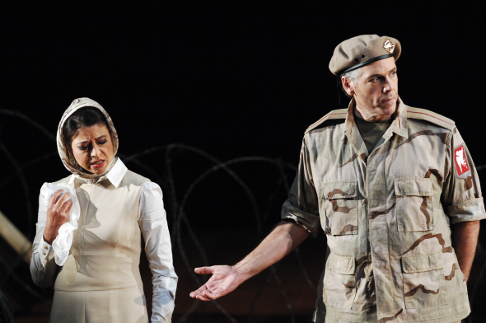
Otello_Zur_3.pngJudith Schmid as Emelia and Thomas Hampson as Iago

Where, you may ask, did Iago fit into all of this? This is where the Zurich casting choices for this remarkable Graham Vick production come into question. Tenor Jose Cura was a gruff, hulking, brutal Otello who held forth magnificently in high Italianate vocal style and whose high style method acting transported his Otello to admirable histrionic heights. Soprano Barbara Frittoli is young and shapely and a formidable Italianate singer whose personal beauty and beauty and range of voice fulfilled the gamut of Desdemona’s expressive needs in this complex concept.

Thomas Hampson simply did not fill the bill as Iago. His size and age precluded a physicality that could color and magnify and therefore interest us in the ugly insinuations Iago dishes out to Otello. In his army fatigues he seemed still the aged Rick Rescorla of the World Trade Center, towering over everyone, and shouting out accusations to Otello like instructions for evacuation. His nemesis Cassio, played by 24-year-old Stefan Pop was equally out of place in age and size, thus depriving this pivotal character of his essential weight and meaning in Verdi’s drama. Vocally however this young singer made the most of Verdi’s musical points.

With the Pesaro Mosé in Egitto and this Zurich Otello Graham Vick has proven himself to be one of our greatest contemporary stage directors, working now in a rich, highly minimal language with the goal of bold and highly pointed storytelling. As well both operas were laden, burdened, over-burdened with contemporary political messages that enriched the inherent political agendas of both operas. With significant participation of his designer, Paul Brown, the visual and theatrical language is refined to few moves, shapes and colors that bring this theater to astonishing heights of a minimalist expressionism.
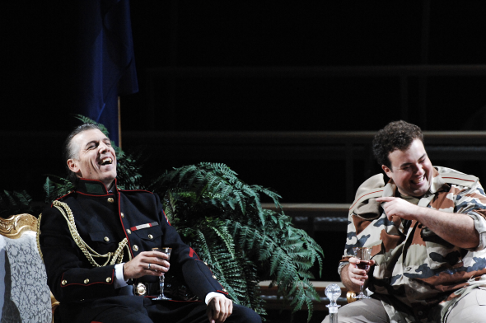
Otello_Zur_4.pngThomas Hampson as Iago and Stefan Pop as Cassio

Conductor Massimo Zanetti rose to the occasion executing Verdi’s score in biting and cutting detail, pushing its nervousness to an ultimate extreme, sometimes forcing his singers, maybe including Mr. Hampson, to shout rather than sculpt their musical lines (there is however the possibility and suspicion that this was a staging mandate). While this musical brutality may work for the Otello personage it can as well suppress much of the well known subtlety of this Verdi score.

Finally this Otello tragedy was powerfully felt, intellectually and theatrically. It was not musically felt. And that is perhaps the inevitable when a formidable stage director like Graham Vick tackles a formidable work of theater, overlooking that Verdi’s Otello is an opera as well.

Michael Milenski

Send to a friend

Send a link to this article to a friend with an optional message.

Friend's Email Address: (required)

Your Email Address: (required)

Message (optional):