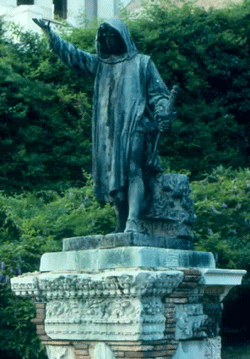
31 Jan 2012
Rienzi, OONY
For the first hour or so of the latest Opera Orchestra of New York venture, a concert performance of Wagner’s Rienzi, I often said to myself, This…isn’t so terrible.
English Touring Opera are delighted to announce a season of lyric monodramas to tour nationally from October to December. The season features music for solo singer and piano by Argento, Britten, Tippett and Shostakovich with a bold and inventive approach to making opera during social distancing.
This tenth of ten Live from London concerts was in fact a recorded live performance from California. It was no less enjoyable for that, and it was also uplifting to learn that this wasn’t in fact the ‘last’ LfL event that we will be able to enjoy, courtesy of VOCES8 and their fellow vocal ensembles (more below …).
Ever since Wigmore Hall announced their superb series of autumn concerts, all streamed live and available free of charge, I’d been looking forward to this song recital by Ian Bostridge and Imogen Cooper.
Although Stile Antico’s programme article for their Live from London recital introduced their selection from the many treasures of the English Renaissance in the context of the theological debates and upheavals of the Tudor and Elizabethan years, their performance was more evocative of private chamber music than of public liturgy.
Evidently, face masks don’t stifle appreciative “Bravo!”s. And, reducing audience numbers doesn’t lower the volume of such acclamations. For, the audience at Wigmore Hall gave soprano Elizabeth Llewellyn and pianist Simon Lepper a greatly deserved warm reception and hearty response following this lunchtime recital of late-Romantic song.
For this week’s Live from London vocal recital we moved from the home of VOCES8, St Anne and St Agnes in the City of London, to Kings Place, where The Sixteen - who have been associate artists at the venue for some time - presented a programme of music and words bound together by the theme of ‘reflection’.
'Such is your divine Disposation that both you excellently understand, and royally entertaine the Exercise of Musicke.’
‘And there was war in heaven: Michael and his angels fought against the dragon; and the dragon fought and his angels, And prevailed not; neither was their place found any more in heaven … that old serpent … Satan, which deceiveth the whole world: he was cast out into the earth, and his angels were cast out with him.’
There was never any doubt that the fifth of the twelve Met Stars Live in Concert broadcasts was going to be a palpably intense and vivid event, as well as a musically stunning and theatrically enervating experience.
‘Love’ was the theme for this Live from London performance by Apollo5. Given the complexity and diversity of that human emotion, and Apollo5’s reputation for versatility and diverse repertoire, ranging from Renaissance choral music to jazz, from contemporary classical works to popular song, it was no surprise that their programme spanned 500 years and several musical styles.
The Academy of St Martin in the Fields have titled their autumn series of eight concerts - which are taking place at 5pm and 7.30pm on two Saturdays each month at their home venue in Trafalgar Square, and being filmed for streaming the following Thursday - ‘re:connect’.
The London Symphony Orchestra opened their Autumn 2020 season with a homage to Oliver Knussen, who died at the age of 66 in July 2018. The programme traced a national musical lineage through the twentieth century, from Britten to Knussen, on to Mark-Anthony Turnage, and entwining the LSO and Rattle too.
With the Live from London digital vocal festival entering the second half of the series, the festival’s host, VOCES8, returned to their home at St Annes and St Agnes in the City of London to present a sequence of ‘Choral Dances’ - vocal music inspired by dance, embracing diverse genres from the Renaissance madrigal to swing jazz.
Just a few unison string wriggles from the opening of Mozart’s overture to Le nozze di Figaro are enough to make any opera-lover perch on the edge of their seat, in excited anticipation of the drama in music to come, so there could be no other curtain-raiser for this Gala Concert at the Royal Opera House, the latest instalment from ‘their House’ to ‘our houses’.
"Before the ending of the day, creator of all things, we pray that, with your accustomed mercy, you may watch over us."
The doors at The Metropolitan Opera will not open to live audiences until 2021 at the earliest, and the likelihood of normal operatic life resuming in cities around the world looks but a distant dream at present. But, while we may not be invited from our homes into the opera house for some time yet, with its free daily screenings of past productions and its pay-per-view Met Stars Live in Concert series, the Met continues to bring opera into our homes.
Music-making at this year’s Grange Festival Opera may have fallen silent in June and July, but the country house and extensive grounds of The Grange provided an ideal setting for a weekend of twelve specially conceived ‘promenade’ performances encompassing music and dance.
There’s a “slide of harmony” and “all the bones leave your body at that moment and you collapse to the floor, it’s so extraordinary.”
“Music for a while, shall all your cares beguile.”
The hum of bees rising from myriad scented blooms; gentle strains of birdsong; the cheerful chatter of picnickers beside a still lake; decorous thwacks of leather on willow; song and music floating through the warm evening air.
For the first hour or so of the latest Opera Orchestra of New York venture, a concert performance of Wagner’s Rienzi, I often said to myself, This…isn’t so terrible.
The orchestra sounds good, lovely rich string sounds that prefigure Tannhäuser, and coarse versions of Wagner’s endless modulation, continually reworking musical material to disguise his slight melodic gift. But it went on and on, brass choirs and brainless choruses, lovers rejoicing or denouncing, nobles sulking and plotting, and it was difficult to be sure which singer was playing which role; no synopsis was provided and, in Wagner’s libretto from a Bulwer Lytton novel about fourteenth-century Roman politics, only the three leads have any individuality.
Rienzi rates a single paragraph in Ernest Newman’s Wagner as Man and Artist. Newman loved Wagner, and his books are the best front-line tomes for background and analysis. He approved Wagner’s distinction between the “romantic operas” (up through Lohengrin) and the “music-dramas,” and when he said Wagner was the greatest opera composer who ever lived, he meant aside from the total-art-works in their higher realm. Yet even Newman (who has a ten-page warm spot for Das Liebesverbot) couldn’t come up with a kind word for Rienzi. “Almost offensive” and “a sheer failure of the imagination” are his dicta on the opera’s musical language. “It is astounding how few phrases there are in all these six hundred pages.” He grudgingly admits the “rampant horse-power vigor” of the overture (the only bit of the work we generally hear), then returns to its “vulgarity, its intolerable prolixity.”
I can’t disagree with this assessment, though Rienzi does offer the intriguing spectacle of youthful genius finding himself…and not quite getting there yet, just as Mozart does with Mitridate or La finta giardiniera. And, to be fair, Rienzi achieved just what its composer desired: A hit at its premiere, it remained popular for years, whereas Fliegende Hollander and Tristan took decades to enter the general repertory. From the chatter around me, I gathered that the house was full of last-minute attendees, lured by a spate of ten-dollar tickets, and that these newbies were happy with what they encountered, with the performance’s sheer busyness. Can opera lovers be so shallow that huge performing forces in colorful costumes and martial formation making a huge noise in a huge room, the power of mere spectacle, overwhelms refinement of taste? Well, you know the answer to that one.
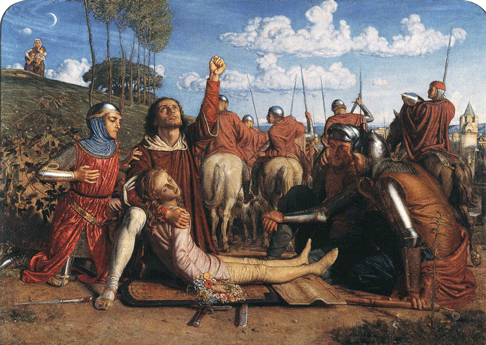 Rienzi Vowing to Obtain Justice for the Death of his Young Brother by William Holman Hunt
The Met last gave Rienzi in 1890; 122 years do not justify any call for its revival. Opera Orchestra of New York has given it in concert four times now, at least two more than curiosity could merit, but Eve Queler loves operas that have lots of moving parts, brasses scattered around the room, choral groups marching up and down the aisles, a long organ solo, and Rienzi gives her all that. Wagnerians used to sneer at Rienzi as “the greatest Meyerbeer opera,” but that is because they do not know Meyerbeer’s tuneful, elegant, dramatically pointed scores. The only thing Meyerbeerian about Rienzi is its grotesque length. (Queler cut it significantly, of course: An uncut Rienzi could last five hours easy.) Rienzi’s repetitiveness, the thrill in exploiting its slight substance, no one would deplore more than Meyerbeer, unless it be the mature Richard Wagner. Effects without causes—that’s what we have here.
The 27-year-old composer, weary of being an underpaid, over-indebted opera conductor and critic, wanted to demonstrate he was ready for hardball with the big boys. You know: Spontini, Auber, Halévy… Too, he wanted to write an opera on imperial themes to set pre-unified Germany afire, and he wanted to set it in Italy because … well, because. But he hadn’t yet visited Italy. So the local color of his medieval Rome is very beer hall. A loud beer hall. A loud, smoky, Germanic beer hall. Hitler is said to have adored Rienzi, but too much need not be made of that: He also adored Die Meistersinger and The Merry Widow.
So the orchestra was okay on this occasion, and the choruses rather good, but what of the singers? Ian Storey, a well-known mediocre Tristan, was in appalling shape, not an unforced tone all day. As no announcement of ill health was made, one must assume he just wasn’t up to the stentorian title role, though he sounded very sick and Queler may simply not have had a replacement handy. (Who learns this role any more? Why bother?) Geraldine Chauvet in the musico (i.e., trouser) role of Adriano Colonna—the only character in the opera with a dash of personality—had a far happier day and the applause to go with it. She sang the Prayer that is the only vocal number ever excerpted from Rienzi, and though not entirely in charge of it, produced fine phrases in a yearning style and got through her Wagner turns, the composer’s favorite ornamental figure, with credit. Elisabete Matos, who made a thrilling Met debut last year in Fanciulla del West but is better known in Europe for dramatic roles, sang Rienzi’s sister and Adriano’s girlfriend, Irene, a one-(very high)-note idealistic personality whose soprano must cut through the orchestra like a gleaming bread knife. Matos had the sheen and was usually on the right pitches, and her final, suicidally heroic outburst implied that she’d sing one hell of a Senta if she got the chance. Among the lesser figures, baritone Shannon DeVine and soprano Emily Duncan-Brown distinguished themselves.
John Yohalem