![An exterior view of the Metropolitan Opera House in New York City [Photo: Marty Sohl/Metropolitan Opera]](http://www.operatoday.com/METOPERAHouse.gif)
03 Feb 2012
An Aria of Lincoln Center — The Metropolitan Opera
To the dismay of New York opera fans, the original Metropolitan Opera House, located at Broadway and 39th Street, was to be torn down and replaced by a new hall a mere 30 blocks away.
English Touring Opera are delighted to announce a season of lyric monodramas to tour nationally from October to December. The season features music for solo singer and piano by Argento, Britten, Tippett and Shostakovich with a bold and inventive approach to making opera during social distancing.
Conductor Oliver Zeffman has commissioned the very first opera for a socially distanced world, which is now available to watch exclusively on Apple Music. Eight Songs From Isolation has been written by eight leading composers, specifically for streaming - rather than live performance - and is the first opera written for a time when the performers were unable to meet in person.
Leading freelance musicians unite in Parliament Square to call for targeted support for colleagues in the arts and entertainment sector.
Duo Lewis Murphy (composer) and Laura Attridge (writer) have launched a charitable song project entitled Notes From Isolation. The resulting songs, featuring some of the UK's top singing talent, are being released online between August and October 2020 and can be enjoyed free of charge.
The Royal Opera House is thrilled to announce an exciting, wide-ranging new line-up for its autumn programme. For the first time, extraordinary performances will be accessible online for a global audience through livestreams and for socially distanced live audiences at our home in Covent Garden. In a global first, we present a new opera in hyper-reality, alongside repertory favourites from both artistic companies.
Some of the most famous and outstanding stars from the opera world are to take part in a very special evening from Wexford Festival Opera, including Aigul Akhmetshina, Joseph Calleja, Daniela Barcellona, Juan Diego Flórez, Igor Golovatenko, Ermonela Jaho, Sergey Romanovsky, and many more.
Following its successful launch in 2019, OperaStreaming streams nine operas on YouTube from the historic opera houses of Emilia-Romagna during the 2020-21 season, with fully-staged productions of Verdi's La traviata in October from Modena and Verdi'sOtello from Bologna in...
‘A brief history of song’ is the subtitle of the 2020 Oxford Lieder Festival (10th-17th October), which will present an ambitious, diverse and imaginative programme of 40 performances and events.
Bampton Classical Opera returns to the Baroque splendour of London’s St John’s Smith Square on November 6 with a concert performance of Gluck’s one-act opera The Crown, the first in the UK since 1987. The performance will also be filmed and available to watch on demand on the Bampton website from 9 November.
While many of us spent lockdown at home taking it a little easier, composer Andrew Synnott wrote an opera.
Owen Wingrave is part of the new Interim Season of 19 brand new events, all free to view online between September and December 2020.
The Arts Council has awarded innovative UK charity Music and Theatre For All (MTFA) a major new grant to develop three ambitious new projects in the wake of Covid 19.
English National Opera (ENO) will reopen the London Coliseum to socially distanced audiences on 6 and 7 November for special performances of Mozart’s Requiem. These will provide audiences with an opportunity to reflect upon and to commemorate the difficulties the nation has faced during the pandemic.
The Royal Opera House is proud to continue its curated #OurHouseToYourHouse programme into the autumn, bringing audiences the best of the ROH through a new series of Friday Premieres and cultural highlights.
After six months of closure, the Royal Opera House is thrilled to be opening its doors to the public as part of Open House London weekend, giving visitors a taste of one of the world’s most famous theatres for free.
The Academy of St Martin in the Fields is thrilled to announce re:connect - an eight concert series with live socially distanced audiences at its namesake church, St. Martin-in-the-Fields. The autumn concerts will take place at 5pm & 7:30pm on two Saturdays per month with guest artists including baritone Roderick Williams, soprano Carolyn Sampson and composer-conductor-pianist Ryan Wigglesworth performing a wide range of repertoire.
Music and poetry unite and collide across centuries, from the Medieval to the Enlightenment to the present day. This year, the Oxford Lieder Festival will present a thrilling and innovative programme comprising more than forty events streamed over eight days.
The English Concert with artistic director Harry Bicket is delighted to announce a series of concerts from 1-15 October 2020. The concerts take place in historic London venues with star soloists and will be performed and streamed live to a paying audience at 7pm GMT on each performance date. The programmes include first-class vocal and instrumental works from the two pillars of the English Baroque, covering different aspects of the repertoire.
Glyndebourne has announced plans for a ‘staycation’ series of socially-distanced indoor performances, starting on 10 October 2020.
The Royal Opera House is delighted to announce two packed evenings of opera and ballet, live from our stage in Covent Garden and available to view wherever you are in the world online.
To the dismay of New York opera fans, the original Metropolitan Opera House, located at Broadway and 39th Street, was to be torn down and replaced by a new hall a mere 30 blocks away.
The building’s first production was Faust in 1883 and the last performance was La Bohème on April 16, 1966. Akin in style to the prominent opera houses of Europe, many were understandingly upset about the destruction of this “landmark” building, in which Enrico Caruso, Ezio Pinza and many other great artists performed.
The “new” Met was dissimilar from the original. Architectural plans were drawn in 1956, and groundbreaking began in 1961. Architect Wallace K. Harrison, recognized for high-rise office buildings, was assigned to the project. It needed to blend in with the surrounding structures slated to be a world-class performing arts hub, designated as Lincoln Center.
Harrison opted for modernism in a low-rise complex totaling 97,700 sq. It would contain an auditorium, a small hall, extensive lobby, private offices, as well as a restaurant and gift shop.
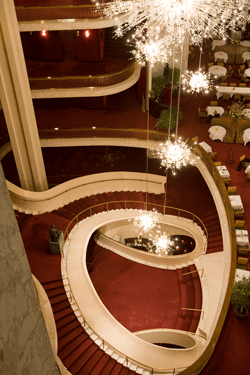 The lobby of the Metropolitan Opera House in New York City. [Photo: Marty Sohl/Metropolitan Opera]
Much of the facade was composed of concrete and masonry work. The focal point remains as five majestic arches resting on six “rectilinear” concrete columns. Reaching 96 feet in height and 35 feet in width within pre-cast shells, the striking curves in glass enhance the building’s front exterior and inner lobby.
Two murals by Marc Chagall, The Triumph of Music and The Sources of Music were commissioned for the Met to fill the immense open space of the lobby. They are visible not only from within the premises, but can be admired from the outside, near Lincoln Center’s fountain in the courtyard.
An abundance of gleaming white marble, gold leafing and cascading crystal chandeliers that illuminate a grand marble staircase in the foyer completed its inner decor.
Rumor has it that the architect, Harrison, handed the crystal chandelier designer, Hans Harald Rath, a book on the “Big Bang,” and requested he should use it as inspiration for their design.
The stage is highly mechanized and the auditorium holds a total capacity of 3,995 (3800 seating, plus 195 standing room).
The final cost for the project was $46 million. The glittering results became the perfect New York symbol for a night at the opera.
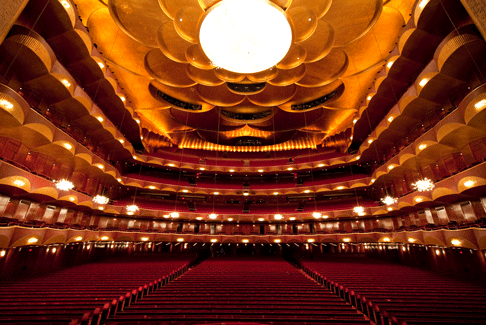 The auditorium of the Metropolitan Opera House in New York City. [Photo: Jonathan Tichler/Metropolitan Opera]
September 16, 1966 was the opening night gala with Antony and Cleopatra by composer Samuel Barber. Although reviewers found fault with the production and appearance of the structure, one thing excelled that couldn’t be ignored — the acoustics. Every note the orchestra played and the stars produce was heard with clarity, no matter where seated.
Opera greats, such as Plácido Domingo, Joan Sutherland, Marilyn Horne, and more recently, Elīna Garanča and Vittorio Grigolo have graced audiences clamoring “Bravo.”
Under the direction of James Levine, the 2012 season offers that much desired Met repertoire favorites including Madam Butterfly, Faust, Tosca, La Traviata and others. Lesser known compositions, such as The Makropulos Case and The Enchanted Island complete a blend of a well-rounded season, running until May 12.
Afterwards, the celebrated opera company goes on hiatus. However, the Metropolitan Opera House doesn’t remain dark. The American Ballet Theatre takes center stage, followed by various touring ballet companies before a new opera season begins.
Tours are accessible all-year-round to explore the behind-the-scenes. “Meet-the-Artist” is an innovative concept in which singers and musicians answer questions from visitors.
Planning a Visit:
The Metropolitan Opera House box office is situated in the lobby and tickets can be purchased Monday–Saturday 10am–8pm, Sunday noon–6pm
The venue can easily be reached via public transportation.
By Subway: Take the number1 (7th Ave local train) to 66th Street/Lincoln Center Station.
By Bus: The M5, M7, M10, M11, M66 and M104 bus lines all stop on 66th Street and Broadway (one block away).
Find accommodations near the Met by visiting NewYorkHotels.org. Securing a hotel near Central Park (on the West Side) will be within walking distance to Lincoln Center.
Veronica Shine
The Metropolitan Opera is not responsible for the content of this article.