![Angela Meade as Elvira and Roberto De Biasio as Ernani [Photo by Marty Sohl courtesy of The Metropolitan Opera]](http://www.operatoday.com/ERNANI2448s.gif)
13 Feb 2012
Ernani, Metropolitan Opera
Ernani accosts us with the charm and the gaucherie of a provincial youth without much experience as the host of a classy party.
English Touring Opera are delighted to announce a season of lyric monodramas to tour nationally from October to December. The season features music for solo singer and piano by Argento, Britten, Tippett and Shostakovich with a bold and inventive approach to making opera during social distancing.
This tenth of ten Live from London concerts was in fact a recorded live performance from California. It was no less enjoyable for that, and it was also uplifting to learn that this wasn’t in fact the ‘last’ LfL event that we will be able to enjoy, courtesy of VOCES8 and their fellow vocal ensembles (more below …).
Ever since Wigmore Hall announced their superb series of autumn concerts, all streamed live and available free of charge, I’d been looking forward to this song recital by Ian Bostridge and Imogen Cooper.
Although Stile Antico’s programme article for their Live from London recital introduced their selection from the many treasures of the English Renaissance in the context of the theological debates and upheavals of the Tudor and Elizabethan years, their performance was more evocative of private chamber music than of public liturgy.
Evidently, face masks don’t stifle appreciative “Bravo!”s. And, reducing audience numbers doesn’t lower the volume of such acclamations. For, the audience at Wigmore Hall gave soprano Elizabeth Llewellyn and pianist Simon Lepper a greatly deserved warm reception and hearty response following this lunchtime recital of late-Romantic song.
For this week’s Live from London vocal recital we moved from the home of VOCES8, St Anne and St Agnes in the City of London, to Kings Place, where The Sixteen - who have been associate artists at the venue for some time - presented a programme of music and words bound together by the theme of ‘reflection’.
'Such is your divine Disposation that both you excellently understand, and royally entertaine the Exercise of Musicke.’
‘And there was war in heaven: Michael and his angels fought against the dragon; and the dragon fought and his angels, And prevailed not; neither was their place found any more in heaven … that old serpent … Satan, which deceiveth the whole world: he was cast out into the earth, and his angels were cast out with him.’
There was never any doubt that the fifth of the twelve Met Stars Live in Concert broadcasts was going to be a palpably intense and vivid event, as well as a musically stunning and theatrically enervating experience.
‘Love’ was the theme for this Live from London performance by Apollo5. Given the complexity and diversity of that human emotion, and Apollo5’s reputation for versatility and diverse repertoire, ranging from Renaissance choral music to jazz, from contemporary classical works to popular song, it was no surprise that their programme spanned 500 years and several musical styles.
The Academy of St Martin in the Fields have titled their autumn series of eight concerts - which are taking place at 5pm and 7.30pm on two Saturdays each month at their home venue in Trafalgar Square, and being filmed for streaming the following Thursday - ‘re:connect’.
The London Symphony Orchestra opened their Autumn 2020 season with a homage to Oliver Knussen, who died at the age of 66 in July 2018. The programme traced a national musical lineage through the twentieth century, from Britten to Knussen, on to Mark-Anthony Turnage, and entwining the LSO and Rattle too.
With the Live from London digital vocal festival entering the second half of the series, the festival’s host, VOCES8, returned to their home at St Annes and St Agnes in the City of London to present a sequence of ‘Choral Dances’ - vocal music inspired by dance, embracing diverse genres from the Renaissance madrigal to swing jazz.
Just a few unison string wriggles from the opening of Mozart’s overture to Le nozze di Figaro are enough to make any opera-lover perch on the edge of their seat, in excited anticipation of the drama in music to come, so there could be no other curtain-raiser for this Gala Concert at the Royal Opera House, the latest instalment from ‘their House’ to ‘our houses’.
"Before the ending of the day, creator of all things, we pray that, with your accustomed mercy, you may watch over us."
The doors at The Metropolitan Opera will not open to live audiences until 2021 at the earliest, and the likelihood of normal operatic life resuming in cities around the world looks but a distant dream at present. But, while we may not be invited from our homes into the opera house for some time yet, with its free daily screenings of past productions and its pay-per-view Met Stars Live in Concert series, the Met continues to bring opera into our homes.
Music-making at this year’s Grange Festival Opera may have fallen silent in June and July, but the country house and extensive grounds of The Grange provided an ideal setting for a weekend of twelve specially conceived ‘promenade’ performances encompassing music and dance.
There’s a “slide of harmony” and “all the bones leave your body at that moment and you collapse to the floor, it’s so extraordinary.”
“Music for a while, shall all your cares beguile.”
The hum of bees rising from myriad scented blooms; gentle strains of birdsong; the cheerful chatter of picnickers beside a still lake; decorous thwacks of leather on willow; song and music floating through the warm evening air.
Ernani accosts us with the charm and the gaucherie of a provincial youth without much experience as the host of a classy party.
Verdi introduces his guests, his fantastical characters, one by one, each with an aria-and-cabaletta construct, each on his or her entrance: “This is Ernani, the delinquent hothead in love; this is Elvira, who loves him back but is being forced to marry her uncle; this is the king, Don Carlo, a youthful roué”—but these warbles do not show them at their best. For one thing, none of them are comfortable on stage yet. They’ve only just arrived; it is cruel to expect flawless vocal feats the instant they appear, and these entrances, however well known, were nobody’s best music-making on the present occasion. Nor do these arias show Verdi at his best—as with any good host, he thrives on interaction, confrontation, agreement and disagreement among the proper mix of company. Only when the “guests” have begun to mill around the story, sample the hors d’oeuvres and reveal their souls (however slight those turn out to be) do we get the duets and trios and ensembles, the friction, the conflict, the harmony of a great occasion. Verdi would learn, in time, to present his characters without bringing them forward, to let us learn who they are in the course of an act or two, to let them surprise us.
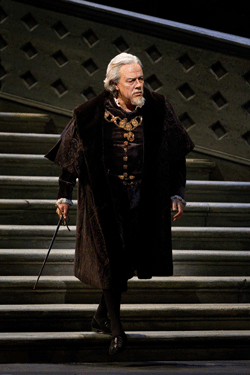 Ferruccio Furlanetto as de Silva
Verdi was a discriminating reader of plays, with an eye for “situations” and thrilling dramatic complexities, stories to which music would add a layer of thrill, pieces that were “musicable” (musicabile). This is a lesson American composers who attempt to make operas of untheatrical novels (Great Gatsby, American Tragedy) have foolishly ignored. Ernani, Verdi’s fifth opera and third great success is based on Victor Hugo’s hyperromantic assault on French classicism, which was right down the composer’s street, a breath of tuneful fresh air at gale force after the inane Solera poems he had been obliged to rescue hitherto (Nabucco, Lombardi). With Ernani, which was also his first collaboration with the librettist Piave who would give him Rigoletto and Traviata, Verdi had a stage-story whose every erratic twist and turn takes place right before our eyes. Hugo’s Hernani may seem ludicrous today, but its ludicrous actions are governed by logic; they build from their premises to a foredestined course, and the prime movers are the four principal characters, not ancient legends, hidden documents or offstage side plots. As Gabriele Baldini remarked, in his quirky study of Verdi’s operas, Ernani is a mating dance about three males each trying to chase off their rivals to get the girl to themselves. You can see walrus perform this sort of thing in the Arctic every year, with somewhat less bel canto line in their wails.
There is a grandeur even to what is farcical here, as there is in so much stage murder for honor and revenge. The codes of Passion, Honor and Vendetta were no longer fashionable in the urban circles of Italy, but their aroma lingers in the Mediterranean heart (and other regions then chic, such as Scott’s Scotland or, later, our Wild West); these feelings are too basic to us, howevermuch deplored—most law codes and ethical religions deplore Vendetta, and most believers pay lip service to that condemnation, if little more. The audience for Ernani when it was new, in 1844, could deplore the egotism of the characters but they were viscerally stirred by Hugo’s doomed love quadrangle. Like Wagner’s Tristan und Isolde, these people love more intensely than any real, sane people could in the mundane world where there are taxes to pay and housework to get done. Their love is beyond such quotidian matters. They love so much that they cannot live.
To perform Ernani correctly, all you need, as Caruso said of Trovatore, is the four best singers in the world—though the singers this time are not S-A-T-B but S-T-Bt-Bs. As in Trovatore, they should know how to sing Italian music properly (a given in Caruso’s day, not in ours), and be willing to howl it as if nothing in their lives was more important than reaching that top note and holding it forever without (apparently) taking a breath. Such matters can no longer be taken for granted. The current Metropolitan Opera revival rates a solid B for effort and achievement. Certainly acting and staging recalled the pre-modern age. Would you want to see a “Regie-theater,” Catalan or Germanic, quasi-pornographic Ernani? What on earth would it look like? As hideous as the Met’s last four Trovatores, probably. The opulent Samaritani sets for Ernani, with their miles of fine fabric and grand staircases dashing about in all directions, recall the luxe of castles in sixteenth-century Spain or opera houses a hundred years ago.
So did the Met have the best singers in the world on this post-Caruso, post-Ponselle, post-Siepi occasion? And did they sing as though their lives depended on it? I cannot say they were, or that they did. A solid B, which nowadays may be the best anyone can expect for blood-and-thunder Verdi.
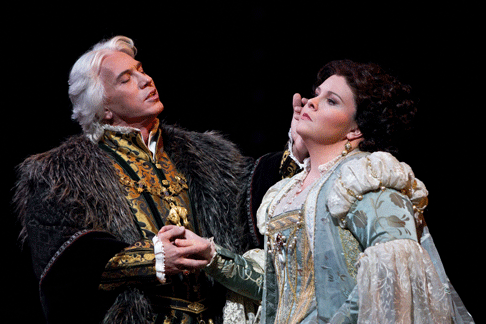 Dmitri Hvorostovsky as Don Carlo and Angela Meade as Elvira
Roberto Di Biasio, a young tenor from Catania, Bellini’s home town, has a lithe, attractive voice, flexible and gracious, and he sings with passion when passion is called for—a major factor in Ernani. He does not have—or on this occasion was too nervous to attempt—the high C’s that can bring an opera house to its feet. He gave great pleasure without arousing enthusiasm. He is a slim, stalwart stage figure and struck whatever poses were called for from him.
Elvira was written for Sofia Loewe, later Verdi’s first Odabella in Attila and his original choice for Lady Macbeth; she must have been one hell of a singer, with extraordinary range and technique. Angela Meade made her stage debut in this role, replacing an indisposed Sondra Radvanovsky. On that occasion the debutante was naturally tentative, and she is not a born actress, but by the conclusion of that first performance it was clear she had chosen the right profession. Since that time she has commendably devoted herself to improving on her weaknesses. Today, she is a local favorite beginning to be more widely known, and she has Norma and Semiramide and Virginia under her belt—not to mention three Anna Bolenas at the Met last fall. She has had time to rethink Elvira, to recalculate the role’s tempo.
Her rich chest voice though not precisely certain of pitch in “Ernani, involami,” rose to that feature of her sound that her fans most admire, the detached head voice for personalized ornamentation, here expressing (perhaps) ethereal daydreams of true love. This lightness above the staff, this softness where so many sopranos are strident, is indeed delightful and Meade is wise enough not to overdo it, but it’s only fair to add that in the bel canto era, perfect evenness from top to bottom rather than separate voices was the ideal. Those sweet, pure notes ravish us and Meade has found ways to make them dramatically effective, but it has always seemed to me that her chest voice, the necessary base of a true Verdi soprano, is potentially her greatest resource. How long has it been since an Aida sang her duets with passion and could float high C’s? Meade may evolve into such a singer, a genuine spinto, and if she does the Verdi repertory will be hers to command. Just sayin’.
Don Carlo, Spain’s and America’s Charles the First, Rome and Germany’s Charles the Fifth (and Burgundy’s Charles the Second, lest we forget), should be a baritone of regal elegance and adolescent fervor as well as, at the last (Act III—he’s de trop for the finale), imperial force. Such baritones once abounded, and those were golden ages for Verdi’s operas; they may not exist today. Dmitri Hvorostovsky has the elegance and the dignity, and his voice is very lovely, but one thing they didn’t teach him in Siberia was how to sing an Italian line. He can sing many, but he cannot get from one phrase to another without a painfully audible gasping for breath, and this has always undercut the pleasure of his singing for me. He does not seem to encounter this problem in smaller opera houses (Houston, for example) or in the Russian repertory (Queen of Spades, War and Peace), but at the Met he is not a Verdi baritone to rank with Merrill, Warren, Bastianini, MacNeil or Milnes. (You see? We did have them once.) He made many gorgeous sounds on the present occasion, and many huffs and puffs between them.
Ferruccio Furlanetto, who has been singing everything from Mefistofele to Mephistophélès to Boris Godunov lately, took on the role of Silva, the honorable foe of young love. This can be a rewarding role for singers in easy command of the extremes of a basso cantante; Silva postures nobly and Verdi subscribes to his noble postures. Basses with self-knowledge or a belief in anything outside themselves lay in Verdi’s future, but Sparafucile, the first of those, was still seven years away. Furlanetto gave much pleasure but he is beginning to gasp between lines in a manner learned, perhaps, from Hvorostovsky.
Once the four characters have been introduced, we get down to business with the confrontational duets, trios and rousing ensembles that are Verdi’s natural element. All our singers were palpably delighted at the change, and all of them sang better than they had on first entrance. The evening rollicked along, staircase following staircase in the mazy sets. The acting remained stiff, but … it’s early Verdi; no one expects naturalism. “The trio,” Verdi told librettist, Piave, “should be the greatest number in the opera,” and so it is, as well as the last one. And while the coronation scene made a superb climax to Act III, that Act IV trio with Meade, Di Biasio and Furlanetto swept memory aside and could have gone on all night. The Ernani engine must be cranked like a tin Lizzie, but when it takes off, it’s a Lamborghini. The singers took the curves on two wheels and crossed the flags like winners.
One annoying bêtise of the Met production when it was new has been corrected. The double aria, “Odi il voto, il grande Iddio,” was inserted into the conclusion of Act II six months after Ernani’s premiere for the Russian tenor Ivanoff, at Rossini’s personal request. It intrudes on Hugo’s plot for no reason at all and muddles Verdi’s beloved dramatic momentum. The aria belongs in recitals (and on recital disks) when a tenor wants so show off in isolation, but the Met inserted it for this production because Luciano Pavarotti was the focal point around which the staging was created, and Pavarotti was an excellent motive so do so: For one thing, he could sing it, even after a previous double aria and any number of duets and ensembles. When the Met last brought this production back, either the conductor was too lazy to delete the piece or Marcello Giordani insisted on having as large a helping of the green stuff (Verdi, I mean) as the Pav had had: Anyway, sing it Giordani did, and badly he sang it. I am delighted that wiser heads have prevailed, and Verdi’s Act II is now given in its proper form, the last words belonging to tenor and bass, united for once—after all, the baritone has run off with their soprano.
John Yohalem