![Erwin Schrott as Don Giovanni [Photo © ROH 2012 / Mike Hoban]](http://www.operatoday.com/DON-GIOVANNI-10155_0435.gif)
20 Feb 2012
Erwin Schrott’s Don Giovanni, ROH
Erwin Schrott triumphed as Don Giovanni in the Mozart/da Ponte series at the Royal Opera House, overcoming the limitations of the staging.
English Touring Opera are delighted to announce a season of lyric monodramas to tour nationally from October to December. The season features music for solo singer and piano by Argento, Britten, Tippett and Shostakovich with a bold and inventive approach to making opera during social distancing.
This tenth of ten Live from London concerts was in fact a recorded live performance from California. It was no less enjoyable for that, and it was also uplifting to learn that this wasn’t in fact the ‘last’ LfL event that we will be able to enjoy, courtesy of VOCES8 and their fellow vocal ensembles (more below …).
Ever since Wigmore Hall announced their superb series of autumn concerts, all streamed live and available free of charge, I’d been looking forward to this song recital by Ian Bostridge and Imogen Cooper.
Although Stile Antico’s programme article for their Live from London recital introduced their selection from the many treasures of the English Renaissance in the context of the theological debates and upheavals of the Tudor and Elizabethan years, their performance was more evocative of private chamber music than of public liturgy.
Evidently, face masks don’t stifle appreciative “Bravo!”s. And, reducing audience numbers doesn’t lower the volume of such acclamations. For, the audience at Wigmore Hall gave soprano Elizabeth Llewellyn and pianist Simon Lepper a greatly deserved warm reception and hearty response following this lunchtime recital of late-Romantic song.
For this week’s Live from London vocal recital we moved from the home of VOCES8, St Anne and St Agnes in the City of London, to Kings Place, where The Sixteen - who have been associate artists at the venue for some time - presented a programme of music and words bound together by the theme of ‘reflection’.
'Such is your divine Disposation that both you excellently understand, and royally entertaine the Exercise of Musicke.’
‘And there was war in heaven: Michael and his angels fought against the dragon; and the dragon fought and his angels, And prevailed not; neither was their place found any more in heaven … that old serpent … Satan, which deceiveth the whole world: he was cast out into the earth, and his angels were cast out with him.’
There was never any doubt that the fifth of the twelve Met Stars Live in Concert broadcasts was going to be a palpably intense and vivid event, as well as a musically stunning and theatrically enervating experience.
‘Love’ was the theme for this Live from London performance by Apollo5. Given the complexity and diversity of that human emotion, and Apollo5’s reputation for versatility and diverse repertoire, ranging from Renaissance choral music to jazz, from contemporary classical works to popular song, it was no surprise that their programme spanned 500 years and several musical styles.
The Academy of St Martin in the Fields have titled their autumn series of eight concerts - which are taking place at 5pm and 7.30pm on two Saturdays each month at their home venue in Trafalgar Square, and being filmed for streaming the following Thursday - ‘re:connect’.
The London Symphony Orchestra opened their Autumn 2020 season with a homage to Oliver Knussen, who died at the age of 66 in July 2018. The programme traced a national musical lineage through the twentieth century, from Britten to Knussen, on to Mark-Anthony Turnage, and entwining the LSO and Rattle too.
With the Live from London digital vocal festival entering the second half of the series, the festival’s host, VOCES8, returned to their home at St Annes and St Agnes in the City of London to present a sequence of ‘Choral Dances’ - vocal music inspired by dance, embracing diverse genres from the Renaissance madrigal to swing jazz.
Just a few unison string wriggles from the opening of Mozart’s overture to Le nozze di Figaro are enough to make any opera-lover perch on the edge of their seat, in excited anticipation of the drama in music to come, so there could be no other curtain-raiser for this Gala Concert at the Royal Opera House, the latest instalment from ‘their House’ to ‘our houses’.
"Before the ending of the day, creator of all things, we pray that, with your accustomed mercy, you may watch over us."
The doors at The Metropolitan Opera will not open to live audiences until 2021 at the earliest, and the likelihood of normal operatic life resuming in cities around the world looks but a distant dream at present. But, while we may not be invited from our homes into the opera house for some time yet, with its free daily screenings of past productions and its pay-per-view Met Stars Live in Concert series, the Met continues to bring opera into our homes.
Music-making at this year’s Grange Festival Opera may have fallen silent in June and July, but the country house and extensive grounds of The Grange provided an ideal setting for a weekend of twelve specially conceived ‘promenade’ performances encompassing music and dance.
There’s a “slide of harmony” and “all the bones leave your body at that moment and you collapse to the floor, it’s so extraordinary.”
“Music for a while, shall all your cares beguile.”
The hum of bees rising from myriad scented blooms; gentle strains of birdsong; the cheerful chatter of picnickers beside a still lake; decorous thwacks of leather on willow; song and music floating through the warm evening air.
Erwin Schrott triumphed as Don Giovanni in the Mozart/da Ponte series at the Royal Opera House, overcoming the limitations of the staging.
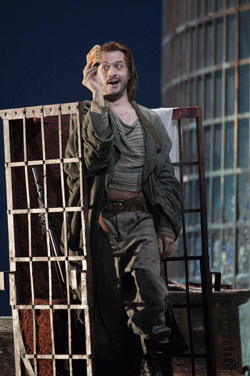 Alex Esposito as Leporello
Schrott exudes charisma, which gives him an advantage not every singer can muster, for Don Giovanni is a larger-than-life personality who needs to be expressed in the grand manner. It’s pointless to nitpick a portrayal as passionate as this. Schrott creates Don Giovanni in all his malevolent glory — virile, confident, arrogant. bursting with animal sexuality, yet manages to hint at the manic obsession that drives the character. Schrott hints at these fears in brief, quieter moments, and slips back into macho mode with increased vehemence. Stunning. To match the well-toned voice he also has a well-toned body. At last, director Francesca Zambello’s bizarre idea that Don Giovanni should dine semi-naked with the Commendatore makes a little sense. You’re hypnotized by Schrott’s biceps and pecs, and forget, for a moment, how silly it is that he should be costumed like this for a banquet that he knows will be the biggest confrontation in his life.
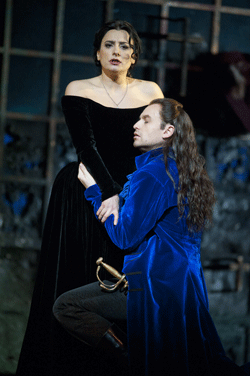 Carmella Remigio as Donna Anna and Pavol Breslik as Don Ottavio
Schrott is brilliant but even he has to work within the limitations of Zambello’s brainless staging and untypically leaden playing from the Royal Opera House Orchestra, conducted by Constantinos Carydis. Also the more reason in this production to appreciate the efforts of the singers, who rise above what they have to deal with. Leporello, for example, should give Don Giovanni a run for his money. He’s a servant, but not entirely subservient. He’s also to some extent culpable for Don Giovanni’s crimes. But in Zambello’s production, he’s portrayed as a buffoon, even more peasant-like than Masetto’s peasant friends. Why would a sophisticate like Don Giovanni hire someone this bucolic? Nobody could possibly be fooled by this servant in his master’s clothes. So the production plays against anything Alex Esposito might make of the role. He sang in the 2008 version of this production, and has done the part many times, so he should have been aware how the production takes the bite out of whatever Mozart and da Ponte may have meant it to be.
Ruxandra Donose is a fiery Latin Donna Elvira, with a spirited edge When Donna Elvira sets out to confront Don Giovanni, she wears what looks like a dirty dress, hem ruched up over her calves in a way no aristocratic lady would dare to be seen. It’s probably not the way to play power games with Don Giovanni, master of intrigue, but Donna Elvira is no strategist. Donose’s “Mi tradi” takes on a wild air, expressing Donna Elvira’s emotional trauma. Donose has a very strong background in French repertoire, so imbibes its values of intelligence and clarity. This enhances her feel for the fundamental elegance of Mozart’s style, even in an opera which should be as dangerous as Don Giovanni.
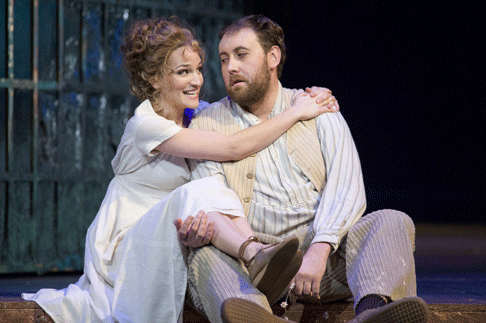 Kate Lindsey as Zerlina and Matthew Rose as Masetto
Carmela Remigio was making her Royal Opera House debut as Donna Anna, though she’s taken the part of Donna Elvira many times (Please read this interview in which she speaks about the challenges). She specializes in 18th century opera, so brings a late baroque sensibility to what she does. She’s far closer to the spirit of Mozart than this maudlin production deserves. She sings with tight focus, suggesting Donna Anna’s tension, struggling with feelings she can’t articulate. Her sexuality is aroused, but she’s trapped by what society expects of her.
Fortunately, Pavol Breslik’s Don Ottavio is sensitively portrayed and sung with more authority than the role usually gets. Donna Anna might luck out, after all. Breslik’s tender “O mio tresoro” was interrupted by the loudest snort I’ve ever heard from any audience. I don’t condemn coughing as it’s involuntary, but it’s not funny to choose to blow one’s nose with such violence at this point. It sounded like a boo, and was not at all fair on the singer.
Throughout this opera, Mozart plays with the idea of identity switchers, expressed through the balance of voice types. Kate Lindsey’s Zerlina was pert and bright, almost strident, but a good foil for Matthew Rose’s deep, authoritative Masetto. Inspired casting! (Click here for an interview of Kate Lindsey.) Rose’s Masetto is big in every way, not simply because he’s so tall : this is a resonant voice, one can imagine him taking on Don Giovanni, at a stretch, and certainly the Commendatore. As for the Commendatore he was hardly present at all. Instead, a huge golden object kept swaying in the background, eventually revealing itself as a giant hand, its finger pointing at Don Giovanni. One of the truly horrific moments in the whole repertoire, reduced to something out of Monty Python, worse still prettified and shiny. Whatever Reinhard Hagen might have done with his role, he was completely upstaged, for no obvious dramatic or logical reason whatsoever.
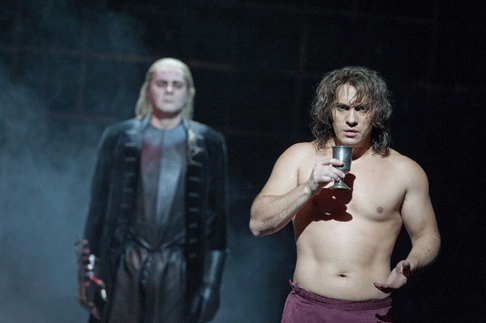 Reinhard Hagen as Commendatore and Erwin Schrott as Don Giovanni
Judging from the audience reaction, this Don Giovanni should be a great hit, though not necessarily for the best artistic reasons. Many burst out laughing at the subtitles, as if to prove they got the joke. Yet if they really know the opera, they’d know it’s not a comedy. Its wit is savage irony, for the story is essentially tragic. Don Giovanni’s sex addiction is a sign of weakness, a symptom of the corruption of a power structure held together by exploitation. In this world of peasants and aristocrats, everyone gets screwed. Instead, Zambello’s production ignores these fundamentals, and plays up irrelevancies like the Madonna, crucifixes and the random objects Masetto’s friends carry for no clear purpose. This trivializes the drama by introducing an inordinate amount of stage noise, further encouraging new audiences to think of Don Giovanni as merry slapstick. This is Regie-opera at its worst, but because it’s scenic, those who don’t like directors will be fooled. So thank goodness for the singers in this cast, who have salvaged what they can, and used their experience and instincts to present a wonderful evening of song. For the singers, and for Erwin Schrott, this production should not be missed. (It runs to 29th February)
Anne Ozorio