![Alan Opie as Klinghoffer and Michaela Martens as Marilyn Klinghoffer [Photo © Richard Hubert Smith courtesy of English National Opera]](http://www.operatoday.com/Klinghoffer_ENO_01.gif)
27 Feb 2012
John Adams — Death of Klinghoffer, London
John Adams’s The Death of Klinghoffer is on at the English National Opera, London.
English Touring Opera are delighted to announce a season of lyric monodramas to tour nationally from October to December. The season features music for solo singer and piano by Argento, Britten, Tippett and Shostakovich with a bold and inventive approach to making opera during social distancing.
This tenth of ten Live from London concerts was in fact a recorded live performance from California. It was no less enjoyable for that, and it was also uplifting to learn that this wasn’t in fact the ‘last’ LfL event that we will be able to enjoy, courtesy of VOCES8 and their fellow vocal ensembles (more below …).
Ever since Wigmore Hall announced their superb series of autumn concerts, all streamed live and available free of charge, I’d been looking forward to this song recital by Ian Bostridge and Imogen Cooper.
Although Stile Antico’s programme article for their Live from London recital introduced their selection from the many treasures of the English Renaissance in the context of the theological debates and upheavals of the Tudor and Elizabethan years, their performance was more evocative of private chamber music than of public liturgy.
Evidently, face masks don’t stifle appreciative “Bravo!”s. And, reducing audience numbers doesn’t lower the volume of such acclamations. For, the audience at Wigmore Hall gave soprano Elizabeth Llewellyn and pianist Simon Lepper a greatly deserved warm reception and hearty response following this lunchtime recital of late-Romantic song.
For this week’s Live from London vocal recital we moved from the home of VOCES8, St Anne and St Agnes in the City of London, to Kings Place, where The Sixteen - who have been associate artists at the venue for some time - presented a programme of music and words bound together by the theme of ‘reflection’.
'Such is your divine Disposation that both you excellently understand, and royally entertaine the Exercise of Musicke.’
‘And there was war in heaven: Michael and his angels fought against the dragon; and the dragon fought and his angels, And prevailed not; neither was their place found any more in heaven … that old serpent … Satan, which deceiveth the whole world: he was cast out into the earth, and his angels were cast out with him.’
There was never any doubt that the fifth of the twelve Met Stars Live in Concert broadcasts was going to be a palpably intense and vivid event, as well as a musically stunning and theatrically enervating experience.
‘Love’ was the theme for this Live from London performance by Apollo5. Given the complexity and diversity of that human emotion, and Apollo5’s reputation for versatility and diverse repertoire, ranging from Renaissance choral music to jazz, from contemporary classical works to popular song, it was no surprise that their programme spanned 500 years and several musical styles.
The Academy of St Martin in the Fields have titled their autumn series of eight concerts - which are taking place at 5pm and 7.30pm on two Saturdays each month at their home venue in Trafalgar Square, and being filmed for streaming the following Thursday - ‘re:connect’.
The London Symphony Orchestra opened their Autumn 2020 season with a homage to Oliver Knussen, who died at the age of 66 in July 2018. The programme traced a national musical lineage through the twentieth century, from Britten to Knussen, on to Mark-Anthony Turnage, and entwining the LSO and Rattle too.
With the Live from London digital vocal festival entering the second half of the series, the festival’s host, VOCES8, returned to their home at St Annes and St Agnes in the City of London to present a sequence of ‘Choral Dances’ - vocal music inspired by dance, embracing diverse genres from the Renaissance madrigal to swing jazz.
Just a few unison string wriggles from the opening of Mozart’s overture to Le nozze di Figaro are enough to make any opera-lover perch on the edge of their seat, in excited anticipation of the drama in music to come, so there could be no other curtain-raiser for this Gala Concert at the Royal Opera House, the latest instalment from ‘their House’ to ‘our houses’.
"Before the ending of the day, creator of all things, we pray that, with your accustomed mercy, you may watch over us."
The doors at The Metropolitan Opera will not open to live audiences until 2021 at the earliest, and the likelihood of normal operatic life resuming in cities around the world looks but a distant dream at present. But, while we may not be invited from our homes into the opera house for some time yet, with its free daily screenings of past productions and its pay-per-view Met Stars Live in Concert series, the Met continues to bring opera into our homes.
Music-making at this year’s Grange Festival Opera may have fallen silent in June and July, but the country house and extensive grounds of The Grange provided an ideal setting for a weekend of twelve specially conceived ‘promenade’ performances encompassing music and dance.
There’s a “slide of harmony” and “all the bones leave your body at that moment and you collapse to the floor, it’s so extraordinary.”
“Music for a while, shall all your cares beguile.”
The hum of bees rising from myriad scented blooms; gentle strains of birdsong; the cheerful chatter of picnickers beside a still lake; decorous thwacks of leather on willow; song and music floating through the warm evening air.
John Adams’s The Death of Klinghoffer is on at the English National Opera, London.
Press reports suggested mass protests against John Adams’s The Death of Klinghoffer at the ENO. But there was just one polite demonstrator, who’d left by the end of the evening. Perhaps he saw the show. The subject is emotive, and important, but Adams’s treatment is not incendiary. It’s the nature of his music. Repetitive, ruminative cadences, which suggest contemplation rather than imposed narrative. Perhaps it’s the very anti-drama in this music that provokes response.
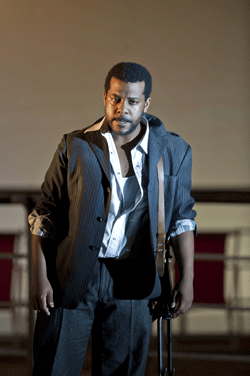 Sidney Outlaw as Rambo
Adams's abstracted cadences evoke blurred boundaries: endless waves on the sea, the whirr of a ship’s engine, the slow ticking away of time. Unfortunately, this music also evokes tedium. Facts about the hijack of the Achille Lauro are projected onto the stage to keep us alert, but the music is saying something else altogether. Furthermore, Adams sets text counter-intuitively, so syntax is distorted in favour of unsettling stresses in places that would not occur in speech. Because our brains don’t process language in this way, meaning is sacrificed. It’s not good when you have to concentrate on sub-titles to figure out what’s being sung. Alice Goodman’s libretto has been criticized for being opaque, but it closely reflects Adams’s musical technique. Images are blurred and shift shape. In the opening Chorus, it’s deliberately unclear who the protagonist is. Is she a young woman in love or an old woman awaiting death? Or both? It’s immaterial. She’s a composite of millions who have been exiled throughout history. When music and text are both this oblique, the thrust of the drama is lost. Perhaps Adams wants us to savour each moment in detail, as we savour life itself, knowing it won’t last, but the cumulative effect of the First Act is soporific.
Things pick up in the Second Act, when Adams frees himself from earnest pseudo-documentary. Up to this point the action has mainly been in choruses. Now we have individuals with whom we can identify. Some of the words they sing come from transcripts made at the time, others are imaginative creations. It doesn’t matter. In these arias there’s dramatic reality. Leon Klinghoffer is presented as a likeable hero, and at last the opera has human focus. Alan Opie sings Klinghoffer so he comes over as a strong, reasonable man of authority, establishing a moral compass. The Aria of the Falling Body anchors Adams’s wavering oscillations with emotional truth.
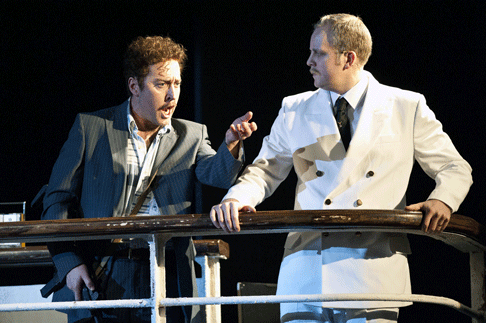 Christopher Magiera as the Captain and Richard Burkhard as Mamoud
Michaela Martens' arias as Marilyn Klinghoffer are tours de force, the last adding bite. The Captain (Christopher Magiera) handled the situation with cool headed professionalism. offering his own life to save his passengers, but Adams and Goodman don’t dilute the focus from Klinghoffer to make the Captain a hero. Mrs Klinghoffer, in her grief, can’t understand why her husband was killed without her knowing. It’s a thoughtful detail to include in the opera since in these situations no-one knows everything all the time. Fine vignettes too from Lucy Schaufer (The Swiss Grandmother), Clare Presland (The Palestinian Mother) and Kate Miller Heidke (The British Dancing Girl), so clueless that she doesn’t comprehend the enormity of what’s happening. In a much needed twist of humour, Adams adds snatches of pop music around the part.
Baldur Brönimann conducted the orchestra so details surfaced tellingly from the amorphous textures. He’s a specialist in modern repertoire and understands how the genre operates. This music is not an undifferentiated mass.
The staging, however, was much less sensitive. Directed by Tom Morris with designs by Tom Pye, it tried to give shape to Adams’s oblique non-forms by over emphasizing the literal, perhaps to create the sensationalism Adams and Goodman avoid. The dance sequences are awful, completely at odds with the story. This is not a game. It is more than just a struggle over a country, it’s part of the eternal struggle between haves and have-nots. In this production, the Palestinians raise their fists in the classic gesture of the oppressed. For a moment it looks like a Nazi salute. What the hijackers did was evil, but it does not follow that the poor should not act, whoever they might be. The scenes where Finn Ross’s video projections fill the stage are far more effective, and being semi-abstract, are more faithful to Adams’s idiom.
The Death of Klinghoffer has its longueurs but it’s an important statement. Twenty five years after the Achille Lauro hijacking, terrorism is, if anything, more widespread and more savage than ever before. Twin Towers, the school in Beslan, the cinema in Moscow, and Utøya. Is there something to be learned from The Death of Klinghoffer? Many thanks to the ENO for giving us a chance to hear for ourselves.
Anne Ozorio