![Alexandra Kurzak as Susanna [Photo © ROH 2012 / Bill Cooper]](http://www.operatoday.com/FIGARO-BC20120208275.gif)
15 Feb 2012
Le nozze di Figaro, Royal Opera
David McVicar’s production of The Marriage of Figaro, previously staged in 2006 (twice),
English Touring Opera are delighted to announce a season of lyric monodramas to tour nationally from October to December. The season features music for solo singer and piano by Argento, Britten, Tippett and Shostakovich with a bold and inventive approach to making opera during social distancing.
This tenth of ten Live from London concerts was in fact a recorded live performance from California. It was no less enjoyable for that, and it was also uplifting to learn that this wasn’t in fact the ‘last’ LfL event that we will be able to enjoy, courtesy of VOCES8 and their fellow vocal ensembles (more below …).
Ever since Wigmore Hall announced their superb series of autumn concerts, all streamed live and available free of charge, I’d been looking forward to this song recital by Ian Bostridge and Imogen Cooper.
Although Stile Antico’s programme article for their Live from London recital introduced their selection from the many treasures of the English Renaissance in the context of the theological debates and upheavals of the Tudor and Elizabethan years, their performance was more evocative of private chamber music than of public liturgy.
Evidently, face masks don’t stifle appreciative “Bravo!”s. And, reducing audience numbers doesn’t lower the volume of such acclamations. For, the audience at Wigmore Hall gave soprano Elizabeth Llewellyn and pianist Simon Lepper a greatly deserved warm reception and hearty response following this lunchtime recital of late-Romantic song.
For this week’s Live from London vocal recital we moved from the home of VOCES8, St Anne and St Agnes in the City of London, to Kings Place, where The Sixteen - who have been associate artists at the venue for some time - presented a programme of music and words bound together by the theme of ‘reflection’.
'Such is your divine Disposation that both you excellently understand, and royally entertaine the Exercise of Musicke.’
‘And there was war in heaven: Michael and his angels fought against the dragon; and the dragon fought and his angels, And prevailed not; neither was their place found any more in heaven … that old serpent … Satan, which deceiveth the whole world: he was cast out into the earth, and his angels were cast out with him.’
There was never any doubt that the fifth of the twelve Met Stars Live in Concert broadcasts was going to be a palpably intense and vivid event, as well as a musically stunning and theatrically enervating experience.
‘Love’ was the theme for this Live from London performance by Apollo5. Given the complexity and diversity of that human emotion, and Apollo5’s reputation for versatility and diverse repertoire, ranging from Renaissance choral music to jazz, from contemporary classical works to popular song, it was no surprise that their programme spanned 500 years and several musical styles.
The Academy of St Martin in the Fields have titled their autumn series of eight concerts - which are taking place at 5pm and 7.30pm on two Saturdays each month at their home venue in Trafalgar Square, and being filmed for streaming the following Thursday - ‘re:connect’.
The London Symphony Orchestra opened their Autumn 2020 season with a homage to Oliver Knussen, who died at the age of 66 in July 2018. The programme traced a national musical lineage through the twentieth century, from Britten to Knussen, on to Mark-Anthony Turnage, and entwining the LSO and Rattle too.
With the Live from London digital vocal festival entering the second half of the series, the festival’s host, VOCES8, returned to their home at St Annes and St Agnes in the City of London to present a sequence of ‘Choral Dances’ - vocal music inspired by dance, embracing diverse genres from the Renaissance madrigal to swing jazz.
Just a few unison string wriggles from the opening of Mozart’s overture to Le nozze di Figaro are enough to make any opera-lover perch on the edge of their seat, in excited anticipation of the drama in music to come, so there could be no other curtain-raiser for this Gala Concert at the Royal Opera House, the latest instalment from ‘their House’ to ‘our houses’.
"Before the ending of the day, creator of all things, we pray that, with your accustomed mercy, you may watch over us."
The doors at The Metropolitan Opera will not open to live audiences until 2021 at the earliest, and the likelihood of normal operatic life resuming in cities around the world looks but a distant dream at present. But, while we may not be invited from our homes into the opera house for some time yet, with its free daily screenings of past productions and its pay-per-view Met Stars Live in Concert series, the Met continues to bring opera into our homes.
Music-making at this year’s Grange Festival Opera may have fallen silent in June and July, but the country house and extensive grounds of The Grange provided an ideal setting for a weekend of twelve specially conceived ‘promenade’ performances encompassing music and dance.
There’s a “slide of harmony” and “all the bones leave your body at that moment and you collapse to the floor, it’s so extraordinary.”
“Music for a while, shall all your cares beguile.”
The hum of bees rising from myriad scented blooms; gentle strains of birdsong; the cheerful chatter of picnickers beside a still lake; decorous thwacks of leather on willow; song and music floating through the warm evening air.
David McVicar’s production of The Marriage of Figaro, previously staged in 2006 (twice),
2008, and 2010, now returns as part of the Royal Opera House’s ‘Da Ponte cycle’. I cannot help wishing that funds had stretched to commissioning three new productions, preferably from the same director, with a sense of how the works might actually cohere as a ‘cycle’. Nevertheless, and despite a good number of reservations I continue to entertain, McVicar’s production remains preferable to Jonathan Miller’s vulgar Così fan tutte, and, assuming it not to have been overhauled beyond recognition, Francesca Zambello’s vacuous Don Giovanni.
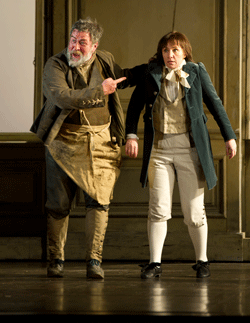 Anna Bonitatibus as Cherubino and Jeremy White as Antonio
Moving the action to the 1820s does no Restoration period, but the motivation remains obscure. If the point be to highlight Talleyrand’s observation concerning the restored Bourbons, that they had learned nothing and forgotten nothing, then it needs to be made, not assumed. The Count’s droit de seigneur is a gross exaggeration in the eighteenth century; in the nineteenth, it merely seems incredible. ‘Absolutism’ was of course a nineteenth-century way of understanding the ancien régime, painting a complex society in the bold, often crude colours of monarchs such as Charles X. A good deal of sophistication would be needed to make the shift coherent, yet here the political seems notable for the most part by its absence. We have neither a society of orders nor an emergent class-based society, merely a house with hyperactive servants in attractive costumes. The result, whatever the intention, seems to be pandering to devotees of mindless ‘costume dramas’. It all nevertheless looks good, and certain moments are very well handled, especially the magical falling of dusk between the third and fourth acts. (Incidentally, when audience members are relentlessly intent upon disrupting the action with mid-act applause, why do they then fall silent at the end of an act? Mystifying!) The servants’ running about during the Overture remains an unnecessary irritant — can anyone really think that Mozart’s music deserves to be drowned out by footsteps? — and Leah Hausman’s revival direction, sadly, tends towards the Carry On school, only encouraging a vocal, puerile section of the audience, about which more anon.
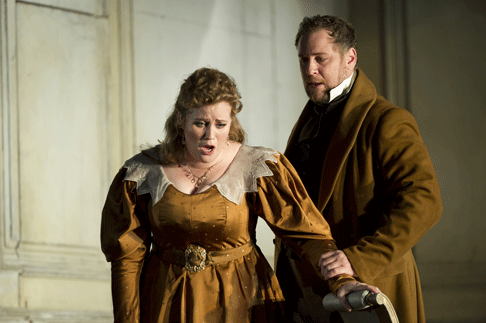 Lucas Meachem as Count Almaviva and Rachel Willis-Sorensen as Countess Almaviva
The greatest surprise of the evening was perhaps Sir Antonio Pappano’s conducting. There were problems: too often, he seems to view Mozart as aspiring towards Rossini, and the consequent motor rhythms have no place whatsoever in Mozart’s music. Certain aspects of phrasing also suffered in that respect, perhaps most glaringly in the Overture; articulation, where desperately needed, came there none. The use of natural horns was at best questionable; their rasping at the conclusion of Figaro’s fourth act aria was unpleasant in the extreme. That said, and with the notable exception of the end of the second act, Pappano did not harry the score; indeed, there were moments when he clearly communicated his delight in its subtleties. Woodwind might not have ravished in the way they did for Sir Colin Davis in 2010, but they seduced nevertheless. Tempi convinced for the most part, and there was little of the tendency towards mere ‘accompaniment’ that has often held back this conductor’s work previously. I seem to be the only person who regrets the ‘traditional’ cuts in the fourth act, but regret them I do.
Casting Figaro successfully seems trickier than one would expect. Even in 2010, a simply astounding male team of Erwin Schrott (Figaro) and Marius Kwiecien (the Count) had to endure sub-par contributions from their Susanna and Countess. Here the undoubted star was Aleksandra Kursak’s Susanna, ever musical, ever lively, and above all ever alert to the twists and turns Da Ponte and Mozart lovingly throw her way. One could not, for the duration of the performance, imagine it being done better any other way. Phrasing was telling but unobtrusive, likewise her sideways glances.
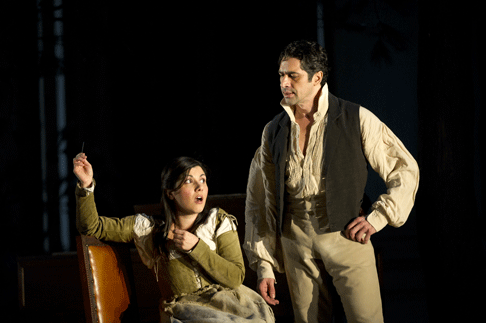 Ildebrando D’Arcangelo as Figaro and Susana Gaspar as Barbarina
Ildebrando d’Arcangelo has never lacked stage presence, and his voice at its dark-chocolate best remains as attractive as his handsome visage and figure. There were, however, a good few moments, especially earlier on, when his delivery lacked focus. Lucas Meachem’s Count suffered similarly, though he also lacked his valet’s presence — a serious drawback, alas. Rachel Willis-Sørensen’s Countess was a serious disappointment: I have never heard ‘Porgi, amor’ so ill-tuned, nor so squally. She improved as time went on, but throughout lacked grace and, straightforwardly, character. The Cherubino of Anna Bonatatibus also disappointed: ill-focused and short-breathed. Even the Marcellina of a stalwart such as Ann Murray, an artist I admire greatly, sometimes sounded out of sorts. And would directors please cease their fixation with turning Don Basilio into a camp monstrosity? It is entirely unwarranted in either libretto or score, and has simply become a tedious cliché.
Finally, alas, a character that was all too present on this occasion: the audience, or at least a considerable section thereof. I had been tempted to open with the words, ‘more in sorrow than in anger,’ but that would have misled, for both emotions ran to the surface dealing with so disruptive a crowd. All manner of disruption was present, unremittingly so. Barely a bar went by without a cough or two. Objects were dropped left, right, and centre — and I am not referring to the stage business. A watch alarm made a charming accompaniment to ‘Porgi, amor’, though we had to wait a little longer for telephones to make their first appearance. Worst of all was the incessant, moronic laughter, perhaps to a certain extent elicited by more dubious aspects of the production; but really, if one finds someone walking onstage with a dog intrinsically hilarious, then one may need to seek treatment.
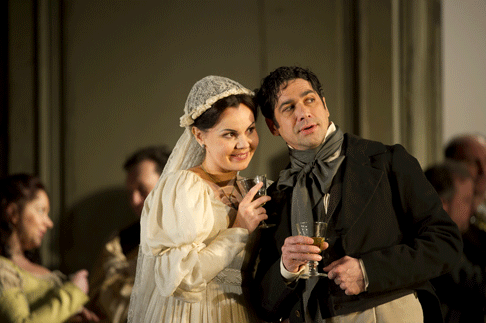 Alexandra Kurzak as Susanna and Ildebrando D’Arcangelo as Figaro
The slightest reference — via the surtitles, be it noted — to anything sexual was met with all the maturity of a convention for non-recovering Benny Hill Show addicts. I should say that those people needed to get out more, except I should much rather they stayed at home. Most unforgivable was the laughter that greeted those words: ‘Contessa, perdono’. McVicar’s production brings a true sense of revelation at that point, the show-stopping appearance of the Countess, ravishing and in more than one sense graceful, fully in tune with Mozart’s approaching benediction. What is even remotely hilarious about seeking a forgiveness that goes beyond even the humanity of the Countess to the Almighty Himself, that ‘peace … which passeth all understanding’? Even if somehow one were to find that hysterically amusing — presumably one would then guffaw through King Lear or the Missa Solemnis — one might have some regard for fellow members of the audience, those who might have come to hear Mozart’s score. As the gentleman seated next to me commented during the curtain calls, it made one long to be Ludwig II, alone with one’s art. None of this is, of course, in any sense the fault of the Royal Opera House, but perhaps an announcement requesting silence during performance and the occasional summary execution, pour encourager les autres, might be in order.
Mark Berry