Recently in Performances
English Touring Opera are delighted to announce a season of lyric monodramas to tour nationally from October to December. The season features music for solo singer and piano by Argento, Britten, Tippett and Shostakovich with a bold and inventive approach to making opera during social distancing.
This tenth of ten Live from London concerts was in fact a recorded live performance from California. It was no less enjoyable for that, and it was also uplifting to learn that this wasn’t in fact the ‘last’ LfL event that we will be able to enjoy, courtesy of VOCES8 and their fellow vocal ensembles (more below …).
Ever since Wigmore Hall announced their superb series of autumn concerts, all streamed live and available free of charge, I’d been looking forward to this song recital by Ian Bostridge and Imogen Cooper.
Although Stile Antico’s programme article for their Live from London recital introduced their selection from the many treasures of the English Renaissance in the context of the theological debates and upheavals of the Tudor and Elizabethan years, their performance was more evocative of private chamber music than of public liturgy.
Evidently, face masks don’t stifle appreciative “Bravo!”s. And, reducing audience numbers doesn’t lower the volume of such acclamations. For, the audience at Wigmore Hall gave soprano Elizabeth Llewellyn and pianist Simon Lepper a greatly deserved warm reception and hearty response following this lunchtime recital of late-Romantic song.
For this week’s Live from London vocal recital we moved from the home of VOCES8, St Anne and St Agnes in the City of London, to Kings Place, where The Sixteen - who have been associate artists at the venue for some time - presented a programme of music and words bound together by the theme of ‘reflection’.
'Such is your divine Disposation that both you excellently understand, and royally entertaine the Exercise of Musicke.’
‘And there was war in heaven: Michael and his angels fought against the dragon; and the dragon fought and his angels, And prevailed not; neither was their place found any more in heaven … that old serpent … Satan, which deceiveth the whole world: he was cast out into the earth, and his angels were cast out with him.’
There was never any doubt that the fifth of the twelve Met Stars Live in Concert broadcasts was going to be a palpably intense and vivid event, as well as a musically stunning and theatrically enervating experience.
‘Love’ was the theme for this Live from London performance by Apollo5. Given the complexity and diversity of that human emotion, and Apollo5’s reputation for versatility and diverse repertoire, ranging from Renaissance choral music to jazz, from contemporary classical works to popular song, it was no surprise that their programme spanned 500 years and several musical styles.
The Academy of St Martin in the Fields have titled their autumn series of eight concerts - which are taking place at 5pm and 7.30pm on two Saturdays each month at their home venue in Trafalgar Square, and being filmed for streaming the following Thursday - ‘re:connect’.
The London Symphony Orchestra opened their Autumn 2020 season with a homage to Oliver Knussen, who died at the age of 66 in July 2018. The programme traced a national musical lineage through the twentieth century, from Britten to Knussen, on to Mark-Anthony Turnage, and entwining the LSO and Rattle too.
With the Live from London digital vocal festival entering the second half of the series, the festival’s host, VOCES8, returned to their home at St Annes and St Agnes in the City of London to present a sequence of ‘Choral Dances’ - vocal music inspired by dance, embracing diverse genres from the Renaissance madrigal to swing jazz.
Just a few unison string wriggles from the opening of Mozart’s overture to Le nozze di Figaro are enough to make any opera-lover perch on the edge of their seat, in excited anticipation of the drama in music to come, so there could be no other curtain-raiser for this Gala Concert at the Royal Opera House, the latest instalment from ‘their House’ to ‘our houses’.
"Before the ending of the day, creator of all things, we pray that, with your accustomed mercy, you may watch over us."
The doors at The Metropolitan Opera will not open to live audiences until 2021 at the earliest, and the likelihood of normal operatic life resuming in cities around the world looks but a distant dream at present. But, while we may not be invited from our homes into the opera house for some time yet, with its free daily screenings of past productions and its pay-per-view Met Stars Live in Concert series, the Met continues to bring opera into our homes.
Music-making at this year’s Grange Festival Opera may have fallen silent in June and July, but the country house and extensive grounds of The Grange provided an ideal setting for a weekend of twelve specially conceived ‘promenade’ performances encompassing music and dance.
There’s a “slide of harmony” and “all the bones leave your body at that moment and you collapse to the floor, it’s so extraordinary.”
“Music for a while, shall all your cares beguile.”
The hum of bees rising from myriad scented blooms; gentle strains of birdsong; the cheerful chatter of picnickers beside a still lake; decorous thwacks of leather on willow; song and music floating through the warm evening air.
Performances
![Three boys [Photo by Dan Rest/Lyric Opera of Chicago]](http://www.operatoday.com/Flute_Chicago_2166.png)
02 Feb 2012
Mozart’s Die Zauberflöte at Lyric Opera of Chicago
Lyric Opera of Chicago’s recent revival of Mozart’s Die Zauberflöte offered a production with vocal pairs carefully matched and dramatic representation expressing the varying shades of Mozart’s score.
Tamino and Pamina, the pair who must undergo separately tests of purification,
were sung by Charles Castronovo (debut) and Nicole Cabell. The Queen of the
Night, mother of Pamina, featured Audrey Luna (debut) and Evan Boyer assumed
the role of Sarastro, since Günter Groissböck was announced as indisposed for
the performance reviewed. Stéphane Degout (debut) and Jennifer Jakob were a
musical and dramatic delight as Papageno and Papagena. Sir Andrew Davis
conducted with attention to nuance while maintaining always a sense of the
whole. During the overture Davis encouraged a terse interplay among the strings
with a measured drive forward. Pauses were effective at transitional moments
just as shifting tempos were integrated to give significant shaping to the
overture.
The three ladies of the Queen of the Night acted and sang as a splendid
trio. Once Tamino’s calls for help prompt their arrival and slaughter of the
serpent pursuing him, the ladies moved in unison yet each doted individually
over the unconscious hero. Elisabeth Meister as the First Lady led the ensemble
with her focused soprano binding the vocal line as she encouraged a report to
the Queen of the Night. Cecelia Hall and Katherine Lerner were equally
entertaining in their attempts to remain vocally and physically in the presence
of Tamino. When the latter awakens, he is met of course by Papageno who accepts
credit for having delivered the hero from danger. In his introductory aria,
“Der Vogelfänger bin ich ja” [“I am indeed the birdcatcher”], and
ensuing dialogue Stéphane Degout combined a lyrical confidence with delightful
swagger in acknowledging the unfounded recognition. As his discussion with
Tamino is interrupted and punished, when the three ladies returned, Degout’s
Papageno displayed his protests with convincing pantomime. In control of the
stage once again, the three ladies present Tamino with a portrait of Pamina. In
reacting to the portrait Castronovo’s performance of “Dies Bildnis ist
bezaubernd schön” [“This portrait is magically beautiful”] displays
lyrical heft and beauty of tone while some of the louder pitches could be
rounded or softened to express the magical attraction. The entrance of the
Queen of the Night and her first bravura aria provided Ms. Luna with
opportunities to show her vocal facility [“O zittre nicht, mein lieber
Sohn” (“O do not tremble, my dear son!”)]. Luna’s dramatic high notes
on “Ach helft!” [“Oh help!”] were especially effective, these being
followed by practiced runs in the famous coloratura passages. After
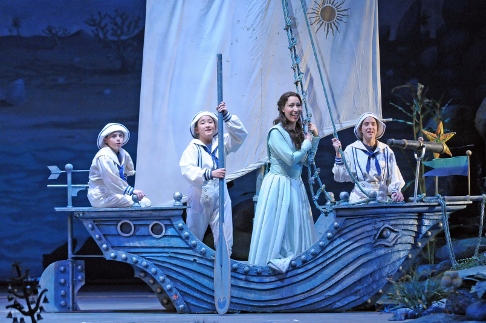
Tamino and Papageno receive their magical instruments, flute and glockenspiel,
from the ladies, they are instructed to follow the lead of the three
Knaben [“youths”] to find the path to Pamina and rescue her from
the palace of Sarastro.
 Nicole Cabell as Pamina
At the first appearance of Pamina under the guard of Monostratos, Nicole
Cabell projected a noble demeanor on lines such as “Der Tod macht mich nicht
beben” [“Death does not make me quake”]. In the ensuing duet with
Papageno, “Bei Männern welche Liebe fühlen” [“For men who truly sense
love”], Ms. Cabell sang expressive, arching lines while Degout truly came
into his own with a superbly resonant tone and appropriate legato. In
the following scene Tamino searches for the entrance to Sarastro’s palace, in
order to confront the alleged captor, just as Papageno leads Pamina in search
of the flute’s response. Ms. Cabell’s encouragement to speak only the truth
(“die Wahrheit”) rang out in pure high tones in preparation for the
entrance of Sarastro. Mr. Boyer’s assumption of this role communicates the
requisite weight of authority, and his distinctive and well developed low
register contributes to a seamless vocal technique. His dramatic approach might
be enhanced at this point in the action in order to signal the gravity of the
forthcoming initiation.
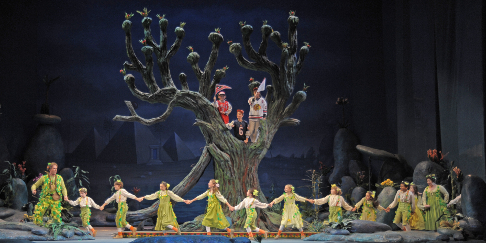
Preparatory ceremony and eighteenth-century dress are emphasized in this
production at the start of Act Two as both Pamina and Tamino are given
instruction toward their trials of purification. Mr. Boyer’s Sarastro and the
chorus assumed here solemn tones in keeping with the following ritual scenes.
The interplay of power between the Queen and Sarastro focuses now on Pamina.
Ms. Luna projected accelerating coloratura intensity in her aria
“Der Hölle Rache” [“The wrath of Hell”] as she encouraged her daughter
to kill Sarastro. Mr. Boyer’s subsequent rendition of “In diesen heil’gen
Hallen” [“In these hallowed halls”] displayed excellent breath control
with rounded bass emphasis fully audible. The final two highlights of this act
belonged indeed to Ms. Cabell and Mr. Degout. Pamina’s “Ach, ich
fühl’s” [“O, I feel it”] in response to Tamino’s enforced silence
was performed with emotional commitment, skillful diminuendo, and further vocal
decorations emphasizing the heroine’s plight. In Papageno’s “Ein Mädchen
oder Weibchen” [“A maiden or a wife”] Degout acted and sang with genuine
ardor, while he climbed onto the stage following his search through the aisles
of the audience. In this scene Degout captured the essence of both the
character and the music as he embellished his yearning lines with tasteful
appoggiatura. In keeping with this performance Papagena was a fitting
reward.
Salvatore Calomino
 Scene from The Magic Flute