27 Feb 2012
“Figures from the Antique”, Wigmore Hall
Modern and historic responses to classical tragedy and myth formed the unifying focus for this latest stage of Ian Bostridge’s year-long ‘Ancient and Modern’ project at the Wigmore Hall.
English Touring Opera are delighted to announce a season of lyric monodramas to tour nationally from October to December. The season features music for solo singer and piano by Argento, Britten, Tippett and Shostakovich with a bold and inventive approach to making opera during social distancing.
This tenth of ten Live from London concerts was in fact a recorded live performance from California. It was no less enjoyable for that, and it was also uplifting to learn that this wasn’t in fact the ‘last’ LfL event that we will be able to enjoy, courtesy of VOCES8 and their fellow vocal ensembles (more below …).
Ever since Wigmore Hall announced their superb series of autumn concerts, all streamed live and available free of charge, I’d been looking forward to this song recital by Ian Bostridge and Imogen Cooper.
Although Stile Antico’s programme article for their Live from London recital introduced their selection from the many treasures of the English Renaissance in the context of the theological debates and upheavals of the Tudor and Elizabethan years, their performance was more evocative of private chamber music than of public liturgy.
Evidently, face masks don’t stifle appreciative “Bravo!”s. And, reducing audience numbers doesn’t lower the volume of such acclamations. For, the audience at Wigmore Hall gave soprano Elizabeth Llewellyn and pianist Simon Lepper a greatly deserved warm reception and hearty response following this lunchtime recital of late-Romantic song.
For this week’s Live from London vocal recital we moved from the home of VOCES8, St Anne and St Agnes in the City of London, to Kings Place, where The Sixteen - who have been associate artists at the venue for some time - presented a programme of music and words bound together by the theme of ‘reflection’.
'Such is your divine Disposation that both you excellently understand, and royally entertaine the Exercise of Musicke.’
‘And there was war in heaven: Michael and his angels fought against the dragon; and the dragon fought and his angels, And prevailed not; neither was their place found any more in heaven … that old serpent … Satan, which deceiveth the whole world: he was cast out into the earth, and his angels were cast out with him.’
There was never any doubt that the fifth of the twelve Met Stars Live in Concert broadcasts was going to be a palpably intense and vivid event, as well as a musically stunning and theatrically enervating experience.
‘Love’ was the theme for this Live from London performance by Apollo5. Given the complexity and diversity of that human emotion, and Apollo5’s reputation for versatility and diverse repertoire, ranging from Renaissance choral music to jazz, from contemporary classical works to popular song, it was no surprise that their programme spanned 500 years and several musical styles.
The Academy of St Martin in the Fields have titled their autumn series of eight concerts - which are taking place at 5pm and 7.30pm on two Saturdays each month at their home venue in Trafalgar Square, and being filmed for streaming the following Thursday - ‘re:connect’.
The London Symphony Orchestra opened their Autumn 2020 season with a homage to Oliver Knussen, who died at the age of 66 in July 2018. The programme traced a national musical lineage through the twentieth century, from Britten to Knussen, on to Mark-Anthony Turnage, and entwining the LSO and Rattle too.
With the Live from London digital vocal festival entering the second half of the series, the festival’s host, VOCES8, returned to their home at St Annes and St Agnes in the City of London to present a sequence of ‘Choral Dances’ - vocal music inspired by dance, embracing diverse genres from the Renaissance madrigal to swing jazz.
Just a few unison string wriggles from the opening of Mozart’s overture to Le nozze di Figaro are enough to make any opera-lover perch on the edge of their seat, in excited anticipation of the drama in music to come, so there could be no other curtain-raiser for this Gala Concert at the Royal Opera House, the latest instalment from ‘their House’ to ‘our houses’.
"Before the ending of the day, creator of all things, we pray that, with your accustomed mercy, you may watch over us."
The doors at The Metropolitan Opera will not open to live audiences until 2021 at the earliest, and the likelihood of normal operatic life resuming in cities around the world looks but a distant dream at present. But, while we may not be invited from our homes into the opera house for some time yet, with its free daily screenings of past productions and its pay-per-view Met Stars Live in Concert series, the Met continues to bring opera into our homes.
Music-making at this year’s Grange Festival Opera may have fallen silent in June and July, but the country house and extensive grounds of The Grange provided an ideal setting for a weekend of twelve specially conceived ‘promenade’ performances encompassing music and dance.
There’s a “slide of harmony” and “all the bones leave your body at that moment and you collapse to the floor, it’s so extraordinary.”
“Music for a while, shall all your cares beguile.”
The hum of bees rising from myriad scented blooms; gentle strains of birdsong; the cheerful chatter of picnickers beside a still lake; decorous thwacks of leather on willow; song and music floating through the warm evening air.
Modern and historic responses to classical tragedy and myth formed the unifying focus for this latest stage of Ian Bostridge’s year-long ‘Ancient and Modern’ project at the Wigmore Hall.
One mild criticism levelled at Bostridge in the past has been that his repertoire range is rather limited, but this recital series is convincingly dispelling that censure; here, an intriguing assemblage of chamber cantatas proved that he is as comfortable, and accomplished, in styles as disparate as baroque seria and French mélodie.
Bostridge was partnered by the Austrian soprano, Angelika Kirchschlager, and, opening the recital with Handel’s O numi eterni, she immediately established her striking dramatic presence, launching with unrestrained emotional force into an anguished account of the rape and suicide of Lucrezia. La Lucrezia is a truly ‘operatic’ work. Except for the admixture of recitative and aria, it has very little resemblance to the standard Baroque cantata; rather it is a complex scena in a multifaceted and unique form. Such complexity is integral to the development of Lucrezia’s agonising responses: pain, fury, doubt, resignation and revenge. Kirchschlager maximised the transitions — often unpredictable and unsettling — from recitative to aria, powerfully revealing the volatility and extremity of Lucrezia’s emotional states. Histrionic outbursts characterised by abrupt, jarring shifts of register were juxtaposed with calmer episodes where a reflective ‘cello accompaniment (sensitively played by Jonathan Manson of the English Concert) intimated the underlying sadness beneath the outpourings of aggressive vengeance. With a wild energy, Kirchschlager absolutely inhabited Lucrezia’s destabilised, damaged psyche. Yet, while not lacking in dramatic impact, her projection of the text was less impressive; and, it was a pity that her performance was so bound to the score throughout.
In contrast, Bostridge’s rendering of Alessandro Scarlatti’s Io son Neron, l’imperator del mondo was most definitely ‘off the book’. Bostridge’s unmannered delivery — and the intermingling of flamboyant posturing and imperious flourishes with traces of ironic insinuation — revealed a dramatic and emotional range far beyond the internalised, tormented modes with which he established his reputation. In the first aria, in which a supercilious Nero challenges even the gods, Bostridge demonstrated both vocal strength and flexibility as he arrogantly declared, “I want Jove to tremble before the magnificence of my presence”. With fitting irony, the rejections of the notion of compassion in the second aria draw forth the tenor’s most beautiful, seductive tone. The recitatives conveyed the tempestuousness of the deluded, unbalanced emperor, demonstrating his extreme cruelty and his delight in the suffering and slaughter he causes. The last aria 'Veder chi pena' is set as a tarantella, a southern Italian folk dance, and Bostridge enjoyed the paradox that this light-hearted form is in fact the ultimate demonstration of Nero's malignity as he sings: "To watch those that suffer and sigh is my heart's desire, evil since birth.”
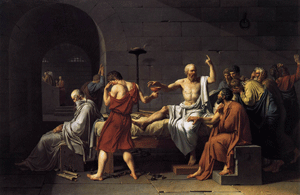
The ‘modern’ half of the recital began with Eric Satie's little known “La Mort de Socrate”, a quiet, reflective account of the great Greek philosopher’s final moments before he is poisoned. Impressively performing the ceaselessly unfolding declamation from memory, Bostridge demonstrated his profound musical intelligence, appreciating both the understated manner and charm of the early twentieth-century French idiom and the underlying sincerity and affectivity of the sentiments expressed. With poise and elegance he related the French text — fragments from Plato’s Dialogues translated by Victor Cousin — his even tone and graceful delivery unaffectedly revealing its simple poignancy. Bostridge’s reading was sympathetically supported by some accomplished playing by the Aurora Orchestra, conducted by Nicholas Collon, who drew sharply defined textures from his ensemble.
Kirchschlager closed the recital with an impassioned performance of Benjamin Britten’s late masterwork, Phaedra, a ‘dramatic cantata’ written for Janet Baker. In contrast to the tragic nobility with which Baker reportedly imbued the role, Kirchschlager went for an unrelenting, full-throttle approach; and while she undoubtedly conveyed the neuroses and instability of Theseus’s unfaithful wife, by emphasising Phaedra’s sexuality and fickleness she neglected the quieter, internalised guilt and remorse that Britten’s music suggests. Certainly, in the ‘Presto to Hippolytus’ Britten sets explicitly sexual imagery from Robert Lowell’s translation of Racine: “Look, this monster ravenous/ For her execution, will not flinch,/ I want your sword’s spasmodic final inch.” And here Kirchschlager’s dazzling timbre together with striking rhythmic incisiveness from the instrumentalists of the Aurora Orchestra powerfully conveyed her adulterous lust and intimated her insanity.
But, Britten’s music is never frantic; the heights of Phaedra’s obsession are depicted by a chilling passage for stratospheric strings accompanied by untuned percussive strikes which suggest a pulsing, diminishing heartbeat, both serenely beautiful and poignantly prophetic of her imminent death. In the final ‘Adagio to Theseus’, Phaedra shows calm acceptance of her fate — “A cold composure I have never know/ Gives me a moment’s pause.” — her resignation underpinned by the orchestra’s gradual modulation towards C Major harmony and ‘resolution’. Superb instrumental playing — cellist Oliver Coates deserves especial mention — brought some emotional variety to the performance, to counter Kirchschlager’s remarkable but unremitting frenzy.
Claire Seymour
Programme:
Handel: O numi eterni (La Lucrezia) HWV145
Corelli: La Follia for violin and string ensemble
Scarlatti: Io son Neron, l’imperator del mondo
Satie: “The Death of Socrates” from Socrate
Britten: Phaedra Op.93