27 Feb 2012
The Opera House that Almost Wasn’t — Le Palais Garnier in Paris
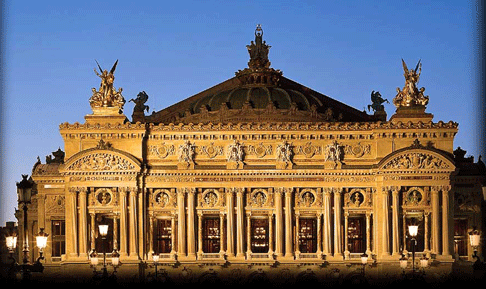
One of the main performing arts venues for opera, ballet and modern dance is Le Palais Garnier in Paris.
English Touring Opera are delighted to announce a season of lyric monodramas to tour nationally from October to December. The season features music for solo singer and piano by Argento, Britten, Tippett and Shostakovich with a bold and inventive approach to making opera during social distancing.
Conductor Oliver Zeffman has commissioned the very first opera for a socially distanced world, which is now available to watch exclusively on Apple Music. Eight Songs From Isolation has been written by eight leading composers, specifically for streaming - rather than live performance - and is the first opera written for a time when the performers were unable to meet in person.
Leading freelance musicians unite in Parliament Square to call for targeted support for colleagues in the arts and entertainment sector.
Duo Lewis Murphy (composer) and Laura Attridge (writer) have launched a charitable song project entitled Notes From Isolation. The resulting songs, featuring some of the UK's top singing talent, are being released online between August and October 2020 and can be enjoyed free of charge.
The Royal Opera House is thrilled to announce an exciting, wide-ranging new line-up for its autumn programme. For the first time, extraordinary performances will be accessible online for a global audience through livestreams and for socially distanced live audiences at our home in Covent Garden. In a global first, we present a new opera in hyper-reality, alongside repertory favourites from both artistic companies.
Some of the most famous and outstanding stars from the opera world are to take part in a very special evening from Wexford Festival Opera, including Aigul Akhmetshina, Joseph Calleja, Daniela Barcellona, Juan Diego Flórez, Igor Golovatenko, Ermonela Jaho, Sergey Romanovsky, and many more.
Following its successful launch in 2019, OperaStreaming streams nine operas on YouTube from the historic opera houses of Emilia-Romagna during the 2020-21 season, with fully-staged productions of Verdi's La traviata in October from Modena and Verdi'sOtello from Bologna in...
‘A brief history of song’ is the subtitle of the 2020 Oxford Lieder Festival (10th-17th October), which will present an ambitious, diverse and imaginative programme of 40 performances and events.
Bampton Classical Opera returns to the Baroque splendour of London’s St John’s Smith Square on November 6 with a concert performance of Gluck’s one-act opera The Crown, the first in the UK since 1987. The performance will also be filmed and available to watch on demand on the Bampton website from 9 November.
While many of us spent lockdown at home taking it a little easier, composer Andrew Synnott wrote an opera.
Owen Wingrave is part of the new Interim Season of 19 brand new events, all free to view online between September and December 2020.
The Arts Council has awarded innovative UK charity Music and Theatre For All (MTFA) a major new grant to develop three ambitious new projects in the wake of Covid 19.
English National Opera (ENO) will reopen the London Coliseum to socially distanced audiences on 6 and 7 November for special performances of Mozart’s Requiem. These will provide audiences with an opportunity to reflect upon and to commemorate the difficulties the nation has faced during the pandemic.
The Royal Opera House is proud to continue its curated #OurHouseToYourHouse programme into the autumn, bringing audiences the best of the ROH through a new series of Friday Premieres and cultural highlights.
After six months of closure, the Royal Opera House is thrilled to be opening its doors to the public as part of Open House London weekend, giving visitors a taste of one of the world’s most famous theatres for free.
The Academy of St Martin in the Fields is thrilled to announce re:connect - an eight concert series with live socially distanced audiences at its namesake church, St. Martin-in-the-Fields. The autumn concerts will take place at 5pm & 7:30pm on two Saturdays per month with guest artists including baritone Roderick Williams, soprano Carolyn Sampson and composer-conductor-pianist Ryan Wigglesworth performing a wide range of repertoire.
Music and poetry unite and collide across centuries, from the Medieval to the Enlightenment to the present day. This year, the Oxford Lieder Festival will present a thrilling and innovative programme comprising more than forty events streamed over eight days.
The English Concert with artistic director Harry Bicket is delighted to announce a series of concerts from 1-15 October 2020. The concerts take place in historic London venues with star soloists and will be performed and streamed live to a paying audience at 7pm GMT on each performance date. The programmes include first-class vocal and instrumental works from the two pillars of the English Baroque, covering different aspects of the repertoire.
Glyndebourne has announced plans for a ‘staycation’ series of socially-distanced indoor performances, starting on 10 October 2020.
The Royal Opera House is delighted to announce two packed evenings of opera and ballet, live from our stage in Covent Garden and available to view wherever you are in the world online.
One of the main performing arts venues for opera, ballet and modern dance is Le Palais Garnier in Paris.
Non-aficionados of the opera are familiar with the 1,900 plus-seat landmark theater. Tourists are in awe by its fine example of Beaux-Arts. The Palais Garnier is a prime stop on numerous sightseeing tours.
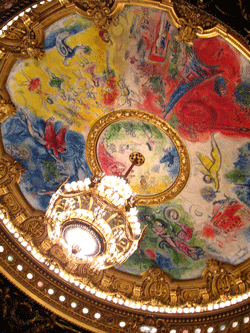 Chandelier at the Palais Garnier [Photo by Minor Keys]
Even those who never visited the “City of Light” are acquainted with the Palais Garnier through Gaston Leroux’s Phantom of the Opera, written in 1910.
Leroux was a frequent visitor and explored the backstage areas and inner sanctions. One tragedy aided in his literary work, and Leroux took poetic license in his novel, when a portion of a chandelier fell and killed one of the opera patrons.
The Palais Garnier has gone through several name changes since its opening. Many simply refer to it as the Paris Opéra.
The Palais Garnier’s history began as part of the great improvement projects instrumented by Napoleon III and Baron Georges-Eugène Haussmann. Napoleon III formulated a competition in search of an architect to design the structure to rival any of the existing opera houses in Italy.
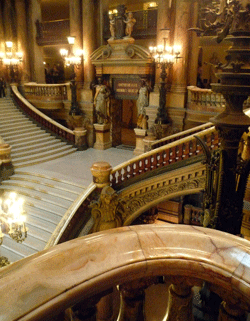 The Grand Stair [Photo by Steven Zucker]
Charles Garnier, a relatively unknown with limited on-hands experience, was awarded the project in 1860. Construction was disrupted by various incidences, including the back up of water from the aquifer, lack of funding, the Franco-Prussian War and the demise of Napoleon III’s Empire.
The incomplete structure was used in part as a storage warehouse for food supplies. Residents wanted it to be demolished since it represented a fallen empire.
Garnier persevered and continued by utilizing new techniques to architecture design. He disliked metal but knew he needed to use these materials in the building’s construction. However, he carefully concealed the metal from view. For cost saving measures, he used the innovative “gilding effect” to replace traditional gold leaves.
When finally launched 15 years later, Fromental Halévy’s La Juive was the inaugural production on January 5th, 1875 . Audiences noted all the ornamental detailing, including sculptures the renowned composers ablaze in bronze and paintings illustrating musical symbols. Equally compelling, the Grand Staircase, which leads into the multi-level theater, is a show-stopping feature measured by its marble of various hues.
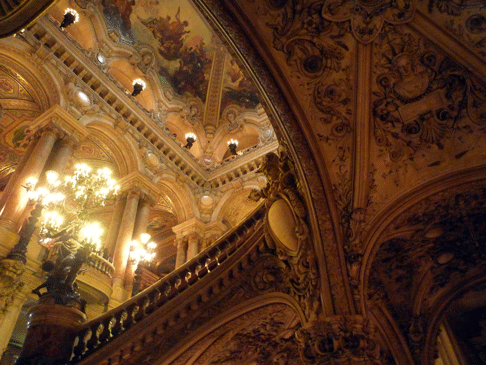 The Grand Stair from Below [Photo by Steven Zucker]
At the entrance, immense mirrors allow patrons to become a part of the building’s interior décor. The vast and richly decorated foyers set the audience’s stage with pleasing scenes to stroll through during intermission.
The fortitude of creativity Charles Garnier shown in his design of the Palais Garnier served as a prototype for other worldwide structures. Examples include The Juliusz Slowacki Theatre in Krakow, Theatro Municipal do Rio de Janeiro, The Jefferson Building in Washington D.C., and National Opera House of Ukraine in Kiev.
Charles Garnier’s ultimate determination was to make the Palais Garnier a palace. Unquestionably he succeeded in his goal.
Veronica Shine
Planning a Visit:
The Palais Garnier is located on 281 Rue Saint-Denis in the district known as the Place de l’Opéra in the 9th arrondissement.
If driving, there is parking at Place Vendôme.
The venue is best reached via Paris’s fine public transportation.
By Métro: Board line nos. 3, 7, 8 to station Opéra
By RER: The regional “A” train closest station is Auber
By Bus: Ride any bus numbered 20, 21, 22, 27, 29, 42, 52, 53, 66, 6 8, 81, 95 directly to the Palais Garnier
The schedule for performances and events are at the Opéra national de Paris’ web site, which also provides a virtual tour of Palais Garnier. Additional nformation on performances and tours is available at the Palais Garnier’s box office, which is open Monday to Saturday from 10:30am to 6:30pm.
Find accommodations near the Palais Garnier at Parishotels.net or search for something with more elbow room with a holiday apartment at holidayapartments.net.