![Georgia Jarman [Photo by Chris Christodoulou courtresy of English National Opera]](http://www.operatoday.com/Georgia_Jarman3.gif)
11 Feb 2012
The Tales of Hoffmann, ENO
In many respects, The Tales of Hoffmann and Richard Jones would seem a good fit.
English Touring Opera are delighted to announce a season of lyric monodramas to tour nationally from October to December. The season features music for solo singer and piano by Argento, Britten, Tippett and Shostakovich with a bold and inventive approach to making opera during social distancing.
This tenth of ten Live from London concerts was in fact a recorded live performance from California. It was no less enjoyable for that, and it was also uplifting to learn that this wasn’t in fact the ‘last’ LfL event that we will be able to enjoy, courtesy of VOCES8 and their fellow vocal ensembles (more below …).
Ever since Wigmore Hall announced their superb series of autumn concerts, all streamed live and available free of charge, I’d been looking forward to this song recital by Ian Bostridge and Imogen Cooper.
Although Stile Antico’s programme article for their Live from London recital introduced their selection from the many treasures of the English Renaissance in the context of the theological debates and upheavals of the Tudor and Elizabethan years, their performance was more evocative of private chamber music than of public liturgy.
Evidently, face masks don’t stifle appreciative “Bravo!”s. And, reducing audience numbers doesn’t lower the volume of such acclamations. For, the audience at Wigmore Hall gave soprano Elizabeth Llewellyn and pianist Simon Lepper a greatly deserved warm reception and hearty response following this lunchtime recital of late-Romantic song.
For this week’s Live from London vocal recital we moved from the home of VOCES8, St Anne and St Agnes in the City of London, to Kings Place, where The Sixteen - who have been associate artists at the venue for some time - presented a programme of music and words bound together by the theme of ‘reflection’.
'Such is your divine Disposation that both you excellently understand, and royally entertaine the Exercise of Musicke.’
‘And there was war in heaven: Michael and his angels fought against the dragon; and the dragon fought and his angels, And prevailed not; neither was their place found any more in heaven … that old serpent … Satan, which deceiveth the whole world: he was cast out into the earth, and his angels were cast out with him.’
There was never any doubt that the fifth of the twelve Met Stars Live in Concert broadcasts was going to be a palpably intense and vivid event, as well as a musically stunning and theatrically enervating experience.
‘Love’ was the theme for this Live from London performance by Apollo5. Given the complexity and diversity of that human emotion, and Apollo5’s reputation for versatility and diverse repertoire, ranging from Renaissance choral music to jazz, from contemporary classical works to popular song, it was no surprise that their programme spanned 500 years and several musical styles.
The Academy of St Martin in the Fields have titled their autumn series of eight concerts - which are taking place at 5pm and 7.30pm on two Saturdays each month at their home venue in Trafalgar Square, and being filmed for streaming the following Thursday - ‘re:connect’.
The London Symphony Orchestra opened their Autumn 2020 season with a homage to Oliver Knussen, who died at the age of 66 in July 2018. The programme traced a national musical lineage through the twentieth century, from Britten to Knussen, on to Mark-Anthony Turnage, and entwining the LSO and Rattle too.
With the Live from London digital vocal festival entering the second half of the series, the festival’s host, VOCES8, returned to their home at St Annes and St Agnes in the City of London to present a sequence of ‘Choral Dances’ - vocal music inspired by dance, embracing diverse genres from the Renaissance madrigal to swing jazz.
Just a few unison string wriggles from the opening of Mozart’s overture to Le nozze di Figaro are enough to make any opera-lover perch on the edge of their seat, in excited anticipation of the drama in music to come, so there could be no other curtain-raiser for this Gala Concert at the Royal Opera House, the latest instalment from ‘their House’ to ‘our houses’.
"Before the ending of the day, creator of all things, we pray that, with your accustomed mercy, you may watch over us."
The doors at The Metropolitan Opera will not open to live audiences until 2021 at the earliest, and the likelihood of normal operatic life resuming in cities around the world looks but a distant dream at present. But, while we may not be invited from our homes into the opera house for some time yet, with its free daily screenings of past productions and its pay-per-view Met Stars Live in Concert series, the Met continues to bring opera into our homes.
Music-making at this year’s Grange Festival Opera may have fallen silent in June and July, but the country house and extensive grounds of The Grange provided an ideal setting for a weekend of twelve specially conceived ‘promenade’ performances encompassing music and dance.
There’s a “slide of harmony” and “all the bones leave your body at that moment and you collapse to the floor, it’s so extraordinary.”
“Music for a while, shall all your cares beguile.”
The hum of bees rising from myriad scented blooms; gentle strains of birdsong; the cheerful chatter of picnickers beside a still lake; decorous thwacks of leather on willow; song and music floating through the warm evening air.
In many respects, The Tales of Hoffmann and Richard Jones would seem a good fit.
An opéra fantastique, with which Offenbach at the end of his career wished to show the world that he was not a mere purveyor of enjoyable froth, certainly offers plenty of opportunity for the surreally-inclined. (Jones’s controversial 1990s Ring for the Royal Opera House garnered plaudits and brickbats on that basis. Sadly, if not entirely unpredictably, it proved not to be Bernard Haitink’s idea of a Ring at all.) The pipe emblazoned upon the stage curtain and the pipes being smoked by Hoffmann and the students seem to hold the key to the director’s conception. Whatever it is that is being smoked would appear to lie behind the visions. Fair enough, but there is perhaps a little too much of the surface psychedelic, especially during the second (here, first) act, and not enough truly Romantic, Gothic darkness. We are dealing with Offenbach rather than Hoffmann himself, of course, but it would be beneficial to see, if not to hear, a little more of the hero, a still grossly underappreciated figure in the English-speaking world. (One really needs German.) Some of what we see resembles a little too closely Jones’s Covent Garden productions of Gianni Schicchi and The Gambler. Difficult though it may be to feel sympathy for the 1950s, a decade of closed-mindedness if every there were one, is it always necessary to send them up so garishly as in the Olympia act? (At least I assume that was what was being attempted.) Why a gorilla was wandering around the stage before and during the fourth (here, third) act, I simply have no idea. Its inclusion seemed to add nothing beyond reminding us of the ménagerie in that splendid production of The Gambler. The appearance of Dr Miracle as Antonia opens her music is very nicely handled, though, likewise the appearance of her mother’s voice through a gramophone trumpet. It is, then, an enjoyable production; costumes, movement, and lighting are all well handled in the production’s own terms. The same basic set is varied imaginatively between acts, providing a finer sense of overall framing than the production as a whole. I just could not help but think that Offenbach’s desire to be taken seriously might have been taken a little more seriously.
From the singers, there was much to enjoy. Barry Banks sang a decent enough English-language Hoffmann, though his style was more Italianate, occasionally jarringly so, than Gallic. If there was not an especially strong sense of Hoffmann as artist, especially at the end, then that was at least as much down to production as performance. Christine Rice, however, made a fine Nicklausse. (She also appeared as Hoffmann’s Muse, that doubling respecting Offenbach’s original intention.) Again, one could not help but wish that the words were in French, but Rice’s palpable sincerity won through time and time again, ‘Vois sous l'archet frémissant’ – I cannot recall what the English was – a particular, soaring highlight. Georgia Jarman, making her ENO debut, truly impressed by taking on all four of Hoffmann’s lovers: Stella, Olympia, Antonia, and Giulietta. Her characterisation varied, bringing something quite new to each of them. Antonia’s fate was rendered as moving as the production – and the music – would allow; Giulietta proved properly seductive; and save for a few slight intonational problems at the very beginning, Olympia’s mechanical coloratura was despatched with great aplomb. Catherine Young’s off-stage turn as the Mother’s Voice (a ghost, traditionally) was beautifully performed. Mention must also be made of Simon Butteriss, kept busy with four different roles: Andrès, Cochenille, Frantz, and Pitichinaccio. Clearly at home in drag as Cochenille, he also provided a wickedly camp turn as the servant Frantz.
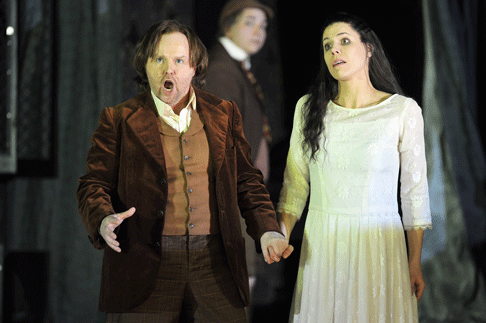 Barry Banks and Georgia Jarman
The ENO orchestra once again proved to be on fine form, though Antony Walker’s direction was less sure-footed. Here, at least, one might have hoped for a little more Gallic suavity; there were times when his approach veered a little close to thinned-down Tchaikovsky (less a point of view, it seemed, than a lack of idiomatic command). Given that the work was performed in English, spoken dialogue might have been a better bet than recitative. Amplification of the chorus at the end was surely both unnecessary and oddly sentimentalising, as if we had come to the end of a Hollywood ‘Romantic comedy’. Again, Offenbach’s desire to be taken seriously might have been taken more seriously. The production is worth seeing, and the cast certainly makes it worth hearing, but one would struggle to discern a message, let alone a Konzept.
Mark Berry