![Kitty Whately as Rosina [Photo by Richard Hubert Smith courtesy of English Touring Opera]](http://www.operatoday.com/Barber_ETO_01.gif)
12 Mar 2012
A Physical Barber by ETO
For an operatic masterpiece The Barber of Seville is surprisingly tricky to do well, it is not one of those pieces which plays itself.
English Touring Opera are delighted to announce a season of lyric monodramas to tour nationally from October to December. The season features music for solo singer and piano by Argento, Britten, Tippett and Shostakovich with a bold and inventive approach to making opera during social distancing.
This tenth of ten Live from London concerts was in fact a recorded live performance from California. It was no less enjoyable for that, and it was also uplifting to learn that this wasn’t in fact the ‘last’ LfL event that we will be able to enjoy, courtesy of VOCES8 and their fellow vocal ensembles (more below …).
Ever since Wigmore Hall announced their superb series of autumn concerts, all streamed live and available free of charge, I’d been looking forward to this song recital by Ian Bostridge and Imogen Cooper.
Although Stile Antico’s programme article for their Live from London recital introduced their selection from the many treasures of the English Renaissance in the context of the theological debates and upheavals of the Tudor and Elizabethan years, their performance was more evocative of private chamber music than of public liturgy.
Evidently, face masks don’t stifle appreciative “Bravo!”s. And, reducing audience numbers doesn’t lower the volume of such acclamations. For, the audience at Wigmore Hall gave soprano Elizabeth Llewellyn and pianist Simon Lepper a greatly deserved warm reception and hearty response following this lunchtime recital of late-Romantic song.
For this week’s Live from London vocal recital we moved from the home of VOCES8, St Anne and St Agnes in the City of London, to Kings Place, where The Sixteen - who have been associate artists at the venue for some time - presented a programme of music and words bound together by the theme of ‘reflection’.
'Such is your divine Disposation that both you excellently understand, and royally entertaine the Exercise of Musicke.’
‘And there was war in heaven: Michael and his angels fought against the dragon; and the dragon fought and his angels, And prevailed not; neither was their place found any more in heaven … that old serpent … Satan, which deceiveth the whole world: he was cast out into the earth, and his angels were cast out with him.’
There was never any doubt that the fifth of the twelve Met Stars Live in Concert broadcasts was going to be a palpably intense and vivid event, as well as a musically stunning and theatrically enervating experience.
‘Love’ was the theme for this Live from London performance by Apollo5. Given the complexity and diversity of that human emotion, and Apollo5’s reputation for versatility and diverse repertoire, ranging from Renaissance choral music to jazz, from contemporary classical works to popular song, it was no surprise that their programme spanned 500 years and several musical styles.
The Academy of St Martin in the Fields have titled their autumn series of eight concerts - which are taking place at 5pm and 7.30pm on two Saturdays each month at their home venue in Trafalgar Square, and being filmed for streaming the following Thursday - ‘re:connect’.
The London Symphony Orchestra opened their Autumn 2020 season with a homage to Oliver Knussen, who died at the age of 66 in July 2018. The programme traced a national musical lineage through the twentieth century, from Britten to Knussen, on to Mark-Anthony Turnage, and entwining the LSO and Rattle too.
With the Live from London digital vocal festival entering the second half of the series, the festival’s host, VOCES8, returned to their home at St Annes and St Agnes in the City of London to present a sequence of ‘Choral Dances’ - vocal music inspired by dance, embracing diverse genres from the Renaissance madrigal to swing jazz.
Just a few unison string wriggles from the opening of Mozart’s overture to Le nozze di Figaro are enough to make any opera-lover perch on the edge of their seat, in excited anticipation of the drama in music to come, so there could be no other curtain-raiser for this Gala Concert at the Royal Opera House, the latest instalment from ‘their House’ to ‘our houses’.
"Before the ending of the day, creator of all things, we pray that, with your accustomed mercy, you may watch over us."
The doors at The Metropolitan Opera will not open to live audiences until 2021 at the earliest, and the likelihood of normal operatic life resuming in cities around the world looks but a distant dream at present. But, while we may not be invited from our homes into the opera house for some time yet, with its free daily screenings of past productions and its pay-per-view Met Stars Live in Concert series, the Met continues to bring opera into our homes.
Music-making at this year’s Grange Festival Opera may have fallen silent in June and July, but the country house and extensive grounds of The Grange provided an ideal setting for a weekend of twelve specially conceived ‘promenade’ performances encompassing music and dance.
There’s a “slide of harmony” and “all the bones leave your body at that moment and you collapse to the floor, it’s so extraordinary.”
“Music for a while, shall all your cares beguile.”
The hum of bees rising from myriad scented blooms; gentle strains of birdsong; the cheerful chatter of picnickers beside a still lake; decorous thwacks of leather on willow; song and music floating through the warm evening air.
For an operatic masterpiece The Barber of Seville is surprisingly tricky to do well, it is not one of those pieces which plays itself.
For a start, it is rather long with copious quantities of plot and of recitative. Essentially it’s a fast paced farce, but one which is populated by believable, human characters thanks to Rossini’s music. But then, Rossini goes and throws in those long, stylised ensembles which sound fabulous but present the director with the problem of what to do. Some solve this by making the farce veer into slapstick, and other productions just aren’t funny (on Radio 3 recently the director of the Met, Peter Gelb, talked about one of their patrons not realising that The Barber of Seville was a comedy).
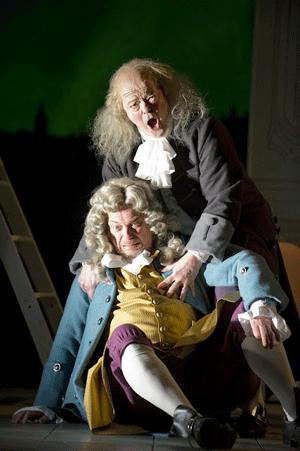 Andrew Slater as Bartolo and Alan Fairs as Basilio
For ETO’s new production, which opened at the Hackney Empire on March 8th (we saw it on March 10th), director Thomas Guthrie opted for a very physical approach, but one that was strongly character based. The cast were all highly choreographed (the ensemble in the first scene actually break out into choreographed dance), but we never descended into slapstick, laughs always came because of the interaction on the stage not simply because a character was doing a funny walk. He kept the piece moving at a very fast pace and the talented, young cast responded by delivering recitative that was dramatically convincing and quick moving. The work was sung in English, in David Parry’s musical translation. The result was, as it should be, highly entertaining, you never felt that you were sitting through the recit simply waiting for the next aria, as can happen.
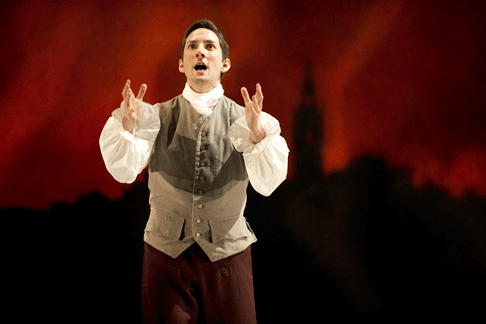 Nicholas Sharratt as Almaviva
Rhys Jarman’s traditionally inspired designs consisted of a series of painted flats representing panelling; with judicious additions in each scene, these created a flexible series of playing spaces, both interior and exterior. All overlooked by a striking backdrop of a city-scape with a lowering sky. Colours were in a carefully chosen tonal palate, modern but classical; with Gillray style cartoons in modern colours as the pictures in Bartolo’s house. Costumes were traditional too, but the piece didn’t feel embedded in aspic.
The title role was played by Grant Doyle, who studied both in his native Australia and at the RCM. He was on the ROH Young Artists programme in 2001-3 and plans include the title role in Don Giovanni at Garsington. Doyle has a strong stage presence and effortlessly dominated, as Figaro should, without ever mugging. (Incidentally he played the guitar himself during the Act 1 serenade). His Figaro was rather a smug character, almost annoyingly so, but a charmer too. His account of ‘Largo al factotum’ was marred very slightly by balance problems, which reoccurred at other times during the performance; from our seat in the Dress Circle the orchestra sometimes was a little too strong for the singers, probably more to do with the acoustic of Frank Matcham’s theatre (which was built as a music hall) than anything else.
Kitty Whately won the Kathleen Ferrier Award in 2011 and currently studies at the RCM International Opera School. We saw her as Teodata in Flavio at ETO last year and were looking forward to her singing Rosina and we were not disappointed. Whately has a poised stage presence and gave the impression that Rosina was looking on the world, for the most part, in amused tolerance. A strong minded person, but lively and certainly attractive; she was touching in the closing scenes when Rosina thinks that she has been betrayed by Figaro and ‘Lindoro’.
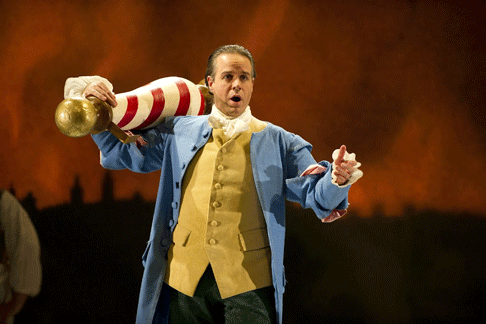 Grant Doyle as Figaro
I have to confess that when it comes to the singing of passage-work both in baroque opera and early 19th century Italian opera, I am a bit of an obsessive; in an ideal world everything should be sung beautifully and cleanly. This Whately did, of the 3 main leads (Rosina, Figaro, Almaviva) all sang their passage-work confidently, expressively and creditably. But there were times when I felt that both Nicholas Sharratt (singing Almaviva) and Doyle were smudging things, but Whately’s divisions always seemed to come out cleanly.
She was partnered by the highly personable Nicholas Sharratt who has sung Nemorino at Grange Park Opera and Brighella (Ariadne auf Naxos) at Garsington. He has an attractive, quite slim-line lyric tenor voice with an easy top so that as Count Almaviva the tessitura of the role did not seem to hold terrors for him. As I have said, there were times when I felt he smudged his passage-work, but I warmed to his performance. His open stage presence and the way he developed a good rapport with Whately were endearing; plus he had good comic timing, he was funny without ever over doing things when playing the drunken soldier. He topped this by giving a fine account of the Count’s final aria, the showpiece which is usually cut and which Rossini re-used for La Cenerentola. After a long evening, Sharratt’s performance was quite brilliant and made a good dramatic case for including the aria.
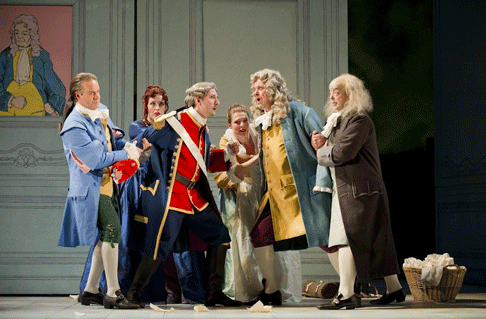 L-R: Grant Doyle as Figaro, Kitty Whately as Rosina, Nicholas Sharratt as Almaviva, Cheryl Enever as Berta, Andrew Slater as Bartolo and Alan Fairs as Basilio
Andrew Slater has been an ETO regular for a few years now. He played Doctor Bartolo as an obsessively jealous dyspeptic, rather than being plain nasty. He coped manfully with having to do some amazingly botched comic surgery on patients during his Act 1 aria; one of the few moments when Guthrie’s ideas got the better of him. As with all good comedy, you felt sorry for Bartolo even though he behaved badly.
Alan Fairs was a hilariously scary Don Basilio and gave a strong, highly characterised account of the calumny arias. Cheryl Enever was a lively Berta, unfortunately deprived of her aria.
Conductor Paul McGrath kept things going at quite a lick, which was great for the comedy but which meant that co-ordination between pit and stage was not always quite what it should have been; this was particularly true in the big comic ensembles when Guthrie has his cast moving around. But it was an understandable error, given the desire to keep everything zipping along.
This was a performance full of energy and vivid character. Guthrie’s very physical approach to theatre was enthusiastically taken up by the cast. Despite the occasional problems, this was a performance that was funny and enjoyable in all the right ways.
ETO is performing the opera on tour in the UK until May 26th, along with Eugene Onegin and three children’s operas.
Robert Hugill