![Alek Shrader as Albert Herring, with Daniela Mack as Nancy and Liam Bonner as Sid [Photo by Robert Millard for LA Opera]](http://www.operatoday.com/alh2098.gif)
22 Mar 2012
Albert Herring, LA
The Los Angeles Opera, anticipating Benjamin Britten’s centennial gave the composer, as well as its patrons, an early birthday present of performances of his charming comic opera, Albert Herring.
English Touring Opera are delighted to announce a season of lyric monodramas to tour nationally from October to December. The season features music for solo singer and piano by Argento, Britten, Tippett and Shostakovich with a bold and inventive approach to making opera during social distancing.
This tenth of ten Live from London concerts was in fact a recorded live performance from California. It was no less enjoyable for that, and it was also uplifting to learn that this wasn’t in fact the ‘last’ LfL event that we will be able to enjoy, courtesy of VOCES8 and their fellow vocal ensembles (more below …).
Ever since Wigmore Hall announced their superb series of autumn concerts, all streamed live and available free of charge, I’d been looking forward to this song recital by Ian Bostridge and Imogen Cooper.
Although Stile Antico’s programme article for their Live from London recital introduced their selection from the many treasures of the English Renaissance in the context of the theological debates and upheavals of the Tudor and Elizabethan years, their performance was more evocative of private chamber music than of public liturgy.
Evidently, face masks don’t stifle appreciative “Bravo!”s. And, reducing audience numbers doesn’t lower the volume of such acclamations. For, the audience at Wigmore Hall gave soprano Elizabeth Llewellyn and pianist Simon Lepper a greatly deserved warm reception and hearty response following this lunchtime recital of late-Romantic song.
For this week’s Live from London vocal recital we moved from the home of VOCES8, St Anne and St Agnes in the City of London, to Kings Place, where The Sixteen - who have been associate artists at the venue for some time - presented a programme of music and words bound together by the theme of ‘reflection’.
'Such is your divine Disposation that both you excellently understand, and royally entertaine the Exercise of Musicke.’
‘And there was war in heaven: Michael and his angels fought against the dragon; and the dragon fought and his angels, And prevailed not; neither was their place found any more in heaven … that old serpent … Satan, which deceiveth the whole world: he was cast out into the earth, and his angels were cast out with him.’
There was never any doubt that the fifth of the twelve Met Stars Live in Concert broadcasts was going to be a palpably intense and vivid event, as well as a musically stunning and theatrically enervating experience.
‘Love’ was the theme for this Live from London performance by Apollo5. Given the complexity and diversity of that human emotion, and Apollo5’s reputation for versatility and diverse repertoire, ranging from Renaissance choral music to jazz, from contemporary classical works to popular song, it was no surprise that their programme spanned 500 years and several musical styles.
The Academy of St Martin in the Fields have titled their autumn series of eight concerts - which are taking place at 5pm and 7.30pm on two Saturdays each month at their home venue in Trafalgar Square, and being filmed for streaming the following Thursday - ‘re:connect’.
The London Symphony Orchestra opened their Autumn 2020 season with a homage to Oliver Knussen, who died at the age of 66 in July 2018. The programme traced a national musical lineage through the twentieth century, from Britten to Knussen, on to Mark-Anthony Turnage, and entwining the LSO and Rattle too.
With the Live from London digital vocal festival entering the second half of the series, the festival’s host, VOCES8, returned to their home at St Annes and St Agnes in the City of London to present a sequence of ‘Choral Dances’ - vocal music inspired by dance, embracing diverse genres from the Renaissance madrigal to swing jazz.
Just a few unison string wriggles from the opening of Mozart’s overture to Le nozze di Figaro are enough to make any opera-lover perch on the edge of their seat, in excited anticipation of the drama in music to come, so there could be no other curtain-raiser for this Gala Concert at the Royal Opera House, the latest instalment from ‘their House’ to ‘our houses’.
"Before the ending of the day, creator of all things, we pray that, with your accustomed mercy, you may watch over us."
The doors at The Metropolitan Opera will not open to live audiences until 2021 at the earliest, and the likelihood of normal operatic life resuming in cities around the world looks but a distant dream at present. But, while we may not be invited from our homes into the opera house for some time yet, with its free daily screenings of past productions and its pay-per-view Met Stars Live in Concert series, the Met continues to bring opera into our homes.
Music-making at this year’s Grange Festival Opera may have fallen silent in June and July, but the country house and extensive grounds of The Grange provided an ideal setting for a weekend of twelve specially conceived ‘promenade’ performances encompassing music and dance.
There’s a “slide of harmony” and “all the bones leave your body at that moment and you collapse to the floor, it’s so extraordinary.”
“Music for a while, shall all your cares beguile.”
The hum of bees rising from myriad scented blooms; gentle strains of birdsong; the cheerful chatter of picnickers beside a still lake; decorous thwacks of leather on willow; song and music floating through the warm evening air.
The Los Angeles Opera, anticipating Benjamin Britten’s centennial gave the composer, as well as its patrons, an early birthday present of performances of his charming comic opera, Albert Herring.
The British composer was born on November 22nd 1913 — St. Cecelia’s day, in the seaside town of Lowestoft. Before we go any further, I think you ought to know that Lowestoft’s chief export was herring.
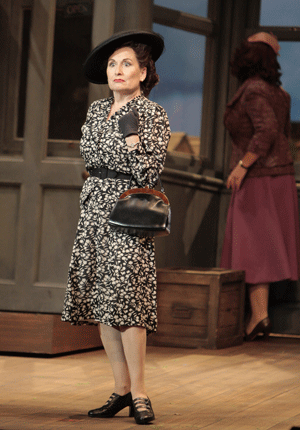 Janis Kelly as Lady Billows
Though Britten is generally known to the operatic public for somber operatic works — the tragedies Peter Grimes and Billy Budd — he also had a lively, if far less frequently displayed musical sense of humor. In 1941,while living in the United States, he wrote the comical Paul Bunyon to a libretto by W.S. Auden. He returned to England in 1942, where Albert Herring premiered at Glyndebourne in 1947. Britten’s most concentrated piece of musical hilarity can be found in his 1960 A Midsummer Night’s Dream. Its Pyramus and Thisbe scene is a bright and brilliant take of 19th century Italian opera.
Albert Herring is based on a story called Le Rosier de Mme. Husson by French author Guy de Maupassant. The tale was suggested to Britten by librettist, Eric Crozier, then a member of Britten’s coterie. The story is set in Gisor, a French town in Normandy, socially structured much like towns of England’s Suffolk County, assuring that the transfer of locale was easily worked out. Its title can be loosely translated as Mme. Husson’s Rose King.
The essence of the French story’s plot and that of the opera are essentially the same. Both describe the eternal societal urge of small town’s upper crust to make its lower crust behave better. Though their endings and styles are far different — Crozier insisted the libretto have some kind of rhyming scheme — both plans for betterment go awry.
Lady Billows, the formidable doyenne of the fictitious British town of Loxford, is distressed by the number of illegitimate births, and decides to find, crown and reward a virtuous May Queen. When the girls suggested by the school teacher, the mayor, the police superintendent and the vicar are found wanting by Lady Billows’ equally formidable housekeeper, Florence Pike, the group decides to crown a May King. He is Albert Herring, a virginal boy who works in his widowed mother’s greengrocer’s shop. Poor, protesting Albert is decked out for the celebration in a white-as-a-swan suit and white hat decorated with orange blossoms. Sitting nearby, his mother glows with pride and waits impatiently to get the award money in her hands. But Albert’s friend Sid and Sid’s girl Nancy, hoping to loosen him up, spike his lemonade with rum. No sooner are the celebrations over when Albert disappears.
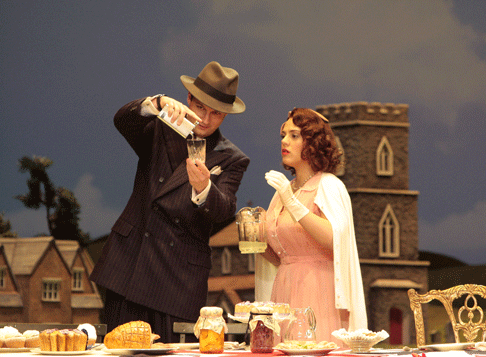 Liam Bonner as Sid; Daniela Mack as Nancy
There is a huge search for the boy. A clue is found – a filthy orange blossom wreath. It is brought to the greengrocer’s home, laid to rest in the center of the table, and mourned by all in a masterful piece of music, an elegiac threnody, as if it were the boy himself. Albert’s sudden appearance in his sullied white suit seems almost unwelcome, but returns us to comedy as each person in turn interrogates him. His vice-laden adventures shock everyone but Sid and Nancy. And in conclusion, after everyone leaves, he tells his mother he’s keeping his money, and (horrors!) to mind her own business.
The Los Angeles Opera production, directed by Paul Curran was created for Santa Fe Opera, whose theater is open to the setting sun and other elements of nature. Differences in the set and lighting required for the enclosed Los Angeles theater, enhanced and intensified elements of the production. Subtle changes in the direction added to the comedy. Considering that Britten wrote the work as a chamber opera, it played well in the Dorothy Chandler Pavilion. Under James Conlon’s direction, the thirteen very individualistic characters on the stage, and the thirteen very precise musicians in the pit evoked the humor and pathos of Albert’s story. Maestro Conlon’s appreciation of the opera — he considers it one of the five great comic operas in the repertory — clarified elements of Britten’s scoring of the work; for example, the differences between the pompous music of the Lady Billows and town’s elite, and the rhythms of Albert and its shop keepers. Conlon also made sure, in word during his pre-performance talk, and in music when on the podium, that his audience heard Britten’s musical jest: the love potion theme from Tristan and Isolde as the rum was poured into Albert’s glass. Why not? This is the drink that will change his life forever.
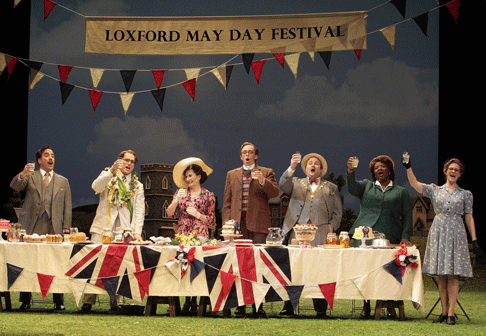 Richard Bernstein as Superintendent Budd; Alek Shrader as Albert Herring; Janis Kelly as Lady Billows; Jonathan Michie as Mr. Gedge, the Vicar; Robert McPherson as Mr. Upfold, the Mayor; Ronnita Nicole Miller as Florence Pike; Stacey Tappan as Miss Wordsworth
Every member of the cast with the exception of Stacey Tappan, Richard Bernstein and Caleb Glickman was making an LA opera debut in his production. Baritone Jonathan Michie, properly fussy as the Vicar, and lyric tenor Alek Shrader, charming as Albert, had appeared in their roles in Santa Fe. Shrader, who has been singing in Europe recently, will debut at the Met later this year. Janis Kelly’s interpretation of the officious Lady Billows left nothing to be desired vocally. She did however lack avoirdupois. One imagines her ladyship to be more generously proportioned. Christine Brewer, a more ample soprano and veteran of the Santa Fe production, sang the last two performances. Mezzo Ronnita Nicole Miller, a singer I have enjoyed in the past, played Florence Pike with great comic timing. Liam Bonner and Daniela Mack as Sid and Nancy, were charmingly carefree lovers, and Jane Bunnell struck the proper notes musically as well as theatrically, as the properly proud and distressed mother who knows a quid when she sees one.
Rarely does one wonder what will happen to the characters in an opera after the final curtain. Most often, all the ones we care about are dead. At the conclusion of Albert Herring, however, every Loxford resident we’ve met will go on living. One can’t help wondering about Albert’s future in the town. Mme Husson’s May King became the sobriquet for the Gisor’s town drunk.
Estelle Gilson