Recently in Reviews
English Touring Opera are delighted to announce a season of lyric monodramas to tour nationally from October to December. The season features music for solo singer and piano by Argento, Britten, Tippett and Shostakovich with a bold and inventive approach to making opera during social distancing.
This tenth of ten Live from London concerts was in fact a recorded live performance from California. It was no less enjoyable for that, and it was also uplifting to learn that this wasn’t in fact the ‘last’ LfL event that we will be able to enjoy, courtesy of VOCES8 and their fellow vocal ensembles (more below …).
Ever since Wigmore Hall announced their superb series of autumn concerts, all streamed live and available free of charge, I’d been looking forward to this song recital by Ian Bostridge and Imogen Cooper.
The Sixteen continues its exploration of Henry Purcell’s Welcome Songs for Charles II. As with Robert King’s pioneering Purcell series begun over thirty years ago for Hyperion, Harry Christophers is recording two Welcome Songs per disc.
Although Stile Antico’s programme article for their Live from London recital introduced their selection from the many treasures of the English Renaissance in the context of the theological debates and upheavals of the Tudor and Elizabethan years, their performance was more evocative of private chamber music than of public liturgy.
In February this year, Albanian soprano Ermonela Jaho made a highly lauded debut recital at Wigmore Hall - a concert which both celebrated Opera Rara’s 50th anniversary and honoured the career of the Italian soprano Rosina Storchio (1872-1945), the star of verismo who created the title roles in Leoncavallo’s La bohème and Zazà, Mascagni’s Lodoletta and Puccini’s Madama Butterfly.
Evidently, face masks don’t stifle appreciative “Bravo!”s. And, reducing audience numbers doesn’t lower the volume of such acclamations. For, the audience at Wigmore Hall gave soprano Elizabeth Llewellyn and pianist Simon Lepper a greatly deserved warm reception and hearty response following this lunchtime recital of late-Romantic song.
Collapsology. Or, perhaps we should use the French word ‘Collapsologie’ because this is a transdisciplinary idea pretty much advocated by a series of French theorists - and apparently, mostly French theorists. It in essence focuses on the imminent collapse of modern society and all its layers - a series of escalating crises on a global scale: environmental, economic, geopolitical, governmental; the list is extensive.
For this week’s Live from London vocal recital we moved from the home of VOCES8, St Anne and St Agnes in the City of London, to Kings Place, where The Sixteen - who have been associate artists at the venue for some time - presented a programme of music and words bound together by the theme of ‘reflection’.
'Such is your divine Disposation that both you excellently understand, and royally entertaine the Exercise of Musicke.’
Amongst an avalanche of new Mahler recordings appearing at the moment (Das Lied von der Erde seems to be the most favoured, with three) this 1991 Mahler Second from the 2nd Kassel MahlerFest is one of the more interesting releases.
‘And there was war in heaven: Michael and his angels fought against the dragon; and the dragon fought and his angels, And prevailed not; neither was their place found any more in heaven … that old serpent … Satan, which deceiveth the whole world: he was cast out into the earth, and his angels were cast out with him.’
If there is one myth, it seems believed by some people today, that probably needs shattering it is that post-war recordings or performances of Wagner operas were always of exceptional quality. This 1949 Hamburg Tristan und Isolde is one of those recordings - though quite who is to blame for its many problems takes quite some unearthing.
There was never any doubt that the fifth of the twelve Met Stars Live in Concert broadcasts was going to be a palpably intense and vivid event, as well as a musically stunning and theatrically enervating experience.
‘Love’ was the theme for this Live from London performance by Apollo5. Given the complexity and diversity of that human emotion, and Apollo5’s reputation for versatility and diverse repertoire, ranging from Renaissance choral music to jazz, from contemporary classical works to popular song, it was no surprise that their programme spanned 500 years and several musical styles.
The Academy of St Martin in the Fields have titled their autumn series of eight concerts - which are taking place at 5pm and 7.30pm on two Saturdays each month at their home venue in Trafalgar Square, and being filmed for streaming the following Thursday - ‘re:connect’.
The London Symphony Orchestra opened their Autumn 2020 season with a homage to Oliver Knussen, who died at the age of 66 in July 2018. The programme traced a national musical lineage through the twentieth century, from Britten to Knussen, on to Mark-Anthony Turnage, and entwining the LSO and Rattle too.
With the Live from London digital vocal festival entering the second half of the series, the festival’s host, VOCES8, returned to their home at St Annes and St Agnes in the City of London to present a sequence of ‘Choral Dances’ - vocal music inspired by dance, embracing diverse genres from the Renaissance madrigal to swing jazz.
Just a few unison string wriggles from the opening of Mozart’s overture to Le nozze di Figaro are enough to make any opera-lover perch on the edge of their seat, in excited anticipation of the drama in music to come, so there could be no other curtain-raiser for this Gala Concert at the Royal Opera House, the latest instalment from ‘their House’ to ‘our houses’.
"Before the ending of the day, creator of all things, we pray that, with your accustomed mercy, you may watch over us."
Reviews
24 Mar 2012
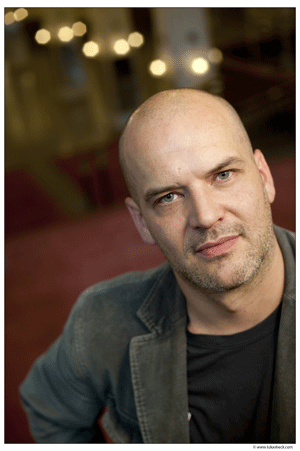
Florian Boesch at Wigmore Hall
The performance at the Wigmore Hall of Schubert’s Die schöne Müllerin by Florian Boesch and Malcolm Martineau was outstanding. Over several decades, I’ve heard hundreds of performances, but this was exceptionally perceptive.
This was a wholly original, perceptive reading, informed by great insight. In Die schöne Müllerin the brook speaks through the piano. A brook flows forth with force. This isn’t a pretty little Bachlein, even if the protagonist is fooled. It powers a large commercial millwheel. This master miller employs many staff, and the brook keeps them all in work. The millwheel crushes grain into flour. The brook also controls the miller lad’s mind and crushes him with overwhelming force.
From the outset, it was clear that Malcolm Martineau understood why Schubert wrote such pounding, repetitive rhythms into the piano part. They are so shocking tthat most pianists soften them to make them more “musical”, but when they’re heard with this force, you realize that the brook is a personality. That’s certainly how the miller’s lad sees it. “Vom Wasser haben wir’s gelent, vom Wasser”. Right from the start, he’s doing what the brook tells him. The energy in the piano part is compulsive rather than merely compelling, so Martineau’s approach is psychologically right. The poem, too, reflects this hard-driven quality, with words repeated at the end of sentences, for emphasis. Boesch sings them purposefully, “Das Wandern”, ““Das Wasser” and “und wandern” yet again. Piano and voice in harmony, but it’s the unison of goosestep march.
Also perceptive was the way Boesch and Martineau revealed the jarring contrasts between each song. The hard-driven march gives way to more seductive rolling patterns, then voice and piano diverge. The miller has spotted the mill. Boesch’s voice warms with hope, “War es also gemeint?”, but Martneau’s dark pedaling tells us no. “Am Feierabend” is often sung gemütlich, for the miller’s lad now feels part of a community.. But the imagery includes the millwheel, still grinding when the workers are at rest. Martineau is ferocious, for the brook is, and will become ever more jealous. Later, the young miller will obey, but for the moment, he’s still contemplating love. Significantly, the voice is relatively unaccompanied at the start of “Der Neugierige”, and Boesch’s voice finds lyrical stillness. But the brook attacks again in “Ungeduld”, with its manic pace. Seldom have these mood swings seemed so bi-polar. In “Mein!” Boesch sings as if he’s won the girl. Martineau’s playing reminds us that the brook might think quite something else. Emphatic, brutal last note, no quibbling.
Many years ago, Matthias Goerne’s first recording of Die schöne Müllerin revealed the young miller as emotionally disturbed, living in schizoid fantasy. It’s a perfectly valid interpretation, though Goerne was to adopt a more conventional but superlative approach in his recording with Christoph Eschenbach. Boesch, however, makes the young miller sympathetic. Because it’s easier to identify with a miller created with such warmth, the brook’s vindictive pursuit seems all the more tragic. Boesch’s rich timbre and faint Austrian burr makes him plausibly masculine, so the rivalry between the miller and the huntsman isn’t entirely one-sided. No less than six songs in this 20 song cycle deal with the miller, the huntsman and the girl, with music and the colour green and all that signifies. The songs were performed without a break, since they’re a last interlude, when the miller still inhabits the real world.
With the minor key “Trockne Blumen”, the young miller enters the death zone. Boesch sings quietly but it’s an unnatural calm. His last cry “Der Mai ist kommen, der Winter is aus!” was a last backwards look at happier times. Martineau makes the last chords resonate into silence. The miller will not live to see Spring. The brook now “speaks” through the text, as well as through the piano. Miller and brook are becoming one again, the miller’s soul absorbed by the brook. This is surreal, even by the Gothic norms of Romantic poetry. Boesch makes interesting connections. His hands may clasp involuntarily, but the stillness of his singing suggests quasi-religious sacrifice. Did the poet Wilhelm Müller think of pre-Christian fertility rites, or to primeval myths of female water spirits luring men to their doom? It hardly matters. Boesch’s eerie calm is disconcerting. It’s as if the miller is willingly hypnotized.
The last song, “Das Baches Weigenlied” is a lullaby but most certainly not serene or comforting. Rolling rhythms again, but now the piano part falls into gentle repose. The brook is now speaking through the voice part and through the miller. It’s not the miller who is now at peace. He’s dead. The brook has consumed him and no longer needs to rage. Schubert sets the song lyrically, but it’s the culmination of a nightmare, straight out of the aesthetic that gave rise to Erlkönig (and indeed to Mary Shelley’s Frankenstein) As I’ve said many times before, only the shallow hear shallow in Schubert, but it needs to be said if we are to learn from him. This recital shows us what real Lieder singing is about. It’s uncompromising psychological truth.
Anne Ozorio