![John Osborn as Otello [Photo by Hans Jörg Michel courtesy of Opernhaus Zürich]](http://www.operatoday.com/Otello_Zurich_01.gif)
05 Mar 2012
Zurich’s Magnificent ‘Other’ Moor
Right to the musical ‘score’ board: Zurich Opera stared down the mighty challenge posed by Rossini’s Otello ossia il moro di Venezia, and knocked it out of the ballpark.
English Touring Opera are delighted to announce a season of lyric monodramas to tour nationally from October to December. The season features music for solo singer and piano by Argento, Britten, Tippett and Shostakovich with a bold and inventive approach to making opera during social distancing.
This tenth of ten Live from London concerts was in fact a recorded live performance from California. It was no less enjoyable for that, and it was also uplifting to learn that this wasn’t in fact the ‘last’ LfL event that we will be able to enjoy, courtesy of VOCES8 and their fellow vocal ensembles (more below …).
Ever since Wigmore Hall announced their superb series of autumn concerts, all streamed live and available free of charge, I’d been looking forward to this song recital by Ian Bostridge and Imogen Cooper.
Although Stile Antico’s programme article for their Live from London recital introduced their selection from the many treasures of the English Renaissance in the context of the theological debates and upheavals of the Tudor and Elizabethan years, their performance was more evocative of private chamber music than of public liturgy.
Evidently, face masks don’t stifle appreciative “Bravo!”s. And, reducing audience numbers doesn’t lower the volume of such acclamations. For, the audience at Wigmore Hall gave soprano Elizabeth Llewellyn and pianist Simon Lepper a greatly deserved warm reception and hearty response following this lunchtime recital of late-Romantic song.
For this week’s Live from London vocal recital we moved from the home of VOCES8, St Anne and St Agnes in the City of London, to Kings Place, where The Sixteen - who have been associate artists at the venue for some time - presented a programme of music and words bound together by the theme of ‘reflection’.
'Such is your divine Disposation that both you excellently understand, and royally entertaine the Exercise of Musicke.’
‘And there was war in heaven: Michael and his angels fought against the dragon; and the dragon fought and his angels, And prevailed not; neither was their place found any more in heaven … that old serpent … Satan, which deceiveth the whole world: he was cast out into the earth, and his angels were cast out with him.’
There was never any doubt that the fifth of the twelve Met Stars Live in Concert broadcasts was going to be a palpably intense and vivid event, as well as a musically stunning and theatrically enervating experience.
‘Love’ was the theme for this Live from London performance by Apollo5. Given the complexity and diversity of that human emotion, and Apollo5’s reputation for versatility and diverse repertoire, ranging from Renaissance choral music to jazz, from contemporary classical works to popular song, it was no surprise that their programme spanned 500 years and several musical styles.
The Academy of St Martin in the Fields have titled their autumn series of eight concerts - which are taking place at 5pm and 7.30pm on two Saturdays each month at their home venue in Trafalgar Square, and being filmed for streaming the following Thursday - ‘re:connect’.
The London Symphony Orchestra opened their Autumn 2020 season with a homage to Oliver Knussen, who died at the age of 66 in July 2018. The programme traced a national musical lineage through the twentieth century, from Britten to Knussen, on to Mark-Anthony Turnage, and entwining the LSO and Rattle too.
With the Live from London digital vocal festival entering the second half of the series, the festival’s host, VOCES8, returned to their home at St Annes and St Agnes in the City of London to present a sequence of ‘Choral Dances’ - vocal music inspired by dance, embracing diverse genres from the Renaissance madrigal to swing jazz.
Just a few unison string wriggles from the opening of Mozart’s overture to Le nozze di Figaro are enough to make any opera-lover perch on the edge of their seat, in excited anticipation of the drama in music to come, so there could be no other curtain-raiser for this Gala Concert at the Royal Opera House, the latest instalment from ‘their House’ to ‘our houses’.
"Before the ending of the day, creator of all things, we pray that, with your accustomed mercy, you may watch over us."
The doors at The Metropolitan Opera will not open to live audiences until 2021 at the earliest, and the likelihood of normal operatic life resuming in cities around the world looks but a distant dream at present. But, while we may not be invited from our homes into the opera house for some time yet, with its free daily screenings of past productions and its pay-per-view Met Stars Live in Concert series, the Met continues to bring opera into our homes.
Music-making at this year’s Grange Festival Opera may have fallen silent in June and July, but the country house and extensive grounds of The Grange provided an ideal setting for a weekend of twelve specially conceived ‘promenade’ performances encompassing music and dance.
There’s a “slide of harmony” and “all the bones leave your body at that moment and you collapse to the floor, it’s so extraordinary.”
“Music for a while, shall all your cares beguile.”
The hum of bees rising from myriad scented blooms; gentle strains of birdsong; the cheerful chatter of picnickers beside a still lake; decorous thwacks of leather on willow; song and music floating through the warm evening air.
Right to the musical ‘score’ board: Zurich Opera stared down the mighty challenge posed by Rossini’s Otello ossia il moro di Venezia, and knocked it out of the ballpark.
Way, way out.
The reasons for this unqualified success are many, beginning with superb casting that no house could better.
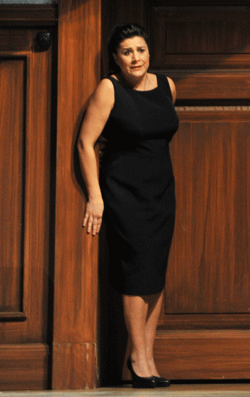 Cecilia Bartoli as Desdemona
As Desdemona, Cecilia Bartoli remains at the top of her game. This was my first live experience with La Bartoli in a dramatic role, and well, to frame the experience in a highly complicated, technical way: she sang the living snot out of it. There seemed nothing Cecilia couldn’t do. Her throbbing soprano summoned forth a gutsy fury one moment, and the next could spin out a pianissississimo so achingly delicate we scarce could breathe. The impeccable vocal fireworks we have come to expect were securely on display to be sure, but this night there was less aspiration on the runs and roulades with no loss of color or accuracy. Her unflinching, fierce commitment and her consummate musical imagination were always in evidence, constantly imbued with an unforced, innate musicality.
Since Signora B had considered every dramatic variant possible in the role, she took us on a richly complicated dramatic journey. Along the way, our Diva gave us a searing finish to Act II as she held the penultimate high note with pointed conviction and incredible duration. A short while later, her Willow Song was a master’s class in meticulously crafted, tonally limp, beautifully judged pathos. Our star has made a happy marriage indeed between her medium-sized voice and this jewel of a medium sized house. She performs staged opera most often here, and her public clearly adores her. And why not? With her immensely satisfying catalogue of recordings, her highly personal performing style, and her glamorous persona, there is no international star bigger than Cecilia Bartoli, and damn’ few her equal.
She was splendidly matched with her Otello, John Osborn. He had paired very ably with her in 2010’s Clari but nothing in that lighter piece showed off his awesome skill set. For Mr. Osborn boasts an usually wide range of tessitura, from the expected ‘very high’ to the unexpected ‘very low indeed.’ The richness, responsiveness and directness of his burnished tenor are a joy; and the precision and meaningfulness of his florid singing are not normally expected from a voice of such generous amplitude. Our Moor took the role by storm (as it were) with a potent, bravura vocal display. Moreover, John and Cecilia worked musical magic together, blending seamlessly as their world class instruments intertwined in the extended duet. (A handful of the tenor’s phrases in middle voice were colored with a slightly grainy cast that recalled James McCracken, a bygone — albeit entirely different — Moor.)
One of the stellar singers on the Zurich house roster, Javier Camarena (Rodrigo) summoned forth a marvelous blend of honeyed tone and technical razzle dazzle. Mr. Camerena’s even, secure, warm lyric tenor brought pleasure all evening, and we got the added bonus of the producers assimilating the final cameo of Lucio into his role, giving this talented performer a final scene to steal. Young Edgardo Rocha has grown enormously since I heard him last November in Wexford. His tenor rang out with élan, and his gleaming, bright sound was all the more effective for its confounding our concept of the usual dark voice types we imagine for Iago. Mr. Rocha’s singing was bright, lean and mean, and effectively insinuating. He and Javier conspired to ravish us with a zinger of a duet that fairly crackled with intensity, and reveled in pyrotechnic coloratura displays.
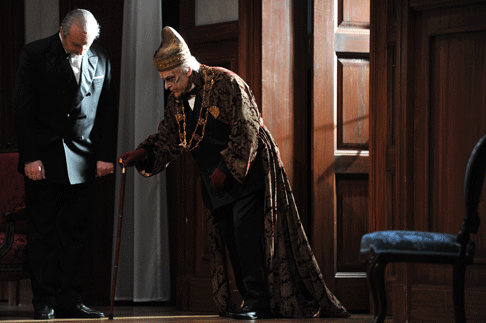 Peter Kálmán as Elmiro and Nicola Pamio as the Doge
In the smaller role of Emilia, Liliana Nikiteanu was a beautiful vocal presence. Her somewhat cooler, reasoned, haunting mezzo provided a good balance, and the two ladies manufactured a seamless blend on the plaintive duets. Peter Kálmán showed off an ample, searing bass as an authoritarian Elmiro, sounding as imposing as many a Don Carlo Filippo. Nicola Pamio created a visually senile and doddering, though vocally solid, Doge. Young Artist Ilker Arcayürek’s lovely off-stage tenor brought a mellifluous serenity to the Gondolier’s arietta, so lovely it made us wish for more.
These outstanding soloists were matched in excellence note for note from the pit, populated by the nonpareil ensemble “Orchestra La Scintilla” of the Zurich Opera. Of course, such Early Music evenings begin as they must. They tuned and tuned. And tuned. And then tuned. But then this period instrument band tore into this infrequently heard opus as though it were a masterpiece deserving of their finest efforts. Conductor Muhai Tang was a revelation as he elicited unstinting, dramatically informed playing from his instrumentalists. Maestro Tang brought to bear notably fine pacing and exquisite attention to color and detail. He accommodated the soloists effectively, breathing with them, urging them on one minute, indulging them in elastic phrasing the next. The reading was driving yet highly responsive, a consummately controlled performance. While the entire band was magnificent, there was standout partnering from the solo horn (Glen Borling) and clarinet (Robert Pickup) who assumed real personalities as they helped underline the psychological state of the singers.
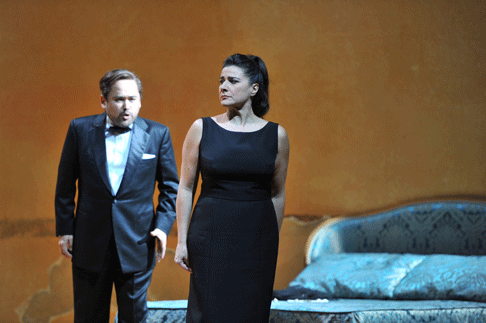 Javier Camarena as Rodrigo and Cecilia Bartoli as Desdemona
No less engaging was the well-considered physical production (set design by Christian Fenouillat). At opening, Otello was being celebrated at a formal indoor ceremony in a huge, late 19th century drawing room, cool blue with oversize oak doors. Up stage left, very tall double doors open (and close) to a formal dining room where the guests retire after the opening chorus. A huge white Murano glass chandelier dominates the room, the only other furnishings a deep blue damask settee up center, and matching chairs down left. A large window, left, afforded wonderful lighting effects from designers Hans-Rudolf Kunz and Christophe Forey. The duo suffused the room with a warm orangey sunlight which later morphed to a harsher cross-lighting that made the ominous faces of the lined up chorus visually ‘pop’.
Agostino Cavalca’s clean, modern day costumes also serve the concept well, the chorus in suits and formal wear, Otello in dress blues (later in military work clothes like Iago’s), the Doge in religious drag. Ms. Bartoli looked fetching in a simple black cocktail dress, to which fitted lace sleeves and a pearl necklace were added to good effect. Emilia appeared to be a social secretary, business casual in slacks and a draping gray silk knit top. Desdemona sheds the dress, to end the night in a satiny white slip. Simple. Effective. Each costume told us who the character was.
Desdemona’s bedroom was a vibrant burnt orange, furnished only with a double bed up left and a settee just inside the door stage right, both again blue damask. The other setting was the servants’ cantina, with violently green colored walls, mismatched furniture, a pool table with chairs upended upon it, and two large cold metal doors up right that open onto the street. Within these re-imagined locales, directors Moshe Leiser and Patrice Caurier crafted a persuasive case not only for their vision, but also for Rossini’s drama.
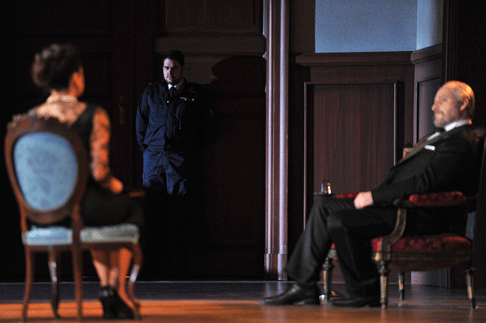 Cecilia Bartoli as Desdemona, Edgardo Rocha as Iago and Peter Kálmán as Elmiro
They accomplished this with unfussy, fluid blocking that placed singers in advantageous stage positions to be able to be seen and heard. (It sounds simple but you have no idea how often that is not the case in Euro-Concept productions.) Next, they kept their singers tightly focused on each other, exploring the dramatic truth that was the underpinning for the need to sing their emotions in the first place. Next, they knew when to get their performers into an effective picture and then stay relatively still, allowing them to sing complicated ensembles (like the fiendishly difficult sextet) to maximum effect. And finally, they contrived just enough unique business to inject a bit of edginess into the proceedings. A few examples:
The thinly disguised racism of the court is pointed up by having a pair of servants appear at the dining room doors with trays of food. The white server is allowed in with his tray, the black server is relieved of his and turned back to the kitchen. When he reappears with a coffee service, it is knocked out of his hands as Elmiro storms through the doors from the dinner. His seething look withers the poor servant into an apologetic mopping up of the mess.
In Two, Otello is presented hanging out drinking beer in the servants’ recreation area, underlining his social status. At that act’s end, as Elmiro discredits his daughter, Desdemona, barefoot now (trapped down left between the pool table, the refrigerator, and the Deep Blue Sea) deliberately and oh-so-slowly reaches into the fridge and pulls out…a beer with which she sarcastically toasts her father. She plays the scene a bit unhinged which works sensationally well, climaxing with a crawl up to stand on the pool table. As she towers over dad, screaming the afore-mentioned searing high note at him, she dementedly pours the beer all over herself. Nuts. Brilliant. Meaningful. They all scramble to grab her down to stop her making a display of the family business in front of the servants.
In the final act, a resplendent treatment of the Willow Song began with Desdemona hauling out an old phonograph from under her bad. She knelt and placed it downstage in silence, lifted and set the needle, and the tune began to play through the speakers. Julie Palloc’s wonderful recorded harp-playing was a little LP-scratchy at first, but as the live orchestra snuck in when Bartoli began singing, we had experienced a luminous effect indeed. The final visual coup: after Otello had stabbed Desdemona and she lay bloodied and lifeless against the back wall, the stage right wall (with locked door) tracked toward center creating a split stage. On the outside were the (now) forgiving, conciliatory forces, while in the bedroom our trapped hero careened helplessly, unlocking the door and stabbing himself just as the optimistic court flooded in. As Elmiro and Rodrigo came upon Desdemona’s corpse, they found an outlet for their shock and grief by kicking the Moor’s crumpled body, reminding us of the racism that had, after all, started the plot’s inexorable descent into tragedy.
To sum up: If this thrilling evening in the opera house was not theatrical and musical perfection, well, then I don’t know what is.
James Sohre