Subscribe to
Opera Today

Receive articles and news via RSS feeds or email subscription.


twitter_logo[1].gif


UCP_9780226043425.gif

Recently in Performances

Wozzeck at ENO

“Man is an abyss. It makes one dizzy to look into it.” So utters Georg Büchner’s Woyzeck, repeating what was also a recurring motif in the playwright’s own letters.

Mulhouse: Rare Britten Well Done

National Opera Company of the Rhine has marked this year’s Benjamin Britten celebration with a remarkably compelling, often gripping new production of the seldom-seen Owen Wingrave.

Frankfurt's Intriguing Idomeneo

Once upon a time, Frankfurt Opera had the baddest ass reputation in Germany as “the” cutting edge producer of must-see opera.

Rigoletto at Lyric Opera of Chicago

Productions of Giuseppe Verdi’s Rigoletto can serve as a vehicle for individual singers to make a strong impression and become afterward associated with specific roles in the opera.

Britten Sinfonia with Ian Bostridge

Just in case we were not aware that the evening’s programme was ‘themed’, the Britten Sinfonia designed a visual accompaniment to their musical exploration of night, sleep and dreams.

Aida, Manitoba Opera

Poor Aida! She never seems to have anything go her way.

Superlative singing: Don Carlo, Royal Opera House

Is it possible to upstage Jonas Kaufmann? Kaufmann was brilliant in this Verdi Don Carlo at the Royal Opera House, London, but the rest of the cast was so good that he was but first among equals. Don Carlo is a vehicle for stars, but this time the stars were everyone on stage and in the pit. Even the solo arias, glorious as they are, grow organically out of perfect ensemble. This was a performance that brought out the true beauty of Verdi's music.

Sarah Connolly: French Song at Wigmore Hall

The big names were absent: Duparc, D’Indy, Debussy, Ravel … and while Fauré, Chausson, Roussel and several members of Les Six put in an appearance, in less than familiar guises, this survey of French song of the early 20th century and interwar years deliberately took us on a journey through infrequently travelled terrain.

Rare restoration: Handel’s Esther 1720

Composed between 1718 and 1720, Handel’s Esther is sometimes described as the ‘first English Oratorio’, but is in fact a hybrid form, mixing elements of oratorio, masque, pastoral and opera.

The Damnation of Faust, London

Hector Berlioz's légende dramatique, La Damnation de Faust, exists somewhere between cantata and opera. Berlioz's flexible attitude to dramatic form made the piece unworkable on the stages of early 19th century Paris and his music is so vivid that you wonder whether the piece needs staging at all.

Elizabeth Connell Memorial Concert, St John's Smith Square

St. John’s Smith Square was the site of Elizabeth Connell’s final London concert, intended as a farewell to London on her moving to Australia. It was rendered ultimately final by her unexpected death.

Aida with all the Trimmings, Even a Blue Silk Elephant!

With the building of the Suez Canal, Egypt became more interesting to Western Europeans. Khedive Ismail Pasha wanted a hymn by Verdi for the opening of a new opera house in Cairo, but the composer said he did not write occasional pieces.

Die Zauberflöte, Royal Opera

Back for its fourth revival, David McVicar’s 2003 production of Mozart’s Die Zauberflöte has much charm, beauty and artistry.

The Marriage of Figaro Ends Season at Arizona Opera

Wolfgang Amadeus Mozart's opera The Marriage of Figaro has a libretto by Lorenzo daPonte based on the French play La folle journée, ou le Mariage de Figaro (The Crazy Day or the Marriage of Figaro) by Pierre Caron de Beaumarchais (1732-1799).

Baden’s Flute Goes Barefoot in the Park

For its world class Easter Festival, Baden-Baden mounted a Die Zauberflöte that owed more to the grey penitential doldrums of Lent than to the unbridled jubilance of re-birth.

Bonjour M. Gauguin in Berkeley

Once Berkeley Opera, renamed West Edge Opera, this enterprising company offers the Bay Area’s only serious alternative to corporate opera, to wit Bonjour M. Gauguin.

Mahler Lieder, Wigmore Hall

In the first of pianist Julius Drake’s three-part series, ‘Perspectives’, our gaze was directed at Gustav Mahler’s eclectic musical responses to human experiences: from the trauma and distress of anguished love to the sweet contentment of true friendship, from the agonised introspection of the artist to the diverse dramas of human interaction.

Cinderella Goes to the Opera

The Los Angeles opera company marketed its spring production of Rossini's La Cenerentola as Cinderella though there is no opera by that name. The libretto of La Cenerentola is not the Cinderella story we know.

Die Walküre, Paris

The Paris Opéra has not staged a full Ring Cycle since 1957, but its current season will conclude with a correction of this grand operatic gap.

Manon Lescaut, Washington National Opera

Washington National’s 2012-2013 season continues this spring with a production of Giacomo Puccini’s first successful opera.

OPERA TODAY ARCHIVES »

Performances

Susannah Biller as Fortuna [Photo by Richard Termine courtesy of Gotham Chamber Opera]
19 Apr 2012

Il Sogno di Scipione

It’s unclear whether Mozart composed this highly undramatic “dramatic action” when he was fifteen, for his kindly master Prince-Archbishop von Schrettenbach of Salzburg, or the following year for the newly-elected successor, Prince-Archbishop Colloredo, who, soon afterwards, had the young man literally kicked out of his service.

W. A. Mozart: Il Sogno di Scipione

Constanza: Marie-Ève Munger; Fortuna: Susannah Biller; Licenza: Maeve Höglund; Scipione: Michele Angelini; Publio: Arthur Espiritu; Emilio: Chad A. Johnson. Chorus and orchestra of the Gotham Chamber Opera, conducted by Neal Goren. Production by Christopher Alden. At the Gerald W. Lynch Theater at John Jay College. Performance of April 13.

Above: Susannah Biller as Fortuna

Photos by Richard Termine courtesy of Gotham Chamber Opera


It is also unclear how much of Sogno was ever performed in Mozart’s lifetime—very little, apparently. The piece’s modern revival, possibly world premiere, took place in 1979 with a cast (recorded) whose luxe is hardly imaginable for such a project today: Popp, Gruberova, Mathis, Schreier, et al.
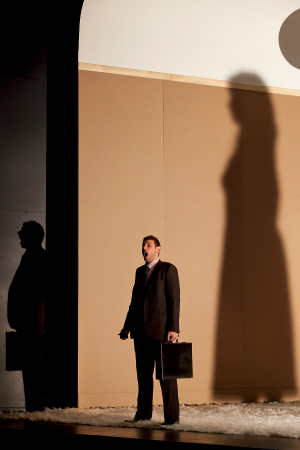
RT_MG_0537_1.pngMichele Angelini as Scipione

The text is a moralizing serenata by the indefatigable imperial court poet Metastasio (only his death, after half a century on the job, left the Viennese post to Lorenzo da Ponte). He drew it from Cicero’s moralizing fable of the younger Scipio Africanus choosing (in a dream) virtue over pleasure in the fine old Roman republican manner, thus putting to shame the decadent Romans of Cicero’s later era when the republic was dying. Metastasio made the choice between Good Luck (Fortuna) and Self-Discipline (Constanza), and of course Scipio chooses the latter, though not without Fortuna getting to make her case pretty well. Sententious sentiment made the libretto ideal for formal occasions, such as the investment of a new archbishop, but rather a stretch in the theater. I saw it at the Residenz-Theater in Munich in 1991 (on a double-bill with Mozart’s Apollo und Hyakinthos); the exquisite jewel-box theater considerably outshone the music. Neal Goren, of Gotham Chamber Opera, claims that when he started his company ten years ago, he slyly told Christopher Alden that there was a Mozart opera that had never been staged in this country (true) and that it was regarded as unstageable. Alden, naturally, took this as a challenge. To celebrate ten felicitous years, Gotham has revived his brilliant opening, which I missed at the time.
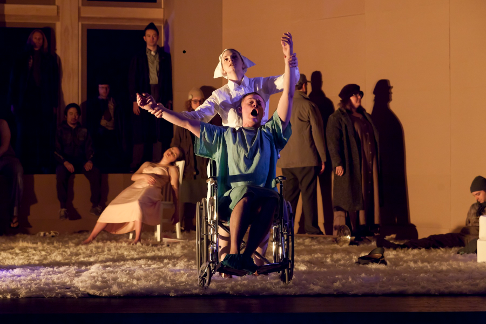
RT_MG_0260_1.pngCast of Il Sogno di Scipione

The production’s Regie-theater clichés must, in 2001, have been as startling to a New York audience as Goren hoped they’d be. They still make the audience laugh—and remain attentive. The curtain rises in heaven, a bare bedroom, and Scipio wakes scratchily from a doze to find himself literally between the sheets between two goddesses, from whom he must choose one. (At last Friday’s performance, Fortuna has gone to bed with filthy feet. I have no idea whether this was part of the director’s vision.) Fortuna presents herself as fickle but fun by doing a reverse striptease, pulling assorted outfits from a closet and trying them on for us. (Shoes! Tops! Wigs!) Constanza never sheds her nightdress but she invokes the Music of the Spheres, impersonated by globular hanging lamps. A chorus of dead heroes appears at the window in assorted deadbeat garb, echoes from a zombie movie. (Scipio, terrified, climbs on the wardrobe to escape them.) Scipio’s father (Publio, an amputee in this version) and grandfather (Emilio, wheelchair-bound and blind) show up to remind the lad of the glories of public service, in arias that Mozart cannot have intended to possess the ironic air Alden’s staging gives them. At last, though spooked, Scipio chooses Constanza (the path of duty), Fortuna is frustrated, and an Epilogue (Licenza) appears to warble the best tune of the night, congratulating the audience (in Mozart’s day, the Archibishop; nowadays, us) for having the taste to admire this sublime entertainment. Alden’s Licenza demonstrates her enthusiasm by tossing disco moves into her coloratura ecstasies.

All of this activity and ironic subtext-as-commentary-within-action undoubtedly gives the score a better chance of being appreciated than it would ever secure if performed “straight.” Doubt crept in during the more elaborate vocal displays—the piece was written for vocal display, illustrating and underlining the meanings of the text, and as the intended first cast were Salzburg singers, Mozart knew just what they could do. The young singers performing for Gotham Chamber Opera were all of them more than qualified to do justice to Mozart, personable, talented actors as well. But none of the performances was entirely on the mark, coloratura were often uneven, a little tuneless or imprecise, and it was impossible to suppress the notion that they’d have sung better if there had been less wriggling about (or tottering, in the case of amputated Publio, or clambering up the walls of the armoire in the case of Scipio, or thrash-dancing in the case of Licenza). It was an occasion of colorful performing but the Mozart-singing suffered for it.
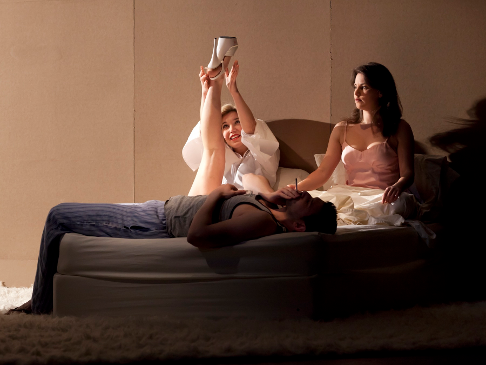
RT_MG_0246_1.pngSusannah Biller as Fortuna, Michele Angelini as Scipione and Marie-Ève Munger as Constanza

The two most interesting voices, the ones that made me eager to hear them again in less athletic circumstances, belonged to Michele Angelini as dreaming Scipio and to Maeve Höglund as Licenza. Angelini possesses a baritonal tenor, an agreeable sound of masculine depth and a happy instinct for phrasing, plus an easy extension to an agreeable lyric top. One foresees enjoying him as Idomeneo or Belmonte. Höglund had the most sensuous voice of the bunch, a soprano with mezzo undertones, luscious and sensuous in a text that lacked seductive implications but seemed to have them when she put it over. Susannah Biller’s Fortuna was flashy, sometimes to strident effect. Marie-Ève Munger’s Costanza was altogether more cozy, but then it can’t be easy to impersonate something so stolid with any flare. Arthur Espiritu and Chad A. Johnson were effective as the ghosts of Scipio’s family past. Neal Goren led a very spirited orchestra and chorus, and nearly two hours passed as harmoniously as Ptolemy the Astronomer could have demanded.

John Yohalem

Send to a friend

Send a link to this article to a friend with an optional message.

Friend's Email Address: (required)

Your Email Address: (required)

Message (optional):