![Patrizia Ciofi as Marie and Colin Lee as Tonio [Photo © ROH 2012 / Bill Cooper]](http://www.operatoday.com/La_Fille_ROH_2012_01.gif)
25 Apr 2012
La Fille du Regiment, Royal Opera
The regiment marches onwards!
English Touring Opera are delighted to announce a season of lyric monodramas to tour nationally from October to December. The season features music for solo singer and piano by Argento, Britten, Tippett and Shostakovich with a bold and inventive approach to making opera during social distancing.
This tenth of ten Live from London concerts was in fact a recorded live performance from California. It was no less enjoyable for that, and it was also uplifting to learn that this wasn’t in fact the ‘last’ LfL event that we will be able to enjoy, courtesy of VOCES8 and their fellow vocal ensembles (more below …).
Ever since Wigmore Hall announced their superb series of autumn concerts, all streamed live and available free of charge, I’d been looking forward to this song recital by Ian Bostridge and Imogen Cooper.
Although Stile Antico’s programme article for their Live from London recital introduced their selection from the many treasures of the English Renaissance in the context of the theological debates and upheavals of the Tudor and Elizabethan years, their performance was more evocative of private chamber music than of public liturgy.
Evidently, face masks don’t stifle appreciative “Bravo!”s. And, reducing audience numbers doesn’t lower the volume of such acclamations. For, the audience at Wigmore Hall gave soprano Elizabeth Llewellyn and pianist Simon Lepper a greatly deserved warm reception and hearty response following this lunchtime recital of late-Romantic song.
For this week’s Live from London vocal recital we moved from the home of VOCES8, St Anne and St Agnes in the City of London, to Kings Place, where The Sixteen - who have been associate artists at the venue for some time - presented a programme of music and words bound together by the theme of ‘reflection’.
'Such is your divine Disposation that both you excellently understand, and royally entertaine the Exercise of Musicke.’
‘And there was war in heaven: Michael and his angels fought against the dragon; and the dragon fought and his angels, And prevailed not; neither was their place found any more in heaven … that old serpent … Satan, which deceiveth the whole world: he was cast out into the earth, and his angels were cast out with him.’
There was never any doubt that the fifth of the twelve Met Stars Live in Concert broadcasts was going to be a palpably intense and vivid event, as well as a musically stunning and theatrically enervating experience.
‘Love’ was the theme for this Live from London performance by Apollo5. Given the complexity and diversity of that human emotion, and Apollo5’s reputation for versatility and diverse repertoire, ranging from Renaissance choral music to jazz, from contemporary classical works to popular song, it was no surprise that their programme spanned 500 years and several musical styles.
The Academy of St Martin in the Fields have titled their autumn series of eight concerts - which are taking place at 5pm and 7.30pm on two Saturdays each month at their home venue in Trafalgar Square, and being filmed for streaming the following Thursday - ‘re:connect’.
The London Symphony Orchestra opened their Autumn 2020 season with a homage to Oliver Knussen, who died at the age of 66 in July 2018. The programme traced a national musical lineage through the twentieth century, from Britten to Knussen, on to Mark-Anthony Turnage, and entwining the LSO and Rattle too.
With the Live from London digital vocal festival entering the second half of the series, the festival’s host, VOCES8, returned to their home at St Annes and St Agnes in the City of London to present a sequence of ‘Choral Dances’ - vocal music inspired by dance, embracing diverse genres from the Renaissance madrigal to swing jazz.
Just a few unison string wriggles from the opening of Mozart’s overture to Le nozze di Figaro are enough to make any opera-lover perch on the edge of their seat, in excited anticipation of the drama in music to come, so there could be no other curtain-raiser for this Gala Concert at the Royal Opera House, the latest instalment from ‘their House’ to ‘our houses’.
"Before the ending of the day, creator of all things, we pray that, with your accustomed mercy, you may watch over us."
The doors at The Metropolitan Opera will not open to live audiences until 2021 at the earliest, and the likelihood of normal operatic life resuming in cities around the world looks but a distant dream at present. But, while we may not be invited from our homes into the opera house for some time yet, with its free daily screenings of past productions and its pay-per-view Met Stars Live in Concert series, the Met continues to bring opera into our homes.
Music-making at this year’s Grange Festival Opera may have fallen silent in June and July, but the country house and extensive grounds of The Grange provided an ideal setting for a weekend of twelve specially conceived ‘promenade’ performances encompassing music and dance.
There’s a “slide of harmony” and “all the bones leave your body at that moment and you collapse to the floor, it’s so extraordinary.”
“Music for a while, shall all your cares beguile.”
The hum of bees rising from myriad scented blooms; gentle strains of birdsong; the cheerful chatter of picnickers beside a still lake; decorous thwacks of leather on willow; song and music floating through the warm evening air.
The regiment marches onwards!
Having conquered operatic stages in Europe and the US during the past five years, Laurent Pelly’s Tyrolean troopers/troupers have tramped back to London, with a sway and a swagger; the company’s stalwarts demonstrate their stamina while some of the leaders take a breather and make way for new recruits.
In particular, Natalie Dessay has resigned from the brigade. In 2010, on the occasion of the first ROH revival, I remarked that the role “is fast becoming a signature role — and indeed it is hard to imagine this production without Dessay”. However, Patrizia Ciofi more than proved me wrong: lacking Dessay’s manic agitation — a gamine hyperactivity that was often achieved at the expense of vocal finesse — Ciofi’s Marie is an altogether more rounded, and composed, character: an energetic, at times unreasonable adolescent, yes, but also a burgeoning young woman with hopes and dreams with which we can identify. Ciofi’s diction at times lacks lucidity; and her wide vibrato — especially at the top where it frequently forces the pitch upwards — is unfortunate in more sustained, ensemble passages.
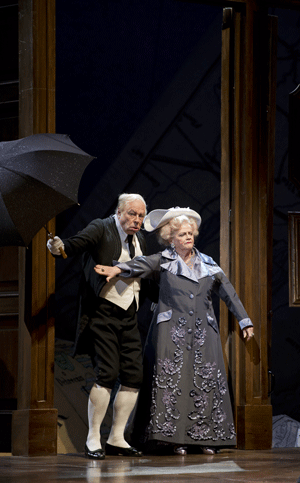 Ann Widdecombe as La Duchesse De Crackentorp and Donald Maxwell as Hortensius
But, Ciofi has the high tessitura and breathtaking coloratura easily under her belt — or should I say braces — and has a rich, creamy tone. Hers is a Marie who makes us laugh and cry. Whether wobbling determinedly across the stage, buried beneath laundry mountains, or leaping aloft a potato bucket to entertain the troops, or being violently hoisted upside down or horizontal as she is ‘abducted’ by her newly found aunt, Ciofi retained her equanimity. Overall, she may lack some of Dessay’s hard-hitting punch but hers is a more genuine bel canto idiom.
Colin Lee has taken progressive but unceasing strides to the front lines: as Juan Diego’s understudy in 2007, he shared the role in 2010 and now stepped into the full glare of the spotlight. Certainly Lee has the vocal gifts and musical temperament to dispatch the infamous high Cs in ‘A mes amis’ — the last relished and sustained to substantial applause. And, in the yodelling leaps he revealed a heroic timbre to counter his previous hapless, bumpkin-esque persona, revealing the sincerity of Tonio’s affections. Although Lee may not possess the physical and vocal appeal of his predecessor in this production, he does have a confident, controlled elegance: his superbly shaped, long, legato lines pay detailed, intelligent attention to phrasing, and the effect is complemented by a focused vibrato, which was put to superb effect in his tender declaration of love, the Act 2 aria, ‘Pour me rapprocher de Marie’.
Returning as the Marquise de Birkenfield, Ann Murray relished the comic potential of her partnership with Donald Maxwell’s emasculated Hortensius. Her Act 1 account of the loss of her sister’s child is in danger of taking on an air of Miss Prism-esque farce — one half expects Lady Bracknell to pop up pompously pronouncing about perambulators and handbags. Indeed, one of the disadvantages of repetition is that wry comedy can become brutish slapstick: more Loony Tunes than Napoleonic rom-com. That said, as in 2010 Murray’s ‘singing lesson’ with Marie and Sulpice produced some of the finest musical and theatrical moments in the performance. And, Alan Opie’s Sulcipe was the warm embodiment of paternal indulgence — even when his feisty ‘daughter’ disowns him and declares her intent to find a regiment of ‘nicer daddies’.
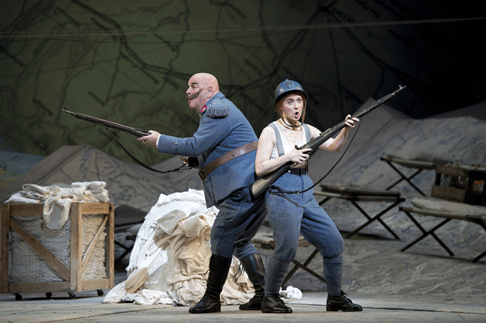 Patrizia Ciofi as Marie and Alan Opie as Sulpice Pingot
Stepping into Dawn French’s shoes as the Duchesse de Crackentorp, Ann Widdicome shares little with her predecessor except her girth — or rather, French’s former girth, given that the latter has recently revealed a new svelte figure. Hot from her Strictly and panto successes, Widdicome is clearly riding a popularist wave — rather surprising for one who made her name as a bastion of Tory/Victorian principled intolerance. However, politics aside, those who witnessed Widdicome’s Strictly ‘triumph’ will be aware that rhythm is not one of her fortes; she possesses none of French’s insouciant comic timing or improvisatory invention. Indeed, it even seemed quite a challenge for her to remember her lines. That said, self-referential surtitles — a bellowing ‘Order, Order!’, and many Strictly references — raised hilarity among the audience, so presumably the ROH management consider this casting well done. I probably deserve censure for failing to appreciate Widdicome’s willingness to laugh at herself and her ability to add to the frivolous fun.
Most pleasingly, the chorus are truly regimented, kept on a tight rein vocally and visually, relishing the mixture of musical self-discipline and the threat of dramatic — and military — mishap.
There is a lot of dialogue to get through, and thus the staging and visual appeal plays an important role in sustaining the audience’s attention: Chantal Thomas’s cartographical collage is both witty and engaging, while the distorted perspective of the Marquise’s château in Act 2 emphasises the bizarre nature of the dramatic development. Balletic dusting routines and a coup de théâtre tank for Tonio’s rescue mission help to overcome any potential dramatic longeurs.
Conductor Yves Abel leads the regimental company on a careful but precise campaign. There was much lovely playing from the ROH orchestra: in the introduction the horns were wonderfully warm and touching, complemented by well-shaped, emotive woodwind and string sectional playing. But, Abel’s tempi were, on the whole, rather slow and conservative — not quite right for the wild abandon on stage; and, he seemed to feel the need to signpost every comic moment with a knowing gesture.
Many chuckles derived from Agathe Mélinand’s surtitles. Indeed, the current Eurozone tensions gave an added frisson to the notion of an Italian soprano cast as a French girl, mangling an Italian aria, written by an Italian for a nineteenth-century French audience, performed in franglais-laden production, directed by a Frenchman, and translated for an English audience.
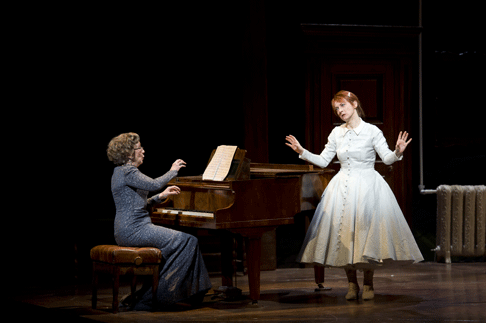 Ann Murray as La Marquise De Berkenfeld and Patrizia Ciofi as Marie
In this context, the contemporary reception of Donizetti’s work is interesting: only two major composers of the age, Mendelssohn and Verdi, genuinely admired him, the former professing, in response to criticism of La fille, “I am afraid I like it. I think it very pretty — it is so merry! Do you know, I should like to have written it myself”. But others, notably Bellini and Berlioz, were less charitable, perhaps in awe and afraid of Donizetti’s prodigious output and adaptability. Indeed, Berlioz accused Donizetti “of treating us like a conquered country; one can no longer speak of the opera houses of Paris, but only of those of M. Donizetti”.
Pelly’s winning production has similarly conquered foreign stages, and there are undoubtedly many deserved victories ahead.
Claire Seymour