Recently in Performances
English Touring Opera are delighted to announce a season of lyric monodramas to tour nationally from October to December. The season features music for solo singer and piano by Argento, Britten, Tippett and Shostakovich with a bold and inventive approach to making opera during social distancing.
This tenth of ten Live from London concerts was in fact a recorded live performance from California. It was no less enjoyable for that, and it was also uplifting to learn that this wasn’t in fact the ‘last’ LfL event that we will be able to enjoy, courtesy of VOCES8 and their fellow vocal ensembles (more below …).
Ever since Wigmore Hall announced their superb series of autumn concerts, all streamed live and available free of charge, I’d been looking forward to this song recital by Ian Bostridge and Imogen Cooper.
Although Stile Antico’s programme article for their Live from London recital introduced their selection from the many treasures of the English Renaissance in the context of the theological debates and upheavals of the Tudor and Elizabethan years, their performance was more evocative of private chamber music than of public liturgy.
Evidently, face masks don’t stifle appreciative “Bravo!”s. And, reducing audience numbers doesn’t lower the volume of such acclamations. For, the audience at Wigmore Hall gave soprano Elizabeth Llewellyn and pianist Simon Lepper a greatly deserved warm reception and hearty response following this lunchtime recital of late-Romantic song.
For this week’s Live from London vocal recital we moved from the home of VOCES8, St Anne and St Agnes in the City of London, to Kings Place, where The Sixteen - who have been associate artists at the venue for some time - presented a programme of music and words bound together by the theme of ‘reflection’.
'Such is your divine Disposation that both you excellently understand, and royally entertaine the Exercise of Musicke.’
‘And there was war in heaven: Michael and his angels fought against the dragon; and the dragon fought and his angels, And prevailed not; neither was their place found any more in heaven … that old serpent … Satan, which deceiveth the whole world: he was cast out into the earth, and his angels were cast out with him.’
There was never any doubt that the fifth of the twelve Met Stars Live in Concert broadcasts was going to be a palpably intense and vivid event, as well as a musically stunning and theatrically enervating experience.
‘Love’ was the theme for this Live from London performance by Apollo5. Given the complexity and diversity of that human emotion, and Apollo5’s reputation for versatility and diverse repertoire, ranging from Renaissance choral music to jazz, from contemporary classical works to popular song, it was no surprise that their programme spanned 500 years and several musical styles.
The Academy of St Martin in the Fields have titled their autumn series of eight concerts - which are taking place at 5pm and 7.30pm on two Saturdays each month at their home venue in Trafalgar Square, and being filmed for streaming the following Thursday - ‘re:connect’.
The London Symphony Orchestra opened their Autumn 2020 season with a homage to Oliver Knussen, who died at the age of 66 in July 2018. The programme traced a national musical lineage through the twentieth century, from Britten to Knussen, on to Mark-Anthony Turnage, and entwining the LSO and Rattle too.
With the Live from London digital vocal festival entering the second half of the series, the festival’s host, VOCES8, returned to their home at St Annes and St Agnes in the City of London to present a sequence of ‘Choral Dances’ - vocal music inspired by dance, embracing diverse genres from the Renaissance madrigal to swing jazz.
Just a few unison string wriggles from the opening of Mozart’s overture to Le nozze di Figaro are enough to make any opera-lover perch on the edge of their seat, in excited anticipation of the drama in music to come, so there could be no other curtain-raiser for this Gala Concert at the Royal Opera House, the latest instalment from ‘their House’ to ‘our houses’.
"Before the ending of the day, creator of all things, we pray that, with your accustomed mercy, you may watch over us."
The doors at The Metropolitan Opera will not open to live audiences until 2021 at the earliest, and the likelihood of normal operatic life resuming in cities around the world looks but a distant dream at present. But, while we may not be invited from our homes into the opera house for some time yet, with its free daily screenings of past productions and its pay-per-view Met Stars Live in Concert series, the Met continues to bring opera into our homes.
Music-making at this year’s Grange Festival Opera may have fallen silent in June and July, but the country house and extensive grounds of The Grange provided an ideal setting for a weekend of twelve specially conceived ‘promenade’ performances encompassing music and dance.
There’s a “slide of harmony” and “all the bones leave your body at that moment and you collapse to the floor, it’s so extraordinary.”
“Music for a while, shall all your cares beguile.”
The hum of bees rising from myriad scented blooms; gentle strains of birdsong; the cheerful chatter of picnickers beside a still lake; decorous thwacks of leather on willow; song and music floating through the warm evening air.
Performances
![Michelle Johnson as Manon [Photo by Kelly & Massa Photography courtesy of Opera Company of Philadelphia]](http://www.operatoday.com/Manon_Lescaut_Phil_01.gif)
26 Apr 2012
Manon Lescaut, Philadelphia
It is Manon month in the Mid-Atlantic states. In New York, the Met is presenting Massanet’s take, while Opera Company of Philadelphia has just opened Puccini’s version: his first successful opera, Manon Lescaut.
The latter is a tribute to the company management, which programmed a work not
heard in Philadelphia for decades in lieu of yet another Bohème,
Tosca or Butterfly, and then overcame adversity to craft an
enjoyable evening.
Opera Philadelphia often benefits from the remarkable number of fine singers
trained in local conservatories—but rarely as much as in this production.
When the scheduled soprano (Ermonela Jaho) cancelled less than a month ago,
Texas-born Michelle Johnston, a 29-year old in her final year at AVA, stepped
in, learned the role from scratch, and sang it with distinction. A grand
finalist in last year’s Met national auditions, Johnston is a well-schooled
singer with the most of the resources to tackle the singular challenge of
Manon, whose evolution from youthful innocence through giddy greed to death in
disgrace is mirrored by a vocal transformation from lyric to
coloratura to spinto soprano. She was most impressive in
slimming down her voice for the Act II minuet scene, complete with a (quasi-)
trill. Given her youth and the rushed conditions of her premiere, it is perhaps
inevitable that, earlier and later, Johnston sometimes seemed a bit cautious.
Later in the run, she will perhaps cut loose more at the big emotional moments,
such as the aria, “Sola, Perduta, Abbandonata.” Overall, however, this was
a smart and sensitive performance by a young singer to watch.
Thiago Arancam is a 32-year old Brazilian lirico spinto tenor who
started singing late and has been trained largely in Milan. He is a sexy guy on
stage, with a voice both pleasant and intriguing, mostly due to its unusually
dark color—a quality often thought to signal grand heroic potential. For the
moment, he sings smoothly and in tune, if uniformly at forte. Yet the
sound in the middle and lower parts of the voice lacks the mixture of warm
timbre and clear ring Italian tenors prize, and sometimes fades out
suddenly—a quality that suggests the tone is being forced. Even at best, the
result, some robust high notes aside, his agreeable approach skims over
subtleties in the character of the Chevalier des Grieux: his flirtatious
serenade, sweet reflection on falling in love, and the gut-wrenching "No! No!,
Pazzo son" all sounded vaguely similar. Perhaps Arancam—scheduled to sing
this role in Dresden under Christian Thielemann in a year—will yet realize
greater potential.
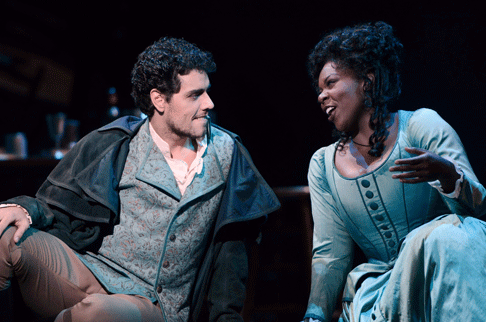 Thiago Arancam as Des Grieux and Michelle Johnson as Manon Lescaut
Two character baritones supported the cast well. Daniel Mobbs continued his
strong work for Philadelphia, seeming to inhabit to the character of Manon’s
rich seducer and patron Geronte de Ravoir. Troy Cook was strong if a bit uneven
as her brother. Cody Austin sang brightly as the student Edmondo, John Viscardi
pranced menacingly as the Dancing Master, and John David Miles’s robust tones
came out of nowhere as the Sergeant.
The production was vintage Philadelphia: realistic, colorful, and
cost-effective without probing even the (relatively shallow) depths of
Manon Lescaut’s libretto-by-committee. Still, it offered one
interesting idea, namely a (mechanically-challenged) drop with projected
paraphrases from of the literary text from which the story originates.
Music director Corrado Rovaris was largely in his element in this
fast-moving score, with the orchestra responding brilliantly—better than I
have ever hesrd them—in moments such as the police raid at the end of Act II.
To be sure, one might have liked to hear Rovaris encourage the young cast to
linger at other critical moments, but rubato is not his thing.
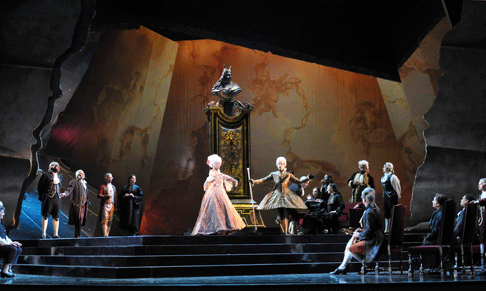 Scene from Manon Lescaut
Given the success of this production, perhaps Philadelphia will now dare to
extend its successful string of operas by 20th-century master Hans Werner Henze
to include his unjustly neglected adaptation of the Manon tale, Boulevard
Solitude.
Andrew Moravcsik