![Anna Netrebko as Manon Lescaut [Photo by Ken Howard/Metropolitan Opera]](http://www.operatoday.com/Manon_Met_2012_02.gif)
26 Apr 2012
Manon, Metropolitan Opera
Massenet’s Manon succeeds in the theater when the soprano has a real sense of the role and how she wants to present it.
English Touring Opera are delighted to announce a season of lyric monodramas to tour nationally from October to December. The season features music for solo singer and piano by Argento, Britten, Tippett and Shostakovich with a bold and inventive approach to making opera during social distancing.
This tenth of ten Live from London concerts was in fact a recorded live performance from California. It was no less enjoyable for that, and it was also uplifting to learn that this wasn’t in fact the ‘last’ LfL event that we will be able to enjoy, courtesy of VOCES8 and their fellow vocal ensembles (more below …).
Ever since Wigmore Hall announced their superb series of autumn concerts, all streamed live and available free of charge, I’d been looking forward to this song recital by Ian Bostridge and Imogen Cooper.
Although Stile Antico’s programme article for their Live from London recital introduced their selection from the many treasures of the English Renaissance in the context of the theological debates and upheavals of the Tudor and Elizabethan years, their performance was more evocative of private chamber music than of public liturgy.
Evidently, face masks don’t stifle appreciative “Bravo!”s. And, reducing audience numbers doesn’t lower the volume of such acclamations. For, the audience at Wigmore Hall gave soprano Elizabeth Llewellyn and pianist Simon Lepper a greatly deserved warm reception and hearty response following this lunchtime recital of late-Romantic song.
For this week’s Live from London vocal recital we moved from the home of VOCES8, St Anne and St Agnes in the City of London, to Kings Place, where The Sixteen - who have been associate artists at the venue for some time - presented a programme of music and words bound together by the theme of ‘reflection’.
'Such is your divine Disposation that both you excellently understand, and royally entertaine the Exercise of Musicke.’
‘And there was war in heaven: Michael and his angels fought against the dragon; and the dragon fought and his angels, And prevailed not; neither was their place found any more in heaven … that old serpent … Satan, which deceiveth the whole world: he was cast out into the earth, and his angels were cast out with him.’
There was never any doubt that the fifth of the twelve Met Stars Live in Concert broadcasts was going to be a palpably intense and vivid event, as well as a musically stunning and theatrically enervating experience.
‘Love’ was the theme for this Live from London performance by Apollo5. Given the complexity and diversity of that human emotion, and Apollo5’s reputation for versatility and diverse repertoire, ranging from Renaissance choral music to jazz, from contemporary classical works to popular song, it was no surprise that their programme spanned 500 years and several musical styles.
The Academy of St Martin in the Fields have titled their autumn series of eight concerts - which are taking place at 5pm and 7.30pm on two Saturdays each month at their home venue in Trafalgar Square, and being filmed for streaming the following Thursday - ‘re:connect’.
The London Symphony Orchestra opened their Autumn 2020 season with a homage to Oliver Knussen, who died at the age of 66 in July 2018. The programme traced a national musical lineage through the twentieth century, from Britten to Knussen, on to Mark-Anthony Turnage, and entwining the LSO and Rattle too.
With the Live from London digital vocal festival entering the second half of the series, the festival’s host, VOCES8, returned to their home at St Annes and St Agnes in the City of London to present a sequence of ‘Choral Dances’ - vocal music inspired by dance, embracing diverse genres from the Renaissance madrigal to swing jazz.
Just a few unison string wriggles from the opening of Mozart’s overture to Le nozze di Figaro are enough to make any opera-lover perch on the edge of their seat, in excited anticipation of the drama in music to come, so there could be no other curtain-raiser for this Gala Concert at the Royal Opera House, the latest instalment from ‘their House’ to ‘our houses’.
"Before the ending of the day, creator of all things, we pray that, with your accustomed mercy, you may watch over us."
The doors at The Metropolitan Opera will not open to live audiences until 2021 at the earliest, and the likelihood of normal operatic life resuming in cities around the world looks but a distant dream at present. But, while we may not be invited from our homes into the opera house for some time yet, with its free daily screenings of past productions and its pay-per-view Met Stars Live in Concert series, the Met continues to bring opera into our homes.
Music-making at this year’s Grange Festival Opera may have fallen silent in June and July, but the country house and extensive grounds of The Grange provided an ideal setting for a weekend of twelve specially conceived ‘promenade’ performances encompassing music and dance.
There’s a “slide of harmony” and “all the bones leave your body at that moment and you collapse to the floor, it’s so extraordinary.”
“Music for a while, shall all your cares beguile.”
The hum of bees rising from myriad scented blooms; gentle strains of birdsong; the cheerful chatter of picnickers beside a still lake; decorous thwacks of leather on willow; song and music floating through the warm evening air.
Massenet’s Manon succeeds in the theater when the soprano has a real sense of the role and how she wants to present it.
There are other juicy roles in the opera, notably that of her Chevalier des Grieux, but a Manon with a vapid Manon never works (no pun on working girl intended). At the Met, Manon has been a major vehicle for singing actresses with small voices but great cachet: Bori, Sayão, Albanese, de los Angeles, and across the Plaza it was a triumph for the vocal acting of Beverly Sills, my first Manon. More recently I have heard Renée Fleming’s listless interpretation at the Met and Natalie Dessay’s rather more on-target version (opposite Jonas Kaufman) in Chicago.
Anna Netrebko has appeared in two DVDs of the opera in rather different styles as she adjusted to different directors’ visions. Now she has come to the Met in a production by Laurent Pelly that allows her to be Manon as she understands this very young, very material girl. A fine actress as well as a talented and hardworking singer with a lovely if not always ideally exploited voice, she makes a thrilling, fully realized sensation in the part.
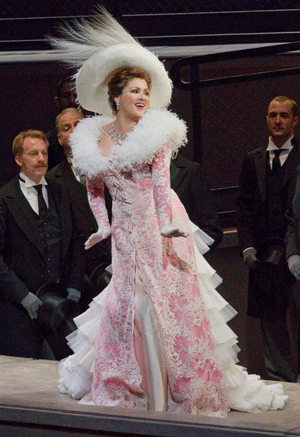 Anna Netrebko as Manon Lescaut
Netrebko brings rather more voice to Manon than is usually the case. She restrains her full-throated sound in the opening scenes, when Manon is fifteen and—at least in Act I—a virgin, albeit une jeune fille en fleur. She then exploits the voluptuous grandeur of her sound to the full to play the haughty beauty of the Cour-la-Reine and the passionate seductress of St. Sulpice. She reaches an ecstatic pinnacle in the Hotel de Transylvania scene, and her glow of sensual delight in the thrill of life and high society and being an object desired by Des Grieux and every other man in the room (and envied by all the women whom she used to envy) flushed body and voice with narcissistic delight. The pitiful comedown (enhanced by Chantal Thomas’s despairing, empty landscape—the best setting of the production) was perhaps not so sickly, so evanescent as the usual Manon plays it. Netrebko still had plenty of lung power to display, expressive more of agony than resigned regret. This makes me eager to hear her take on Puccini’s Manon Lescaut, which requires full-blooded sensuality in the voice from start to finish and hasn’t had it since Freni and Scotto stopped singing the part.
In any case, I can guarantee that those who go to the opera for Netrebko in Manon will not find a half-understood, half-realized or lackluster portrayal. She is bursting with life even in her saddest moments, which makes the fluster she creates among the men around her perfectly comprehensible—even in the Pelly production that (in keeping with our pornographic age) insists on making explicit, shoving our nose into, what Massenet is content to imply: the rape fantasies not merely imagined but enacted by just about every male on stage, of Manon and of every girl in the corps de ballet. (I think Massenet had it right, and Pelly’s direction undercuts the effect of Manon’s fate.)
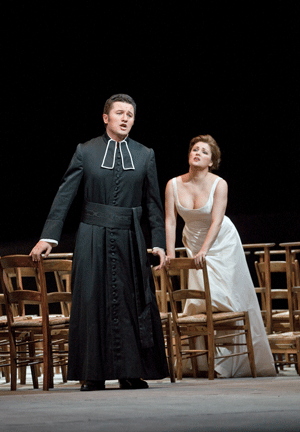 Piotr Beczala as des Grieux and Anna Netrebko as Manon Lescaut
Piotr Beczala plays Des Grieux. He is goodlooking, tender, frenzied by turns, a fine actor and a sympathetic figure. His voice always gives pleasure, interpreting and expressing; if it sometimes fades to indistinction in the distant reaches of the house. Michael Todd Simpson replaced Paulo Szot as Manon’s corrupt cousin at the last minute, presumably with little preparation—but there was nothing in his professional, casually sensuous performance to indicate that anything (in life or this story) was new to him; he was entirely at ease, his voice agreeable and suave, his acting witty and to the point. I am told he is an admired Don Giovanni and I am eager to hear him take it on. Christophe Mortagne, light of step and livid with, alas, not quite impotent indignation, was quite fine as the roué Guillot. The trio of cocottes was played by Anne-Carolyn Bird, Jennifer Black and Ginger Costa-Jackson, top-notch casting for these small but far from insignificant character roles. They set Manon off, inspiring her to her life of ill-fame, but since they have no hearts, they have survived the catastrophe to which she succumbs.
The production is set in fin-de-siècle Paris, an era in which girls of ill fame (and accusation) were not sent to exile in Louisiana. I am not sure what Mr. Pelly thinks he has gained by abandoning the proper era except anything-as-long-as-it-hasn’t-been-done is the current style. Nor is there any point at all in having Des Grieux sleep in a bed in the nave of St. Sulpice except (as we guessed from the rise of the curtain on the scene) it will enable the act to end not with Manon and her priest taking hands and running off but with them wallowing on the blankets. Is this realistic? Do you, if you seduce someone, not seek privacy to consummate the event? Again: It is merely Pelly slavishly following current fashion, which is as evanescent as adolescent passion. I can’t wait to be free of it and of the artists who succumb to it.
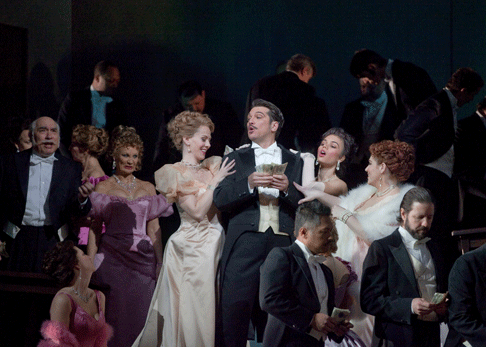 Anne-Carolyn Bird as Poussette, Paulo Szot as Lescaut, Ginger Costa-Jackson as Rosette, and Jennifer Black as Javotte
Fabio Luisi led the Met orchestra in a suave, elegant account of this long, tuneful score and made the dramatic points: Real emotions lurked under the frivolous surface.
Someone should really tell the Met Titlestm that “abbé” does not mean abbot or imply the existence of an abbey; it is simply a polite way to address a priest in French.
John Yohalem