![Cast of Show Boat, Lyric Opera of Chicago [Photo by Robert Kusel courtesy of Lyric Opera of Chicago]](http://www.operatoday.com/Show_Boat_Chicago_03.png)
19 Apr 2012
Show Boat at Lyric Opera of Chicago
Lyric Opera of Chicago has begun with the current season’s production of Show Boat a series of musicals of the American theater to be featured in coming years.
English Touring Opera are delighted to announce a season of lyric monodramas to tour nationally from October to December. The season features music for solo singer and piano by Argento, Britten, Tippett and Shostakovich with a bold and inventive approach to making opera during social distancing.
This tenth of ten Live from London concerts was in fact a recorded live performance from California. It was no less enjoyable for that, and it was also uplifting to learn that this wasn’t in fact the ‘last’ LfL event that we will be able to enjoy, courtesy of VOCES8 and their fellow vocal ensembles (more below …).
Ever since Wigmore Hall announced their superb series of autumn concerts, all streamed live and available free of charge, I’d been looking forward to this song recital by Ian Bostridge and Imogen Cooper.
Although Stile Antico’s programme article for their Live from London recital introduced their selection from the many treasures of the English Renaissance in the context of the theological debates and upheavals of the Tudor and Elizabethan years, their performance was more evocative of private chamber music than of public liturgy.
Evidently, face masks don’t stifle appreciative “Bravo!”s. And, reducing audience numbers doesn’t lower the volume of such acclamations. For, the audience at Wigmore Hall gave soprano Elizabeth Llewellyn and pianist Simon Lepper a greatly deserved warm reception and hearty response following this lunchtime recital of late-Romantic song.
For this week’s Live from London vocal recital we moved from the home of VOCES8, St Anne and St Agnes in the City of London, to Kings Place, where The Sixteen - who have been associate artists at the venue for some time - presented a programme of music and words bound together by the theme of ‘reflection’.
'Such is your divine Disposation that both you excellently understand, and royally entertaine the Exercise of Musicke.’
‘And there was war in heaven: Michael and his angels fought against the dragon; and the dragon fought and his angels, And prevailed not; neither was their place found any more in heaven … that old serpent … Satan, which deceiveth the whole world: he was cast out into the earth, and his angels were cast out with him.’
There was never any doubt that the fifth of the twelve Met Stars Live in Concert broadcasts was going to be a palpably intense and vivid event, as well as a musically stunning and theatrically enervating experience.
‘Love’ was the theme for this Live from London performance by Apollo5. Given the complexity and diversity of that human emotion, and Apollo5’s reputation for versatility and diverse repertoire, ranging from Renaissance choral music to jazz, from contemporary classical works to popular song, it was no surprise that their programme spanned 500 years and several musical styles.
The Academy of St Martin in the Fields have titled their autumn series of eight concerts - which are taking place at 5pm and 7.30pm on two Saturdays each month at their home venue in Trafalgar Square, and being filmed for streaming the following Thursday - ‘re:connect’.
The London Symphony Orchestra opened their Autumn 2020 season with a homage to Oliver Knussen, who died at the age of 66 in July 2018. The programme traced a national musical lineage through the twentieth century, from Britten to Knussen, on to Mark-Anthony Turnage, and entwining the LSO and Rattle too.
With the Live from London digital vocal festival entering the second half of the series, the festival’s host, VOCES8, returned to their home at St Annes and St Agnes in the City of London to present a sequence of ‘Choral Dances’ - vocal music inspired by dance, embracing diverse genres from the Renaissance madrigal to swing jazz.
Just a few unison string wriggles from the opening of Mozart’s overture to Le nozze di Figaro are enough to make any opera-lover perch on the edge of their seat, in excited anticipation of the drama in music to come, so there could be no other curtain-raiser for this Gala Concert at the Royal Opera House, the latest instalment from ‘their House’ to ‘our houses’.
"Before the ending of the day, creator of all things, we pray that, with your accustomed mercy, you may watch over us."
The doors at The Metropolitan Opera will not open to live audiences until 2021 at the earliest, and the likelihood of normal operatic life resuming in cities around the world looks but a distant dream at present. But, while we may not be invited from our homes into the opera house for some time yet, with its free daily screenings of past productions and its pay-per-view Met Stars Live in Concert series, the Met continues to bring opera into our homes.
Music-making at this year’s Grange Festival Opera may have fallen silent in June and July, but the country house and extensive grounds of The Grange provided an ideal setting for a weekend of twelve specially conceived ‘promenade’ performances encompassing music and dance.
There’s a “slide of harmony” and “all the bones leave your body at that moment and you collapse to the floor, it’s so extraordinary.”
“Music for a while, shall all your cares beguile.”
The hum of bees rising from myriad scented blooms; gentle strains of birdsong; the cheerful chatter of picnickers beside a still lake; decorous thwacks of leather on willow; song and music floating through the warm evening air.
Lyric Opera of Chicago has begun with the current season’s production of Show Boat a series of musicals of the American theater to be featured in coming years.
Francesca Zambello applied her directorial talents to the current production and allows Show Boat to speak for itself as a straightforward and entertaining piece of theatrical tradition. Featured cast members include Ashley Brown as Magnolia Hawks, Nathan Gunn as Gaylord Ravenal, Alyson Cambridge as Julie, Angela Renée Simpson as Queenie, Morris Robinson as Joe, Ross Lehmann as Captain Hawks, Cindy Gold as Parthy Ann Hawks, and Ericka Mac as Ellie May Chipley. John DeMain conducted the Lyric Opera Orchestra.
After the overture settled from a brassy start into familiar melodic lines, DeMain highlighted rhythmic shifts to good effect. The “Cotton Blossom” song, named for the riverboat with its staged entertainment, was performed with choral energy yet individual phrases could profit from greater emphasis on diction. The argument between the engineer Pete and the actor Steve, which motivates so much of the subsequent conflict, is convincingly staged. Others members of the ship’s community react immediately to Steve’s dismissal and to the isolation of his wife Julie LaVerne. In the role of the undertalented Ellie May, Ms. Mac sings intentionally off-key and overcompensates charmingly in her attempts to portray an ambitious yet ill-trained replacement for Julie in the ship’s roster of actors.
The arrival of Gaylord Ravenal introduces the second dramatic and emotional twist that will have an effect on the remainder of the piece. It is a role that suits Mr. Gunn’s voice and dramatic talents well. In his first song, “Who cares if my Boat Goes Upstream?” Gunn’s sense of line adds to the carefree swagger of Ravenal’s personality. Here and elsewhere the orchestra could serve the soloist better if taken less forte in its enthusiastic accompaniment. The pivotal duet with Magnolia, “Make Believe,” was performed touchingly by Ms. Brown and Mr. Gunn, as the impression of a naïve yet convincing affection was kindled. When left to consider her thoughts, Magnolia asks Joe the husband of Queenie whether this attraction could be a signal of love. As sung by Mr. Robinson, the response of Joe, “Ol’ Man River,” is one of the highlights of the production. Robinson portrays Joe with dramatic physicality and with fully assured vocal technique. His sonorous bass is rich and full in even the lowest pitches, and his legato matches the rolling pull of the river. When Robinson repeats the song subsequently with male chorus, the effect is equally striking. Magnolia’s second confidante Julie hears next of the budding romance. After the trusting exchange with Magnolia, Ms. Cambridge sang the well-known comment on love, “Can’t Help Lovin’ Dat Man.” Cambridge showed here a firm sense of musical line as it supported the text yet the enunciation of lyrics was overly careful. After Ravenal’s gambling song, performed with spirited determination by Gunn, the remainder of Act I alternates between staffing the showboat’s entertainment and the developing romance of the protagonists.
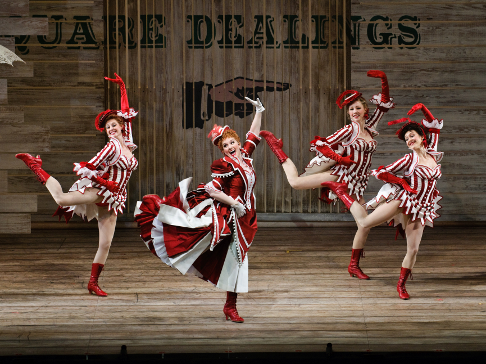
Because of Mississippi racial laws the marriage of Julie and Pete is questioned, a complication leading to her dismissal as lead in the musical show. Captain Hawks decides that his daughter Magnolia will substitute since she is familiar with the numbers from having attended rehearsals. Almost simultaneously Ellie May performs with female chorus the comment, “Life on the Wicked Stage.” Ms. Mac assured that the number was an exhilarating showstopper with all pitches at this point sung correctly. The love between Magnolia and Ravenal blooms, just as they rehearse the fictional parts of lovers on the stage. Brown and Gunn gave a convincing rendition of “You are Love” as they make plans for their own wedding in keeping with the stage-show’s narrative. As Act I ends, stories about Ravenal’s past do not deter Captain Hawks from supporting the marriage yet his wife Parthy’s reaction hints at domestic difficulties in Act II.
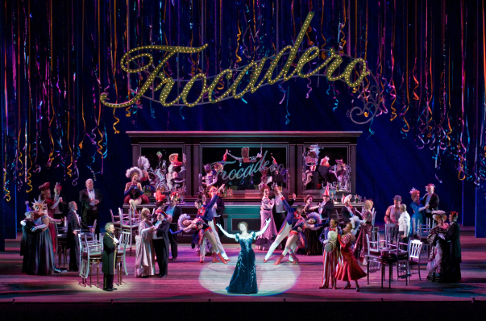
In the second act as arranged for this production the chronological sequence unfolded smoothly. The individual scenes cover a span of several decades in the domestic and emotional lives of Magnolia and Ravenal. Only the first scene taking place at the 1893 Columbian Exposition in Chicago gave any indication of the idyllic marriage promised by the lyrical exchange in the first act. The birth of a daughter hardly deters Ravenal from his continued gambling. Indeed one of the most emotionally moving scenes in Act II is Gunn’s departure from his daughter staged in the convent school. The reprise of “Make Believe” in this scene recalls earlier happiness and looks wistfully toward a future reconciliation. For her part Ms. Brown’s portrayal of Magnolia as an independent performer after having been left by Ravenal was achieved with both vocal and dramatic skill. Her voice matured noticeably as she sang “After the Ball,” and sheer confidence could only describe her solo appearance in a Ziegfield show in New York. Since Queenie had attended these latter performances, she repeats one of Nola’s popular numbers back on the show boat. Ms. Simpson sings “Hey Feller!” with gusto and decided glee in her committed enthusiasm. The final reunion of Magnolia, Ravenal, and their daughter takes place, appropriately, where the romance began with the hope of a transformed future.
Salvatore Calomino