![Dimitri Platanias as Rigoletto [Photo © ROH 2012 / Johan Persson]](http://www.operatoday.com/Rigoletto_ROH_2012_05.gif)
02 Apr 2012
Rigoletto, Royal Opera House
How would a period instrument specialist like John Eliot Gardiner approach Rigoletto, Verdi’s sordid tale? This was his first Rigoletto (though not his first Verdi); but he created it with great insight.
English Touring Opera are delighted to announce a season of lyric monodramas to tour nationally from October to December. The season features music for solo singer and piano by Argento, Britten, Tippett and Shostakovich with a bold and inventive approach to making opera during social distancing.
This tenth of ten Live from London concerts was in fact a recorded live performance from California. It was no less enjoyable for that, and it was also uplifting to learn that this wasn’t in fact the ‘last’ LfL event that we will be able to enjoy, courtesy of VOCES8 and their fellow vocal ensembles (more below …).
Ever since Wigmore Hall announced their superb series of autumn concerts, all streamed live and available free of charge, I’d been looking forward to this song recital by Ian Bostridge and Imogen Cooper.
Although Stile Antico’s programme article for their Live from London recital introduced their selection from the many treasures of the English Renaissance in the context of the theological debates and upheavals of the Tudor and Elizabethan years, their performance was more evocative of private chamber music than of public liturgy.
Evidently, face masks don’t stifle appreciative “Bravo!”s. And, reducing audience numbers doesn’t lower the volume of such acclamations. For, the audience at Wigmore Hall gave soprano Elizabeth Llewellyn and pianist Simon Lepper a greatly deserved warm reception and hearty response following this lunchtime recital of late-Romantic song.
For this week’s Live from London vocal recital we moved from the home of VOCES8, St Anne and St Agnes in the City of London, to Kings Place, where The Sixteen - who have been associate artists at the venue for some time - presented a programme of music and words bound together by the theme of ‘reflection’.
'Such is your divine Disposation that both you excellently understand, and royally entertaine the Exercise of Musicke.’
‘And there was war in heaven: Michael and his angels fought against the dragon; and the dragon fought and his angels, And prevailed not; neither was their place found any more in heaven … that old serpent … Satan, which deceiveth the whole world: he was cast out into the earth, and his angels were cast out with him.’
There was never any doubt that the fifth of the twelve Met Stars Live in Concert broadcasts was going to be a palpably intense and vivid event, as well as a musically stunning and theatrically enervating experience.
‘Love’ was the theme for this Live from London performance by Apollo5. Given the complexity and diversity of that human emotion, and Apollo5’s reputation for versatility and diverse repertoire, ranging from Renaissance choral music to jazz, from contemporary classical works to popular song, it was no surprise that their programme spanned 500 years and several musical styles.
The Academy of St Martin in the Fields have titled their autumn series of eight concerts - which are taking place at 5pm and 7.30pm on two Saturdays each month at their home venue in Trafalgar Square, and being filmed for streaming the following Thursday - ‘re:connect’.
The London Symphony Orchestra opened their Autumn 2020 season with a homage to Oliver Knussen, who died at the age of 66 in July 2018. The programme traced a national musical lineage through the twentieth century, from Britten to Knussen, on to Mark-Anthony Turnage, and entwining the LSO and Rattle too.
With the Live from London digital vocal festival entering the second half of the series, the festival’s host, VOCES8, returned to their home at St Annes and St Agnes in the City of London to present a sequence of ‘Choral Dances’ - vocal music inspired by dance, embracing diverse genres from the Renaissance madrigal to swing jazz.
Just a few unison string wriggles from the opening of Mozart’s overture to Le nozze di Figaro are enough to make any opera-lover perch on the edge of their seat, in excited anticipation of the drama in music to come, so there could be no other curtain-raiser for this Gala Concert at the Royal Opera House, the latest instalment from ‘their House’ to ‘our houses’.
"Before the ending of the day, creator of all things, we pray that, with your accustomed mercy, you may watch over us."
The doors at The Metropolitan Opera will not open to live audiences until 2021 at the earliest, and the likelihood of normal operatic life resuming in cities around the world looks but a distant dream at present. But, while we may not be invited from our homes into the opera house for some time yet, with its free daily screenings of past productions and its pay-per-view Met Stars Live in Concert series, the Met continues to bring opera into our homes.
Music-making at this year’s Grange Festival Opera may have fallen silent in June and July, but the country house and extensive grounds of The Grange provided an ideal setting for a weekend of twelve specially conceived ‘promenade’ performances encompassing music and dance.
There’s a “slide of harmony” and “all the bones leave your body at that moment and you collapse to the floor, it’s so extraordinary.”
“Music for a while, shall all your cares beguile.”
The hum of bees rising from myriad scented blooms; gentle strains of birdsong; the cheerful chatter of picnickers beside a still lake; decorous thwacks of leather on willow; song and music floating through the warm evening air.
How would a period instrument specialist like John Eliot Gardiner approach Rigoletto, Verdi’s sordid tale? This was his first Rigoletto (though not his first Verdi); but he created it with great insight.
There’s a lot to be learned from period practice, and anyone who knows it well knows how rambunctious it can be. Gardiner knows the Renaissance was violent. Verdi isn’t sentimental and the court at Mantua was cruel. This was historically-informed practice adapted to repertoire often milked for lush effect. Gardiner’s vigorous approach might not appeal to all, but it’s extremely perceptive. He makes Rigoletto raw and shocking, as it should be.
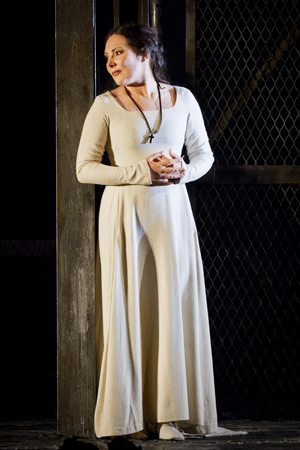 Ekaterina Siurina as Gilda
David McVicar’s 2001 production is bleak. The ducal palace is evoked by a metallic wall — shiny but hard. Michael Vale, the designer, uses a large wooden structure that pivots like the twists in the plot, but the focus remains on the cast. Vocal performances take their cue from Gardiner and McVicar. Vittorio Grigolo bursts onto the stage in full throttle. “Questa o quella” is thrown like a gauntlet. The Duke doesn’t brook challenge. Grigolo has the power and showmanship to create the Duke, bursting with arrogant machismo. Like the Duke, he’s a force unto himself. The courtiers are a mob for whom subtlety means nothing. Grigolo’s Duke uses swagger as a weapon. The Duke’s brutishness come over well, moments of decorative richness adding a touch of devious artifice, totally in keeping with character.
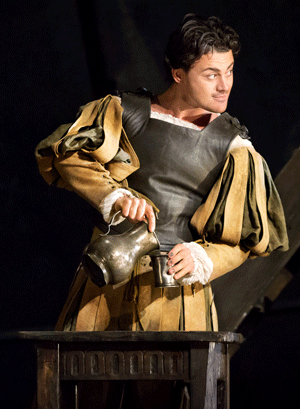 Vittorio Grigolo as Duke of Mantua
Yet Grigolo also manages to suggest the Duke’s inner fragility. With Gilda, he can play the man he might have been had he not been born to a crown. The duet with Gilda is genuinely tender. In “Ella mi fu rapita”, Grigolo let the Duke’s mask drop for a moment, singing with genuine tenderness. In many ways this is the heart of the opera for it touches on the Duke’s inner psyche. Significantly, Verdi keeps cutting “La donna è mobile” so the sections don’t connect. Gardiner emphasizes the disjoint, for by this stage, the Duke is back to his old tricks, morally disintegrating again. Grigolo is a consummate actor and creates the part with more depth than he’ll get credit for. The problem is that the Duke himself is hard to pin down.
There have been so many great Rigolettos over the years that Dimitri Platanias has a lot to live up to. This was his Covent Garden debut, though he has done the role many times elsewhere. McVicar’s concept has Rigoletto crawling like a broken spider, which is perfectly valid. Platanias is physically imposing, with a voice to match, so a different concept would perhaps suit him better. Platanias does Rigoletto’s anger rather than his anguish. His dialogues with Gilda show Rigoletto’s fatherly side, but don’t access the demented, tortured soul within. Nonetheless, he’s a good counterbalance to Grigolo’s Duke and to Matthew Rose’s Sparafucile, sung with the power of an amoral force of nature. Rose doesn’t need to invest the part with histrionics. To Sparafucile, murder is a business transaction without emotional meaning. Rose’s detachment is chilling in itself. In his exchanges with Christine Rice’s Maddalena, Rose’s sibilants cut with suppressed sexual violence. They’re not “brother and sister” in the modern sense of the term, but pimp and whore.
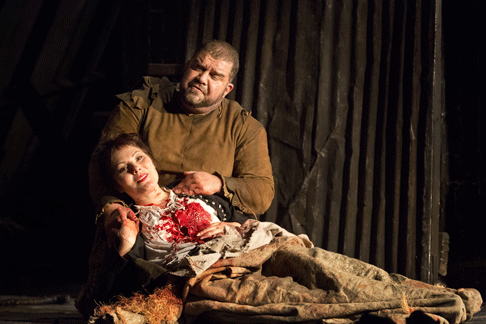 Dimitri Platanias as Rigoletto and Ekaterina Siurina as Gilda
Ekaterina Siurina is an impeccable Gilda. It’s her signature role with which she debuted with Dmitri Hvorostovsky at the age of nineteen. A beautifully rounded, sensual “Caro nome” expresses the passion in Gilda’s personality, making her love for the Duke perfectly plausible. Gilda is too sheltered to articulate her feelings, but her instincts burst forth. Siurina’s clear, ringing timbre and perfect pitch make the long cadenzas bloom with promise, expressing emotions that words can’t convey. This intensity makes her sacrifice believable too. When Siurina appears dressed as a boy, her voice glows with purpose, for she’s found a way to fulfill her love in a sacrifice only a cloistered Catholic innocent might chose. Ironically, Rigoletto loses his child because she’s been brainwashed by her upbringing.
This was an extremely rewarding Rigoletto because it cuts past surface glamour and goes to the visceral drama.
The performance on 17th April will be broadcast live internationally in HD cinemas.
Anne Ozorio